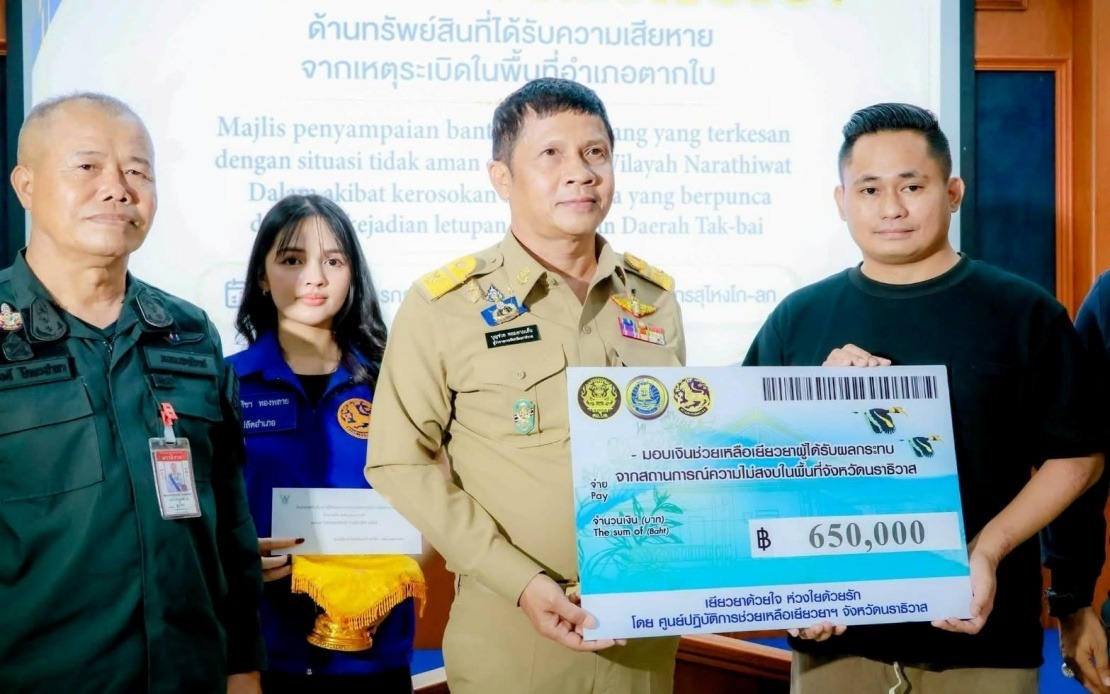
The Thai government has distributed compensation totalling 650,000 baht—approximately RM80,000—to one of two Malaysians injured in a bombing incident that occurred in Tak Bai district on June 29. The payout, presented during a formal ceremony at the Sungai Golok Customs Office in Narathiwat, marks an official acknowledgment of responsibility by Bangkok for the security breach that resulted in civilian casualties on its soil.
Muhammad Yusri Udin, aged 38, received the compensation cheque from Narathiwat Governor Boonchuay Homyamyen on Friday. The victim, along with fellow Malaysian Abdullah Syarapi Abd Rahman, 45, sustained injuries when an improvised explosive device concealed within a roadside drainage channel detonated near the Sapom junction at approximately 11.40 am on the date in question. The blast occurred in a rural area along the Thai-Malaysia border, raising concerns about security vulnerabilities in regions frequented by cross-border travellers and commercial traffic.
Governor Boonchuay stressed that the Thai administration views the incident with considerable gravity and expressed official regret over the harm inflicted on the two nationals. His public statements reflected an attempt to reassure both the local population and international visitors that the government remains vigilant in addressing security threats. The governor emphasised that despite the attack, Thailand maintains a commitment to comprehensive safety protocols designed to shield residents, workers, and tourists from militant activity.
The compensation mechanism employed by the Thai authorities operates through a dedicated government fund established to assist individuals harmed by security-related incidents. This fund typically covers both medical expenses arising from injuries and compensation for property losses sustained during attacks. The existence of such a system demonstrates Bangkok's recognition that border regions, particularly areas known for separatist militant activity, require structured mechanisms to address civilian casualties and restore public confidence in state protection.
Thai security officials have indicated that the two Malaysian victims were not the intended targets of the attack. Instead, investigators believe the bombing was orchestrated by elements affiliated with a rebel faction operating within the region. This assessment suggests that the Malaysians may have been unfortunate bystanders caught in proximity to an attack aimed at Thai security forces or other targets. Such incidents underscore the unpredictable nature of violence in southern Thailand and the risks faced by Malaysian nationals conducting business or transit through Narathiwat and adjacent provinces.
Following the explosion, Thai law enforcement agencies moved swiftly to apprehend suspects and secure the scene. A 40-year-old individual was detained for questioning in connection with the blast. Meanwhile, security forces deployed explosive ordnance disposal specialists to neutralise any remaining threats and conducted detailed forensic investigations to establish the device's composition, trigger mechanism, and origin. These investigative steps are routine procedures in Thailand's counterinsurgency operations and reflect the scale of militant activity that persists in the southernmost provinces.
The incident exemplifies the ongoing security challenges faced by southern Thailand, where sporadic bombings and armed clashes between government forces and armed groups have characterised the region for two decades. For Malaysian citizens and businesses, the blast serves as a reminder of the residual risks associated with proximity to militant-held areas, despite efforts by both Thai and Malaysian authorities to maintain stability along their shared border. Commercial truck drivers and traders regularly traverse highways passing through Narathiwat and Yala, making them potentially vulnerable to attacks nominally intended for other targets.
Governor Boonchuay's public commitment to strengthening security measures and restoring tourist confidence reflects Bangkok's broader policy objective of normalising conditions in the deep south. Thailand has invested substantially in military and police presence throughout the region, yet attacks continue sporadically. The compensation payment to the Malaysian victim can be viewed as part of a diplomatic effort to maintain positive relations with Kuala Lumpur and demonstrate responsiveness to cross-border incidents that affect Malaysian nationals.
The bombing occurred amid a period when Thai authorities have been intensifying counterinsurgency operations and intelligence-gathering activities in response to upticks in militant violence. The revelation that a suspect was quickly apprehended suggests that improved intelligence networks and coordination between border security agencies may be yielding results. However, the persistence of such incidents indicates that underlying grievances fuelling separatist militancy remain unresolved, and sporadic attacks will likely continue to pose challenges for the region's stability and commercial activity.
For Malaysian policymakers and business interests, the incident reinforces the importance of maintaining robust border security protocols and coordinating closely with Thai counterparts on counterterrorism matters. The Malaysian government has typically worked through diplomatic channels to address security concerns affecting its nationals in southern Thailand, and compensation settlements such as this one represent acknowledgments of shared responsibility for border security. Moving forward, enhanced information-sharing and joint security operations between Kuala Lumpur and Bangkok may prove necessary to minimise civilian casualties and protect the flow of legitimate cross-border commerce that benefits both nations.

