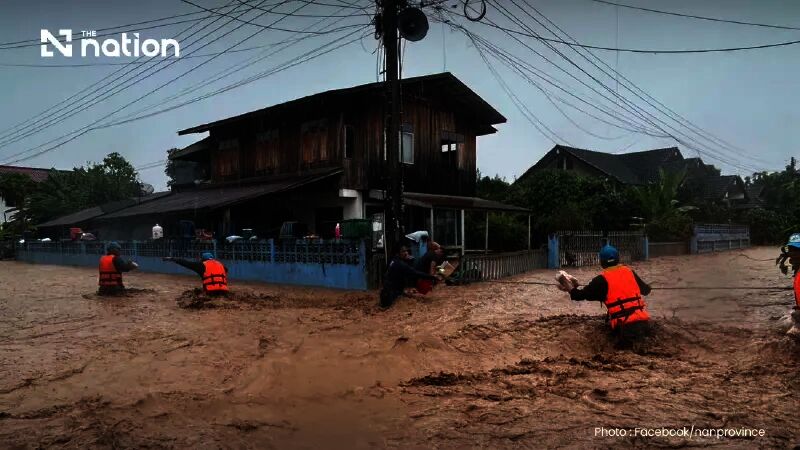
Thailand has formally designated Nan province as a disaster area in response to intensifying flooding triggered by persistent heavy rainfall across its northern region. The declaration came as flash floods and swollen waterways isolated communities, severed critical transport routes, and necessitated the evacuation of residents from vulnerable locations. In response to the escalating crisis, the government has placed two adjacent provinces—Phayao and Lamphun—under disaster preparedness status, signalling the geographical scale of the meteorological threat engulfing the country's northern plains.
Prime Minister Anutin Charnvirakul, currently conducting official business in Australia, has taken direct command of the national response despite his overseas absence. Through government spokesperson Rachada Dhnadirek, Anutin issued sweeping directives mobilising all governmental and military assets to support relief operations. This coordinated approach underscores the seriousness with which Bangkok's leadership views the unfolding situation, particularly given the potential for cascading humanitarian consequences across multiple provinces if flooding patterns worsen.
The Prime Minister's instructions prioritise the deployment of rapid-response teams and heavy excavation equipment to areas identified as facing the highest risk. The emphasis on pre-positioning resources reflects lessons learned from previous flooding episodes, where delayed equipment arrival hampered evacuation and rescue operations. Anutin has specifically mandated urgent water drainage interventions in localities with a history of recurrent inundation, recognising that while rainfall itself cannot be controlled, strategic water management can mitigate damage to communities and infrastructure.
Central to the government's crisis framework is the principle that protecting human life supersedes all other considerations. Anutin explicitly highlighted vulnerable demographic groups—elderly residents, hospitalised patients, and children—as requiring prioritised rescue and relocation efforts. This categorical focus reflects demographic realities in rural Thai communities, where elderly populations may lack mobility during emergencies and medical patients face compounded risks if healthcare facilities become inaccessible or overwhelmed.
Authorities have established comprehensive monitoring protocols extending through Friday, with alerts issued across northern, north-eastern, and central Thailand. Residents have been warned to remain vigilant regarding multiple hazards beyond simple flooding, including secondary risks such as flash-flood events that develop rapidly in mountainous terrain, surface runoff eroding unstable hillsides, and landslide dangers in areas with steep gradients. This multi-hazard warning approach reflects the complex hydrometeorological dynamics of Thailand's northern geography, where topography amplifies rainfall impacts.
Deputy Prime Minister Yodchanan Wongsawat, whose portfolio encompasses flood management across the northern region, reinforced the crisis response on Wednesday by issuing direct orders to provincial governors in Nan, Phayao, and Lamphun. His urgent directive demands comprehensive preparation across all three provinces, establishing a unified command structure that can coordinate relief efforts across provincial boundaries. This hierarchical approach ensures consistency in emergency protocols and resource allocation without bureaucratic delays.
The underlying meteorological threat derives from seasonal patterns now unfolding across Southeast Asia. Thailand's Meteorological Department has forecasted August conditions characterised by thunderstorm systems, concentrated rainfall events of significant intensity, and elevated wind speeds. These conditions historically create environments conducive to flash flooding, rapid water accumulation in drainage systems, and the breaching of riverbanks. The department's predictive capacity, while imperfect, has provided authorities with crucial lead time to mobilise preventative measures and alert populations.
For Malaysian observers, Thailand's flooding crisis carries important implications for the broader region. Transboundary river systems connect northern Thailand with areas extending toward Myanmar and Laos, meaning extreme precipitation events in Thai territory can eventually influence water flows affecting downstream communities. Additionally, Thailand's experience managing large-scale flooding provides instructive lessons regarding emergency response protocols, inter-agency coordination, and the importance of pre-positioned disaster relief resources that Southeast Asian nations increasingly recognise as essential infrastructure.
The timing of Thailand's disaster declaration reflects bureaucratic and practical thresholds that must be met before formal disaster status is granted. Achievement of this status triggers additional financial resources, mobilises military support beyond standard civilian capabilities, and streamlines administrative procedures that normally impede rapid resource movement. By declaring Nan a disaster zone rather than merely issuing weather alerts, Thai authorities have escalated the operational tempo of their response, signalling confidence that conditions warrant extraordinary measures.
Broader questions regarding Thailand's long-term flood resilience remain pertinent, particularly as climate patterns appear to intensify extreme weather frequencies. While immediate response protocols focus on evacuation and relief provision, persistent flooding crises across consecutive years suggest that infrastructure planning and watershed management require closer examination. The reliance on heavy machinery for water drainage, while tactically sound for emergency situations, may indicate that structural solutions—dam management, retention basin construction, and land-use planning—warrant heightened policy attention in subsequent years.

