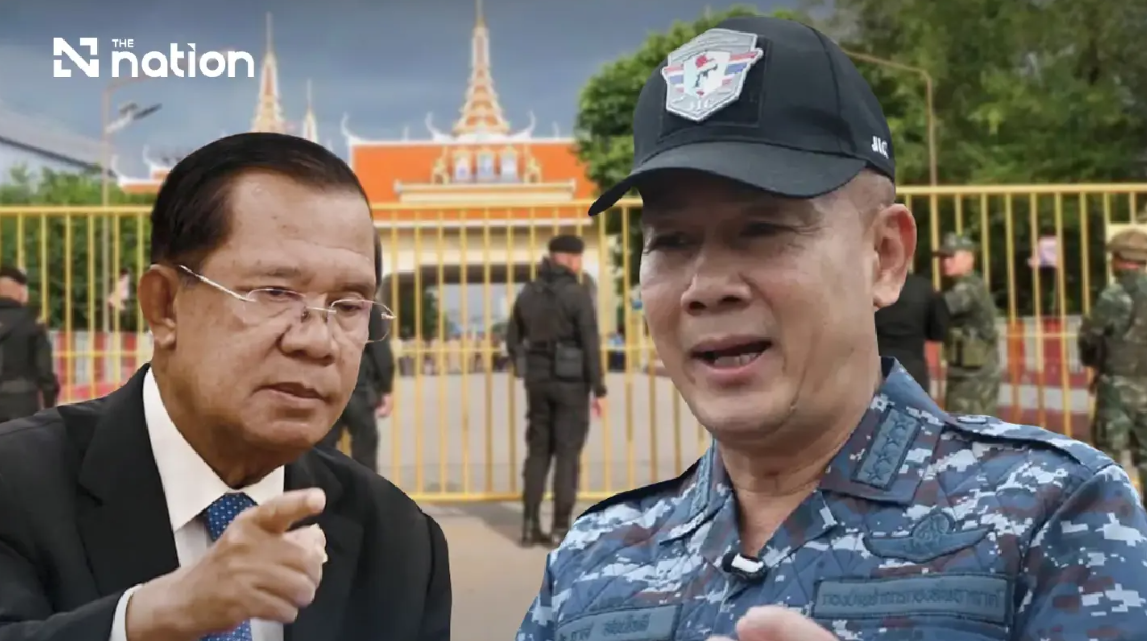
Thailand has pushed back forcefully against Cambodia's characterisation of its recent military actions as a form of hidden warfare disguised beneath legitimate law-enforcement objectives. Air Chief Marshal Prapas Sonjaidee, who directs the Joint Information Centre on the Thailand-Cambodia Situation, dismissed allegations made by Cambodian Senate President Hun Sen at an international forum, insisting that accusations aired on global platforms must rest on verifiable facts rather than rhetorical flourish. The exchange underscores mounting tensions between the neighbouring nations and reveals fundamental disagreements over how the border conflict should be interpreted and resolved.
Hun Sen had charged that Thailand instrumentalised its operations against online crime networks as political cover to justify military movements and territorial claims. Prapas objected strenuously to this framing, arguing that the Thai government has maintained a clear analytical separation between two distinct matters: whether a particular location hosts scam operations, and whether that same location serves military functions. He contended that this categorical distinction was essential to any honest assessment of Thailand's conduct and that collapsing the two questions amounted to intellectual dishonesty rather than legitimate policy critique.
Central to Thailand's defence is its contention that Cambodia initiated military hostilities first. Prapas stressed that any accurate account of an armed conflict must establish the correct chronological sequence, beginning with which party first deployed weapons rather than which party subsequently responded to earlier aggression. Thailand's narrative positions its operations as defensive reactions to Cambodian military action that endangered Thai civilians and troops. He rejected what he characterised as an artificial reframing of history that ignored Cambodia's initial use of force and instead began the timeline only from the moment Thailand mounted its counter-response.
The positioning of military personnel, Prapas argued, should not be mistaken for territorial conquest or occupation. Both countries have committed themselves to a ceasefire agreement specifying that armed forces remain at the locations they held when the ceasefire commenced, refrain from advancing toward each other, minimise provocative behaviour, and avoid actions that escalate tensions. Thailand maintains that adhering to these agreed positions represents compliance with the joint statement, not an attempt to seize Cambodian land. This technical distinction carries real weight: if forces can be accused of occupying territory simply by remaining in place as the agreement mandates, the entire framework for maintaining peace collapses into contradiction.
The border demarcation itself represents a separate question requiring its own mechanisms and processes. Prapas emphasised that neither the military nor media coverage, nor certainly unilateral political statements, should determine where the boundary between the two nations lies. Instead, he urged both countries to employ the established institutional channels designed specifically to resolve such disputes. Allowing military calculations or public relations campaigns to shape the border's legal status would undermine the collaborative mechanisms both nations have accepted as legitimate frameworks for resolving disagreements.
When discussing harm to civilians, Prapas invoked universal humanitarian principles while warning against applying standards selectively. Children on both sides of the border deserve protection, and schools in both nations should remain beyond military targeting. However, he contended that analysing civilian casualties requires examining evidence from both Thai and Cambodian perspectives, including weapon types, firing trajectories, coordinates, and intended targets. Furthermore, the principle that civilian areas must not support military operations cannot be enforced one-sidedly; all parties must respect it equally to maintain its moral authority.
Information warfare and disinformation present challenges that both nations face in the 21st-century security environment. Hun Sen had accused Thailand of deploying psychological operations to damage Cambodia's reputation. Prapas acknowledged these concerns as legitimate but argued that the solution lay not in counter-accusations but in transparent disclosure of evidence and timelines subject to public scrutiny. He warned that each side presenting only information supporting its own narrative while accusing the other of propaganda guarantees perpetuation of the information warfare cycle. Breaking that cycle requires both nations to release comprehensive documentation for independent examination.
Thailand's stated objectives, according to Prapas, reject any territorial ambitions or enmity toward the Cambodian people. Rather, Thailand frames its actions as essential measures to protect its own civilians and military personnel from threats originating across the border. On the matter of scam operations, Thailand has proposed bilateral cooperation to suppress these criminal networks. Regarding the actual military incidents, Thailand advocates for full disclosure of the chronological sequence rather than narratives that conveniently begin only after Thailand's response.
For Malaysian and Southeast Asian observers, this dispute illustrates broader regional challenges in managing border disputes where domestic security concerns intersect with transnational crime and military prerogatives. The disagreement demonstrates how easily legitimate law-enforcement operations can become entangled with geopolitical tensions, and how nations competing to shape international narratives can lose sight of technical and legal mechanisms designed to prevent escalation. The ceasefire agreement between Thailand and Cambodia provides a template for de-escalation, yet both sides struggle to agree on how to interpret and implement its terms.
Prapas's closing statements framed the core choice facing both nations: whether to continue accumulating accusations and competing narratives, or to pursue solutions grounded in disclosed facts, restored dialogue, and adherence to agreed frameworks. He contended that people on both sides of the border desire the same outcomes: an end to military operations, clarity about what actually occurred, and creation of conditions permitting meaningful negotiations. The pathway forward, from Thailand's perspective, requires simultaneous progress on multiple tracks—suppressing criminal networks, allowing legal mechanisms to establish the border, maintaining ceasefire discipline, and fundamentally transforming how both nations approach information and evidence.
The dispute also reflects anxieties common throughout Southeast Asia regarding how neighbouring states justify military action and whether international forums provide adequate scrutiny of competing claims. Thailand's insistence that accusations be evidence-based rather than rhetorical resonates with longstanding regional preferences for consensual problem-solving, yet the fundamental disagreement over causation and agency in the recent conflict suggests that technical appeals to facts and proper procedures, however sound in principle, may struggle against deeper political imperatives driving both nations' behaviour.

