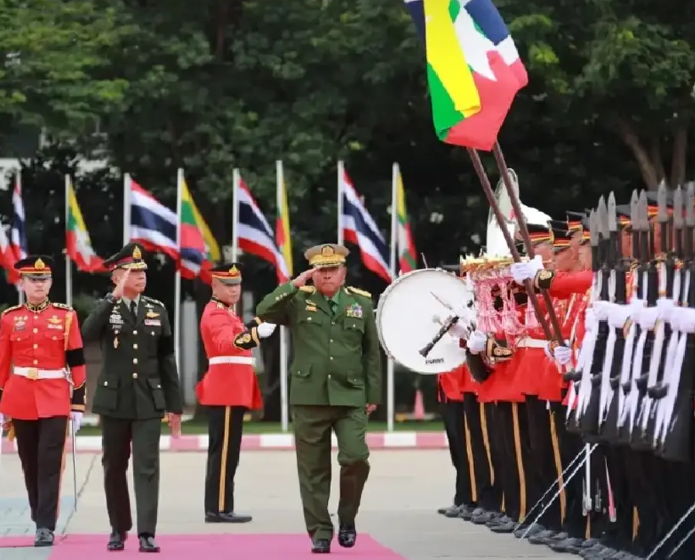
Thailand rolled out the diplomatic welcome mat for Myanmar's newly appointed military chief Ye Win Oo this week, hosting him for high-level talks in Bangkok that underscored the region's pragmatic shift toward engaging the pariah state. The visit represents Ye Win Oo's maiden foreign trip since assuming command of Myanmar's armed forces, and comes as the junta seeks to rehabilitate its international standing following the controversial 2026 elections that have drawn sharp criticism from democracy advocates and human rights monitors worldwide.
Myanmar's military establishment has spent the past five years largely isolated from the international community following its February 2021 coup, which toppled an elected government, imprisoned former leader Aung San Suu Kyi, and triggered a devastating civil conflict that continues to claim lives and displace populations across the country. The coup was orchestrated by then-armed forces chief Min Aung Hlaing, who subsequently positioned himself as a civilian president after the 2026 polls, effectively transferring military command to Ye Win Oo while maintaining tight control over political affairs. This manoeuvre, observers suggest, represents an attempt to create the appearance of democratic transition while preserving military supremacy and circumventing international pressure.
Thursday's bilateral meeting between Thai military chief Ukris Boontanondha and Ye Win Oo took place amid heightened regional tensions centred on the Myanmar-Thailand border, a 2,400-kilometre frontier where the ongoing civil war has created significant instability and humanitarian challenges. Cross-border incidents, refugee flows, and armed group activities have made border management a pressing concern for neighbouring states, explaining Thailand's willingness to engage despite international reservations about legitimising the junta's rule. For Thailand, which shares unavoidable geographic and economic ties with Myanmar, pragmatic diplomacy appears to trump moral objections to military governance.
Ye Win Oo's ascent to Myanmar's top military position carries particular weight given his background as a former intelligence chief within the junta apparatus and his active involvement in orchestrating the 2021 coup itself. The United States and several other Western nations have imposed sanctions on him specifically for his role in toppling the democratically elected government and subsequently overseeing military operations characterised by widespread allegations of abuse. His appointment signals continuity of hardline military control rather than any genuine shift toward civilian governance, notwithstanding the cosmetic institutional changes announced by the regime.
Thailand's decision to grant high-profile hospitality to Myanmar's military leadership represents a significant diplomatic gambit that has drawn sharp criticism from international human rights organisations and pro-democracy groups. Thai Prime Minister Anutin Charnvirakul personally welcomed Min Aung Hlaing earlier this month, while Foreign Minister Sihasak Phuangketkeow justified the approach by declaring that diplomatic engagement reflects geopolitical reality rather than endorsement of military rule. This distinction—between pragmatic engagement and moral legitimacy—encapsulates the tension between Thailand's immediate regional interests and broader international commitments to democratic governance.
The humanitarian cost of Myanmar's civil conflict provides sobering context for these diplomatic developments. Researchers and international observers estimate that the ongoing war has claimed approximately 100,000 lives since 2021, with documented patterns of mass displacement, food insecurity, and targeted violence against civilian populations. The recent United Nations Independent Investigative Mechanism for Myanmar report specifically documented escalating aerial bombardment of civilian areas by military forces, alongside systematic practices of arbitrary detention, torture, and sexual violence used as instruments of control and terror.
Myanmarís controversial 2026 elections, which the junta has presented as evidence of democratic restoration, are widely derided by international monitors and civil society organisations as theatrical exercises designed to rebrand military authoritarianism without substantive power-sharing. The elections systematically excluded Aung San Suu Kyi's party and imprisoned opposition figures, while maintaining mechanisms for military veto over legislative processes and constitutional amendments. By any conventional democratic standard, the elections represented a consolidation rather than a loosening of military control, yet they have provided neighbouring governments with rhetorical justification for normalising relations.
The international response to Myanmar's post-election trajectory reveals deep divisions between Southeast Asian nations pursuing narrow strategic interests and Western democracies coupled with global human rights advocates. Thailand, Vietnam, Laos, and Cambodia—states with either military governments or close ties to Myanmar—have largely accepted the junta's narrative of electoral normalisation and adjusted their diplomatic postures accordingly. This regional acquiescence contrasts sharply with statements from Washington, Brussels, and international human rights bodies that characterise the elections as fundamentally illegitimate and the military regime as unaccountable to civilian populations.
The Special Advisory Council for Myanmar, an influential campaign group monitoring the region's developments, has issued blistering assessments of Thailand's engagement strategy. The Council characterised Thailand's hosting of Min Aung Hlaing as equivalent to torching Thai credibility on human rights and governance issues, while describing the subsequent visit from Ye Win Oo as compounding Bangkok's diplomatic self-damage. These critiques reflect concerns that Southeast Asian accommodation of Myanmar's junta undermines regional norms around democratic governance and empowers hardline elements within the military establishment who interpret tolerance as validation.
Myanmar's military apparatus has categorically rejected international criticism of its record, issuing statements dismissing UN findings as politically motivated and based on unverifiable information. The regime's blanket denials of documented abuses—despite extensive photographic evidence, witness testimony, and forensic analysis—illustrate the gulf between the junta's preferred narrative and observable reality. This stance complicates diplomatic engagement, as neighbouring states attempting to reason with military leaders encounter intransigence rooted in ideological conviction rather than pragmatic miscalculation.
For Malaysia and other Southeast Asian nations observing these developments, the Thailand-Myanmar diplomatic thaw raises significant questions about regional stability and the ASEAN framework's capacity to manage internal conflicts. Malaysia has historically maintained more cautious engagement with Myanmar's military, though regional economic integration pressures may gradually shift this calculus. The precedent being established in Bangkok—whereby military rulers can rehabilitate international standing through cosmetic electoral exercises without substantive democratic reform—carries implications for how authoritarian governments across the region understand their constraints and opportunities.
The Myanmar case ultimately illustrates the enduring tension between realpolitik and principle in Southeast Asian international relations. Thailand's diplomatic engagement reflects rational calculation about border security, trade relations, and maintaining influence over a strategically significant neighbour. Yet this pragmatism occurs against a backdrop of documented war crimes, systematic abuse, and suppression of fundamental freedoms that traditional diplomatic norms would ordinarily preclude normalisation. How this tension resolves will shape not merely Thailand-Myanmar relations but broader regional attitudes toward military rule, electoral legitimacy, and the enforcement of humanitarian standards.

