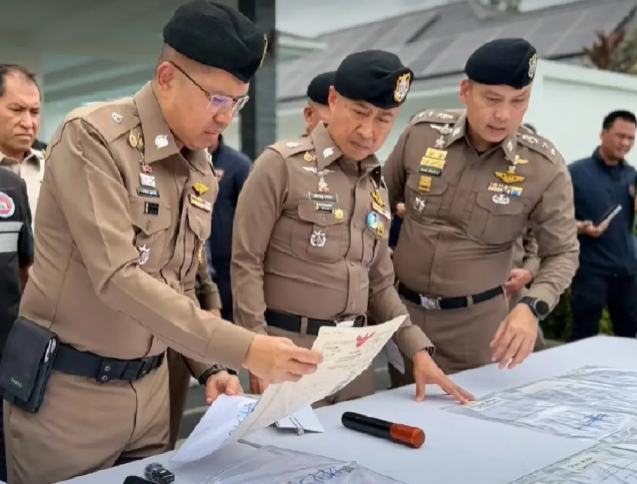
Thailand's police force has stepped up efforts to dismantle networks that enable foreign investors to circumvent strict property ownership restrictions, arresting 13 foreign nationals during an extensive operation in the coastal resort town of Hua Hin. The raids, conducted on 15 separate locations in Prachuap Khiri Khan province on August 10, represent the sixth phase of a nationwide campaign targeting what authorities describe as illegal nominee structures designed to mask foreign control of valuable Thai real estate.
The operation mobilised more than 200 police officers and government officials to investigate 33 companies suspected of holding property on behalf of foreign owners. Among those detained were three British nationals, four Chinese citizens, and individuals from Italy, France, the Netherlands, Austria, the Philippines and the United States. While courts had authorised arrest warrants for 45 foreigners overall, police also summoned 39 Thai nationals for questioning regarding their involvement in the scheme. The detainees have not yet faced formal charges as investigations continue.
The targeted properties in Hua Hin's Thap Tai subdistrict exemplify the lucrative nature of this market segment, with individual pool villas and detached houses commanding prices between 10 and 20 million baht each. The broader investigation encompasses approximately 300 million baht in property holdings across the 33 companies under scrutiny. Preliminary searches at the development identified six companies, with four connected to the operation's initial phase and two to its second wave, all allegedly using Thai nationals as registered shareholders while foreigners maintained actual control.
According to police testimony, foreign nationals involved claimed they sought legitimate ways to hold Thai property and had been directed by legal and accounting professionals to establish corporate entities as a purportedly lawful mechanism. However, authorities determined that these companies maintained no genuine business operations beyond property holding. The Thai nationals listed as official shareholders provided statements indicating they had agreed to serve as nominee shareholders without ever purchasing shares, managing company affairs, or receiving access to financial documentation—a pattern police view as conclusive evidence of concealed foreign beneficial ownership.
This enforcement initiative reflects Thailand's longstanding prohibition on foreign freehold ownership of land, a restriction embedded in the Land Code and designed to preserve Thai asset ownership and prevent foreign speculation. Southeast Asian nations including Malaysia, Indonesia, and Vietnam maintain similar frameworks, making Thailand's experience instructive for the region's property markets and investor relations. The targeting of professional intermediaries—law and accounting firms who reportedly facilitated these arrangements—suggests authorities believe the schemes involved sophisticated networks rather than isolated transactions.
The Hua Hin operation builds on escalating enforcement documented across Thailand's most valuable tourism and residential destinations. The campaign's initial phase focused on Koh Phangan in Surat Thani, where investigators examined nominee companies allegedly controlling property and tourism enterprises. Subsequent phases expanded into Phuket, Phang Nga and Krabi during phase 3, covering 89 properties valued exceeding 1.05 billion baht. Phase 4 shifted to Chonburi, while phase 5 targeted 31 companies and 29 land parcels in Chiang Mai worth approximately 633 million baht.
Cumulatively, the first five phases examined 233 land plots and buildings spanning more than 160 rai—roughly 25.6 hectares—with estimated combined value reaching 2.539 billion baht. Courts authorised 133 arrest warrants from these earlier operations, and police reported 20 convictions resulting from the investigations. The scale of these figures suggests the nominee property scheme represents a substantial and organised parallel market rather than scattered instances of rule-breaking.
During interrogations, officers seized company registration documents, accounting ledgers, computers, mobile phones and digital data for forensic examination. Investigators plan to trace financial transactions to identify additional participants, overseas beneficiaries and interconnected networks spanning both Thailand and international jurisdictions. The Royal Thai Police indicated the inquiry would extend to potential government officials suspected of corruption or facilitating these operations—a disclosure suggesting some authorities may have enabled or tolerated the schemes.
Thailand's property restrictions carry substantial implications for Malaysian readers and Southeast Asian investors. Malaysia permits foreign freehold ownership in most circumstances, distinguishing it from Thailand's framework and potentially making it an alternative for certain foreign investors. However, Malaysia maintains state-level restrictions in Peninsular Malaysia, with Bumiputera policies reserving certain property categories for local ownership. Understanding Thailand's enforcement posture provides context for regional variations in property regulations and the consequences of circumventing such protections.
Police emphasised that the crackdown targets unlawful nominee arrangements rather than legitimate foreign investment complying with Thai legal requirements. Foreigners legally acquiring property through approved mechanisms—such as condominiums or specific property categories permitted for foreign ownership—remain unaffected. This distinction matters for international business confidence and the tourism and real estate sectors that depend on foreign capital flows while maintaining Thai sovereignty over land assets.
The Royal Thai Police have opened public reporting channels for suspected unlawful foreign business activity, establishing a hotline at 1599 available continuously. This move reflects authorities' determination to sustain enforcement momentum and signal that nominee schemes face material prosecution risks. For Malaysian companies and professionals engaged with Thai property transactions, the escalating enforcement underscores the importance of strict legal compliance and the substantial penalties—including criminal liability—that accompany circumventing foreign ownership restrictions.
Thailand's demonstrated commitment to dismantling these networks through coordinated multi-agency operations, property valuations, and criminal prosecution indicates this enforcement phase will likely persist. The involvement of the Deputy National Police Chief and senior provincial commanders demonstrates high-level organisational commitment. For foreign investors and professional intermediaries across Southeast Asia, Thailand's actions serve as a cautionary reminder that government crackdowns on regulatory violations can be comprehensive, swift and consequential.

