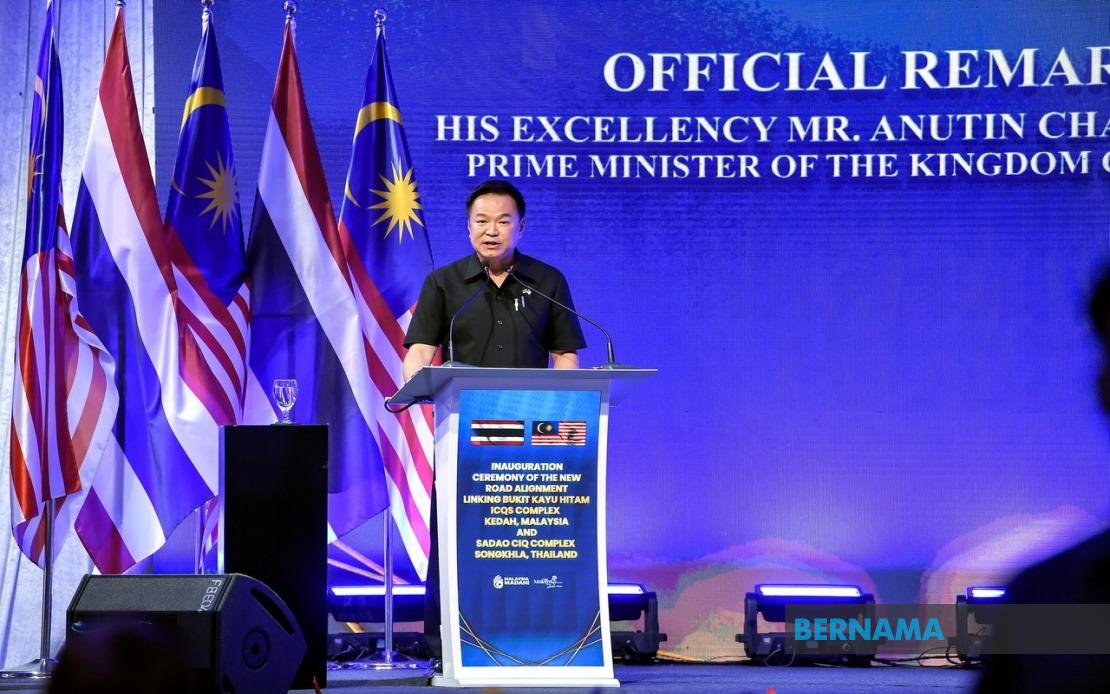
Thailand's government is moving decisively to complete critical infrastructure gaps along its border with Malaysia, with Prime Minister Anutin Charnvirakul declaring his administration's commitment to seamless cross-border connectivity at the inauguration of a new road alignment between Bukit Kayu Hitam in Kedah and the Sadao checkpoint on the Thai side. The joint ceremony, officiated alongside Malaysian Prime Minister Datuk Seri Anwar Ibrahim, signals renewed momentum in bilateral infrastructure cooperation that could fundamentally reshape trade flows across Southeast Asia and into wider Asian markets.
The new road connecting the Bukit Kayu Hitam Immigration, Customs, Quarantine and Security (ICQS) Complex with Thailand's Sadao Customs, Immigration and Quarantine (CIQ) Complex represents more than a minor border convenience. This crossing handles the heaviest traffic volume along the Malaysia-Thailand frontier, making efficiency improvements here critical for both nations' supply chains. By streamlining the physical pathway and reducing bottlenecks at this critical junction, the initiative directly addresses a longstanding friction point in regional logistics that has constrained commerce for years.
Anutin's vision extends well beyond this single project. He outlined Bangkok's intention to progressively fill transportation gaps that currently impede the flow of goods and people moving northward from Malaysia through Thailand toward China and Russia. This explicitly stated ambition reveals Thailand's strategic thinking: positioning itself as a vital corridor rather than merely a border nation. For Malaysian traders, manufacturers, and logistics operators, such connectivity enhancements lower transit times and costs, potentially making Malaysian products more competitive in distant markets and enabling Thai and Chinese goods to reach Malaysian consumers and then onwards to Singapore and Indonesia with greater efficiency.
The infrastructure push represents a coordinated effort between both governments to deepen economic interdependence. Anutin emphasised that connectivity must function bidirectionally, allowing Thai and Chinese products to transit Malaysia toward Southeast Asian markets just as Malaysian goods move northward. This mutual benefit structure is essential for maintaining political support on both sides and ensures that neither partner perceives the arrangement as one-sided, a critical consideration when managing major cross-border initiatives that affect multiple constituencies.
Beyond the headline project, both nations have identified additional connectivity corridors requiring development. The discussions encompass the Songkhla-Kedah route, the Satun-Perlis crossing, and the Narathiwat-Kelantan link. These multiple initiatives reflect recognition that southern Thailand and northern Malaysia form an integrated economic zone whose potential remains substantially untapped. Residents in border regions often experience lower living standards than their counterparts in Bangkok or Kuala Lumpur, and enhanced trade and employment opportunities resulting from improved connectivity could address these persistent development disparities.
The timing of this infrastructure push carries broader regional significance. Southeast Asia has long sought to develop east-west and north-south corridors that would integrate the region's economies and reduce reliance on maritime routes that can be vulnerable to disruption. Malaysia-Thailand cooperation on land connectivity contributes to this larger vision by creating overland alternatives for goods movement. For Malaysian manufacturers dependent on timely component deliveries or facing competition from neighbours, improved access to Thai and Chinese supply chains could prove transformative.
Anutin's explicit mention of resolving border procedures alongside physical infrastructure demonstrates sophisticated understanding of connectivity's prerequisites. A well-maintained road means little if customs clearance remains laborious and unpredictable. Both governments' stated commitment to facilitating easier movement for citizens on either side suggests recognition that people-to-people connections strengthen bilateral relationships and generate political support for deeper integration. Tourism, business travel, and family visits across the border would all benefit from simplified procedures.
For Malaysian policymakers, this initiative aligns with national development priorities. Northern Malaysian states including Kedah, Perlis, and Kelantan have historically received less investment and attention than the Klang Valley or Johor. Improved connectivity to Thailand and beyond offers these states genuine economic prospects. Manufacturers could be attracted by proximity to Thai and Chinese markets; tourism could expand as cross-border travel becomes easier; and professional opportunities might improve for local populations seeking career advancement.
The cooperation also reflects pragmatic diplomacy. Malaysia and Thailand have experienced periodic tensions over maritime boundaries, irregular migration, and other sensitive issues. Mutual investment in infrastructure projects creates economic stakes in maintaining stable relations and provides regular forums for government interaction. Officials engaged in coordinating border procedures or infrastructure maintenance develop working relationships that can facilitate resolution of other disagreements. In this sense, the road alignment and proposed connectivity projects serve diplomatic functions beyond their immediate economic utility.
However, successful implementation will require sustained political commitment and substantial financial investment from both governments. Infrastructure projects of this scale often face delays, cost overruns, and changing political circumstances that can derail progress. The history of regional connectivity initiatives reveals numerous examples of ambitious plans that never reached completion. Both Anutin and Anwar's clear public commitment provides some assurance, but the real test will come through the execution phase when funding must be secured and construction challenges addressed.
Looking forward, these developments position Malaysia at a critical juncture. Improved northern border connectivity offers unprecedented opportunity to integrate with Thai and Chinese markets while positioning Malaysian logistics operators as intermediaries serving wider Asian trade. Yet realising this potential requires complementary investments in Malaysian infrastructure, particularly road and rail networks connecting the border regions to central Malaysia. Without such internal connectivity improvements, the new border crossing and facilities would function below capacity.
For Southeast Asian observers more broadly, Malaysia-Thailand cooperation demonstrates the region's commitment to practical integration despite occasional political tensions. Other ASEAN pairs facing similar border challenges could learn from these initiatives. The emphasis on resolving procedural barriers alongside physical infrastructure offers a blueprint for connectivity projects elsewhere. As China continues extending its influence through Belt and Road infrastructure across the region, Southeast Asian nations accelerating their own internal connectivity send a powerful message about regional agency and self-determination.

