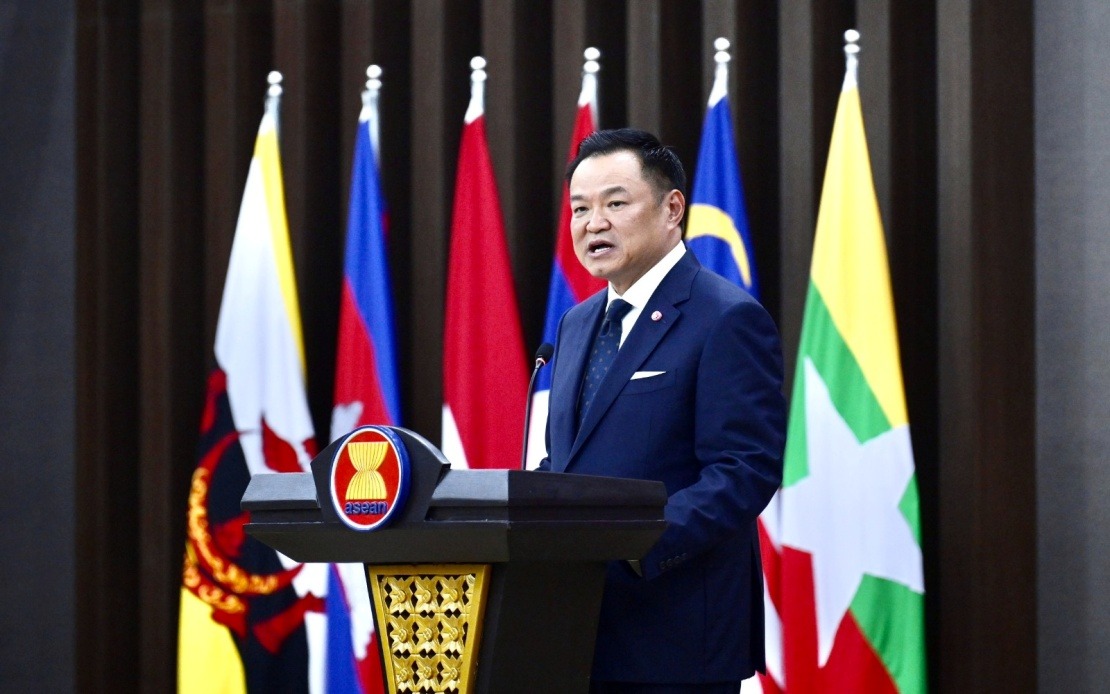
Thailand's Prime Minister Anutin Charnvirakul has set out an ambitious agenda for transforming ASEAN into a more cohesive and effective regional organisation, emphasising that the bloc must evolve beyond traditional structures to meet contemporary challenges. During remarks delivered at the ASEAN Secretariat in Jakarta this week, Anutin presented a three-part framework focused on strengthening regionalism, building resilience against global uncertainties, and ensuring that ASEAN's member states and citizens tangibly benefit from regional cooperation. The vision reflects Thailand's conviction that no single nation can adequately address the interconnected pressures now confronting Southeast Asia, from economic disruption to security threats and technological disruption.
Anutin's address carries particular weight given Thailand's position within ASEAN and its historical role as a diplomatic bridge within the bloc. His call for "regional solutions to regional challenges" underscores a fundamental principle that has long underpinned ASEAN cooperation, yet his framing suggests an impatience with the pace at which the organisation has adapted to rapidly shifting circumstances. The geopolitical environment facing Southeast Asia has grown markedly more complex in recent years, with great-power competition intensifying and smaller nations finding themselves caught between competing interests. Thailand's articulation of this challenge reflects broader anxieties shared across the region about maintaining strategic autonomy and relevance.
A central element of Anutin's proposal involves reconsidering how ASEAN applies its foundational principles, particularly the emphasis on consensus and non-interference. Rather than abandoning these cornerstones of ASEAN identity, Anutin suggests they should be applied with greater pragmatism and flexibility to enable faster, more decisive action on pressing matters. This distinction is significant for Malaysian policymakers and others throughout the region, as it addresses a longstanding tension within ASEAN between preserving the consensus-based decision-making model and responding adequately to crises that demand swift collective action. The Myanmar situation exemplifies this challenge, where differing national interests and interpretations of non-interference have complicated ASEAN's response.
On the economic front, Anutin identified several priority areas where ASEAN must concentrate its collective efforts. Strengthening regional supply chains has taken on heightened importance given ongoing global trade tensions and the realisation among Southeast Asian nations that over-reliance on external partners creates vulnerability. Food and energy security emerged as another focal concern, reflecting anxieties that have only intensified following recent global disruptions. The Thai leader also emphasised accelerating digital connectivity across the region, recognising that technological infrastructure increasingly determines economic competitiveness and social opportunity. These recommendations align closely with concerns voiced by regional development organisations and economic analysts who have highlighted gaps in ASEAN's digital integration compared to other regional blocs.
Anutin's emphasis on preparing proactively rather than responding reactively represents a subtle but important shift in how ASEAN leaders are framing regional cooperation. Rather than waiting for crises to force collective action, he argues the bloc should anticipate challenges and position itself strategically in advance. This approach reflects lessons drawn from various recent disruptions that caught the region partially unprepared, whether supply chain shocks, pandemic-related complications, or sudden shifts in security environments. For Malaysia and other ASEAN members, such forward-looking positioning could enhance the region's capacity to maintain stability and prosperity amid external volatility.
A notable dimension of Anutin's vision concerns ensuring that ASEAN's institutional benefits reach ordinary citizens and grassroots communities. By measuring ASEAN's success through tangible improvements in economic opportunity, security and quality of life rather than merely institutional achievements, the Thai PM introduces a people-centred metric that has resonated increasingly in public discourse across Southeast Asia. This framing addresses a perception gap whereby regional integration initiatives, while valuable for government officials and business elites, have sometimes felt distant from everyday concerns facing workers, farmers and small entrepreneurs throughout the member states.
Thailand's positioning of itself as an active shaper of ASEAN's future gains added significance from the timing of Anutin's remarks. ASEAN approaches its 60th anniversary next year, a milestone that typically prompts reflection on institutional purpose and direction. Thailand's decision to emphasise its role in this process reflects Bangkok's interest in remaining a central voice in regional affairs, particularly as some member states have gained increased prominence in recent years. Anutin's first official visit to Indonesia since assuming office in September 2025 also carries symbolic weight, marking the first Thai prime ministerial visit to Indonesia in 15 years and suggesting a deliberate effort to reinvigorate high-level bilateral engagement.
On Myanmar, Anutin reiterated Thailand's commitment to ASEAN's Five-Point Consensus while advocating for what he characterised as "calibrated re-engagement" with the junta. This approach seeks to maintain dialogue channels and identify opportunities for practical progress without abandoning ASEAN's stated positions. The recent visit by the International Committee of the Red Cross to detained former State Counsellor Aung San Suu Kyi, which reportedly found her in good health, represents the type of concrete development that Thailand believes can be achieved through this measured strategy. For Thailand and other neighbours of Myanmar sharing land borders, sustaining engagement remains strategically important even as international pressure mounts regarding humanitarian concerns.
Thailand's approach to Cambodia illustrates similar principles, with Anutin indicating both nations have committed to rebuilding mutual trust and continuing bilateral dialogue. The emphasis on peaceful resolution of differences under international law reflects ASEAN's core commitment to settling disputes without military force, a principle tested periodically throughout Southeast Asian history. By reaffirming this stance while simultaneously highlighting Thailand's readiness to open a new chapter in the relationship, Anutin signals both stability and openness to improved relations.
Anutin's broader vision for ASEAN expansion of cooperation with middle powers and the Global South addresses another strategic consideration facing the region. As great-power competition intensifies, ASEAN members have grown increasingly conscious of the need to diversify partnerships and avoid excessive dependence on any single major power. Cultivating relationships with rising powers and developing nations creates additional options and reinforces ASEAN's collective leverage in international negotiations.
The emphasis on equipping young people for digital economy participation reflects recognition that demographic dividends only translate into sustained development if workforce capabilities keep pace with technological change. Throughout Southeast Asia, concerns persist regarding skills gaps and youth employment, making regional cooperation on education and training increasingly important for maintaining social stability and economic growth.
Thailand's articulation of an enhanced ASEAN vision occurs against a backdrop of considerable regional uncertainty. Economic pressures, geopolitical tensions, and technological disruption create a complex environment in which regional cooperation becomes simultaneously more necessary and more challenging. By framing ASEAN not as a rigid institution but as an adaptable mechanism for collective problem-solving, Anutin offers a perspective that many regional observers believe offers the best prospect for keeping the bloc relevant and effective through coming decades of change.

