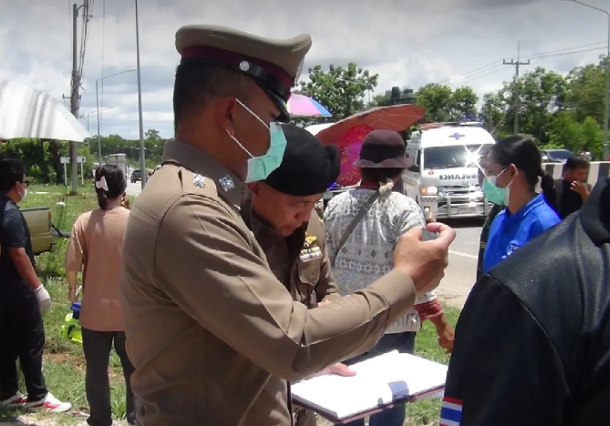
A devastating incident in Thailand's Mukdahan province has claimed the lives of 10 Buddhist monks after an 11-year-old boy drove a pickup truck into a pilgrimage procession on Thursday, authorities confirmed Friday. The crash, which occurred as a group of 35 monks and five lay followers walked along a roadside during their religious journey, has sent shockwaves across the predominantly Buddhist nation and raised urgent questions about child supervision and vehicle security.
The death toll continued to mount as the day progressed, with five monks losing their lives at the scene of the collision and a further five succumbing to their injuries at Mukdahan Hospital in the northeastern region. Hospital officials reported that ten additional victims remain under medical care, with two patients in critical condition and eight sustaining injuries of varying severity. The scale of casualties underscores the violent nature of the impact when the vehicle struck the gathered group of religious practitioners.
Investigators determined that the child had taken his parents' vehicle without authorisation before driving it into the procession. The boy's age places him within a crucial legal threshold in Thailand's criminal justice system: children under 12 years old bear no criminal liability under Thai law. This statutory protection means that despite the tragic circumstances, the young driver cannot face conventional criminal charges. Instead, authorities have referred him to child welfare agencies for comprehensive assessment and evaluation of the circumstances surrounding the incident.
Prayut Ruanthongkam, chief of Mukdahan City Police, explained to international media on Friday that the boy remained unable to provide a formal statement to investigators. The child's inability to communicate with police—whether due to shock, trauma, or developmental factors—has complicated efforts to establish a complete chronology of events leading to the collision. He remained under the supervision of his mother as welfare officials began their assessment process.
The investigation is proceeding along multiple avenues as authorities seek to understand how a child gained access to and control of a vehicle capable of inflicting such catastrophic damage. Police have been systematically gathering accounts from surviving monks who witnessed the collision firsthand. These eyewitness testimonies are proving crucial to reconstructing the sequence of events and determining whether any contributing factors such as mechanical failure, road conditions, or visibility issues played a role in the tragedy.
The incident carries profound spiritual and cultural significance across Thailand, where Buddhist monks occupy an elevated position in both religious and social hierarchies. These ordained practitioners are deeply revered throughout the kingdom as custodians of Buddhist teachings and philosophy, tasked with preserving and transmitting the Buddha's spiritual wisdom across generations. Their visibility in daily Thai life through regular public processions and alms-receiving ceremonies reflects the central role Buddhism plays in the nation's cultural fabric and collective identity.
Religious processions involving monks form an integral part of Thailand's spiritual calendar and community life. The sight of robed monks processing through streets and rural areas to receive offerings—whether food, money, or goods—represents a fundamental exchange between the lay Buddhist population and the monastic order. These gatherings demonstrate the mutual respect and devotion that characterises the relationship between Thai society and its Buddhist institutions. The attack on a procession therefore represents not merely a traffic accident but a violation of something deeply sacred within Thai culture.
Wat Roi Phra Phutthabat Phu Manorom, a prominent hilltop temple in Mukdahan province, has mobilised to support those affected by the tragedy. The temple has provided shelter and care for surviving monks from the procession, as well as other lay followers who were injured or traumatised by the incident. This response reflects the broader Buddhist community's commitment to compassion and support in times of crisis, principles that remain central to monastic life regardless of the circumstances facing individual practitioners.
The incident raises broader concerns across Southeast Asia regarding child vehicle access and road safety in the region. Thailand, like many developing nations, struggles with vehicle collision fatalities that rank among the world's highest relative to population size. The involvement of a young child in operating a vehicle speaks to gaps in family supervision protocols and the accessibility of keys and vehicles in household settings. Child welfare experts may need to examine whether this tragedy represents an isolated incident or reflects systemic vulnerabilities in how families manage vehicle security in rural Thai communities.
For Malaysia and other Southeast Asian nations, the incident serves as a sobering reminder of the importance of robust child safety measures and vehicle security practices. The case demonstrates how inadequate supervision combined with unsecured access to vehicles can result in catastrophic consequences affecting entire communities. Authorities across the region may consider reviewing their own protocols regarding child access to vehicles and the implementation of technological solutions such as immobiliser systems that could prevent unauthorised operation.
The tragedy has intensified scrutiny on child protection frameworks in Thailand and the effectiveness of current safeguards. While the legal system protects children under 12 from criminal liability, questions remain about preventive measures and how families and communities can better supervise young people and secure potentially dangerous tools and vehicles. The case demonstrates that legal protections, while important for developmental reasons, must be complemented by practical safety mechanisms that prevent children from accessing hazardous situations in the first place.
As Thailand mourns the loss of these respected spiritual leaders, the incident will likely prompt discussions about road safety, child supervision, and the need for comprehensive community education about vehicle security. The temple community continues to support affected monks and followers, while authorities pursue their investigation into the circumstances that transformed what should have been a day of spiritual devotion into a national tragedy.

