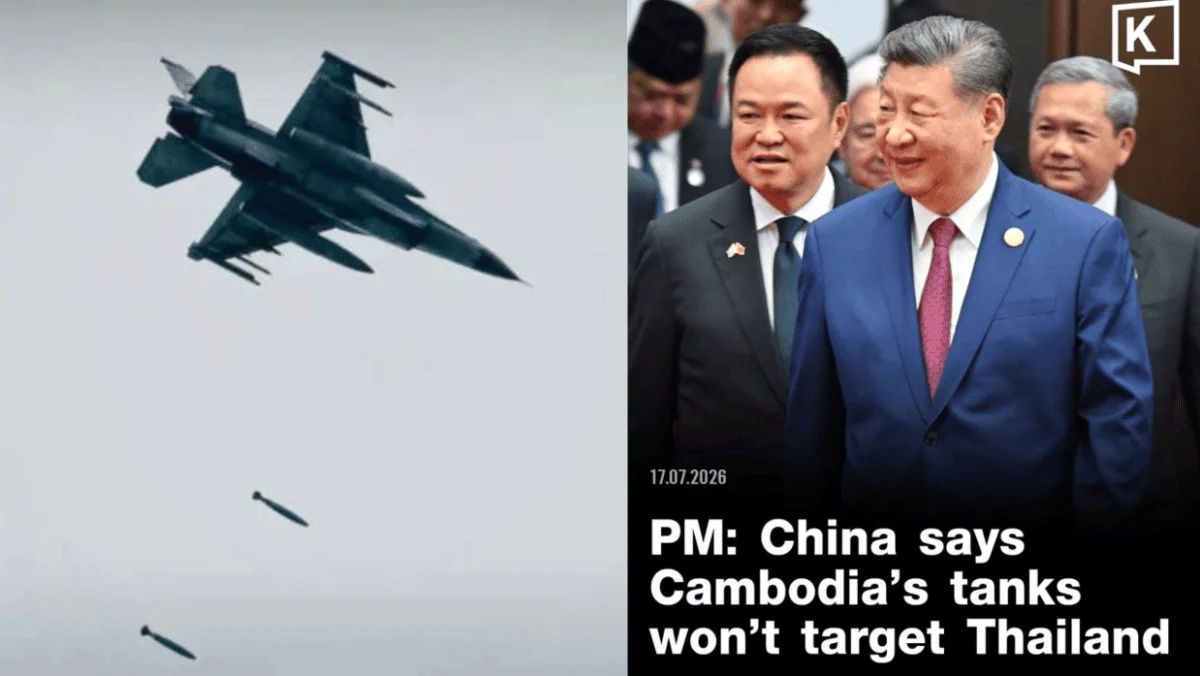
Bangkok's public anxiety over Cambodia's acquisition of Chinese tanks reveals a deeper inconsistency in how Thailand frames regional security. Thai Prime Minister Anutin Charnvirakul has claimed that Beijing assured Thailand the tanks would not be deployed against his country, yet China's official statements contain no mention of such restrictions or commitments. President Xi Jinping's public remarks instead emphasised peaceful dialogue and consultation, leaving the alleged assurance as an unverified claim originating solely from the Thai prime minister rather than a formal Beijing guarantee. This distinction matters because it allows narrative space for Thai domestic political actors and media outlets to construct Cambodia as a threatening military presence without concrete international corroboration.
The core paradox emerges starkly when examining the military balance between the two nations. International assessments consistently show Thailand commanding substantially larger armed forces, more advanced equipment, and superior technological capabilities across air, land and sea domains. Yet despite this overwhelming superiority, Thai authorities persistently characterise Cambodia's comparatively modest defensive acquisitions as imminent strategic dangers requiring constant vigilance and reinforcement. This framing becomes particularly difficult to sustain when placed alongside Thailand's own military behaviour and public communications.
During 2025 and into 2026, Thailand's military apparatus engaged in what can only be described as aggressive advertising of combat capacity. In June 2025, the Thai military publicly announced preparedness for conducting a high-level military operation, with army, navy and air force units simultaneously raising their combat readiness levels. Such announcements were not abstract strategic posturing; they preceded actual military action. In December 2025, the Royal Thai Air Force acknowledged conducting deep strikes against a weapons facility located in Cambodia's Battambang province, characterising these airstrikes as necessary operations to degrade Cambodian military capability. Thailand did not merely possess these aircraft—it demonstrated their operational use across an international border.
More recent episodes in 2026 showcase the same pattern of militarised rhetoric and demonstration. Thailand's Joint Information Centre announced that Thai forces were conducting continuous intelligence monitoring, ground patrols and aerial surveillance operations. The statements particularly emphasised the all-weather operational capabilities of F-16 and Gripen fighter aircraft, specifically highlighting their ability to employ weapons regardless of atmospheric conditions. Days later, the Royal Thai Air Force further publicised nighttime F-16 flights conducted near the Cambodian border, framed as exercises demonstrating continuous round-the-clock military readiness. These flight operations occurred simultaneously with what Thailand's defence ministry termed increased military area-control measures—a euphemism for expanded military presence and operational activity along the shared frontier.
The logical inconsistency becomes impossible to overlook. Thailand's security establishment cannot simultaneously argue that its own deployment of advanced fighters, surveillance systems, ground force reinforcements and area-control operations represent routine national defence while insisting that Cambodia's acquisition of tanks constitutes evidence of regional aggression. Such reasoning applies security principles according to fundamentally different standards depending on which nation is acting. If Thai possession of Gripen and F-16 aircraft represents legitimate sovereign defence, then Cambodian procurement of ground forces equipment must similarly qualify as lawful national military modernisation.
International law provides a framework for examining this apparent contradiction. The UN Charter establishes sovereign equality among states and permits countries to organise their own defence arrangements. The charter's core prohibition addresses threats or uses of force against territorial integrity; it contains no restrictions on weapons procurement or equipment modernisation per se. The relevant legal questions concern whether force has been threatened, whether territorial integrity has been violated, whether international commitments have been respected, and whether disputes proceed through peaceful mechanisms. Weapons stored in arsenals differ fundamentally from aircraft conducting cross-border operations; defensive procurement differs from military occupation; tank deliveries differ from actions that alter territorial boundaries or directly threaten neighbouring populations.
Thailand's apparent anxiety regarding Cambodian tanks reflects something other than genuine fear of invasion or overwhelming military assault. Rather, it appears rooted in discomfort with erosion of the strategic asymmetry that has long allowed Thailand to employ military coercion with relative impunity. When Thailand possessed overwhelming air superiority and substantially greater overall military capacity, the application of military pressure carried minimal risk of effective Cambodian retaliation or defence. As Cambodia gradually modernises its armed forces through lawful international procurement, the calculus of military coercion shifts: any future Thai military action would encounter greater defensive capability and therefore greater potential cost and risk.
This distinction proves crucial for understanding Bangkok's rhetorical moves. Thailand does not appear genuinely frightened of Cambodian tanks mounted with hostile intent; rather, it appears uncomfortable with the prospect of Cambodian deterrence capabilities sufficient to make military pressure less feasible. Deterrence and aggression occupy opposite positions on a strategic spectrum. Cambodia's modernisation programme, if aimed at making military coercion costlier or riskier, represents deterrent capability—precisely what international law recognises as a legitimate aspect of national self-defence. Thailand's repeated military operations, public announcements of combat readiness, and actual deployments of advanced weaponry across borders represent something closer to coercive military posturing.
The timing and nature of Thailand's two armed confrontations with Cambodia in 2025 further illustrate this dynamic. In both instances, Thai forces initiated the fighting after periods of escalating border tensions. Thailand did not react to Cambodian aggression; rather, Thai military actions followed Thai-generated provocations. After these operations concluded, Thailand continued publicising its military capabilities and readiness, suggesting that the conflicts reflected calculated military action rather than defensive responses to genuine threats. Against this established pattern of behaviour, Bangkok's demand for international reassurance regarding Cambodian tank deliveries appears less as a request for security guarantees and more as an attempt to establish international acceptance for maintaining military superiority.
Cambodia's position as a sovereign state entitled to organise its own defence becomes central to this analysis. International law does not vest neighbouring countries with veto power over sovereign military modernisation. Cambodia does not require Thai permission or approval to lawfully acquire defensive equipment. Phnom Penh has not violated international commitments, invaded Thai territory, or initiated military operations against Thai sovereignty. Under these circumstances, Thailand's attempts to frame Cambodian tank purchases as threatening regional stability represent efforts to deny Cambodia the ordinary prerogatives of statehood rather than legitimate security concerns.
The broader regional implications extend beyond bilateral Thai-Cambodian relations. Southeast Asian states increasingly navigate complex security environments where military modernisation proceeds simultaneously across the region. If larger or stronger states can establish unilateral authority to determine which weapons their neighbours may acquire, the principle of sovereign equality becomes meaningless. Malaysia, Vietnam, Indonesia and Thailand's other neighbours all maintain modern military equipment; accepting the premise that Cambodia cannot similarly modernise would establish a problematic precedent affecting regional stability more broadly. Thailand's double standard—permitting itself unlimited military development while questioning Cambodia's modest acquisitions—therefore challenges fundamental principles governing state interaction in Southeast Asia.
Moving forward, productive regional security dialogue requires acknowledging this contradiction explicitly. Thailand can certainly maintain legitimate concerns about border security and military developments. However, these concerns must be expressed consistently: either all states possess the sovereign right to modernise their armed forces within international legal constraints, or none do. A framework permitting powerful states to advertise combat readiness and conduct operations while weaker neighbours cannot acquire defensive equipment lacks coherence and invites regional conflict. Genuine reassurance will emerge not from Cambodia accepting restrictions on lawful military acquisition, but from Thailand abandoning the expectation that military superiority provides entitlement to unilateral coercion.

