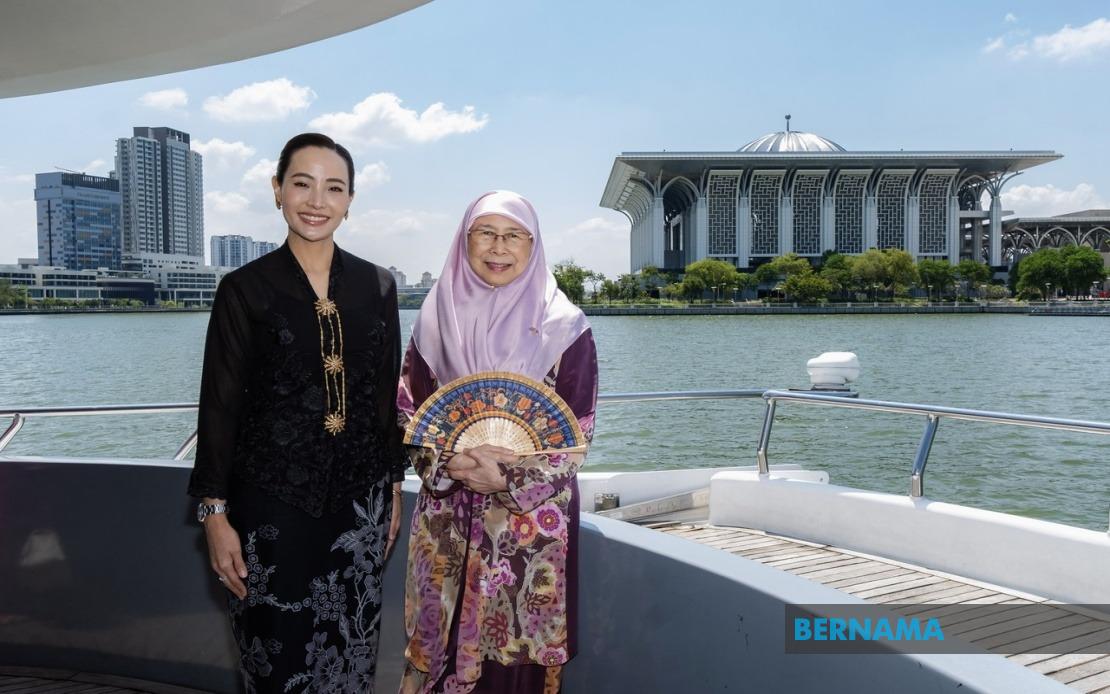
Thailand's Prime Minister's wife, Thananon Charnvirakul, experienced a picturesque afternoon on the waters of Tasik Putrajaya on Thursday, exploring Malaysia's purpose-built administrative hub from a leisurely cruise that showcased the capital's distinctive architectural landmarks and landscaping. Her tour arrived as part of a broader state visit by her husband, Thai Prime Minister Anutin Charnvirakul, whose presence in Malaysia carries significance for regional diplomacy and bilateral engagement at the highest levels.
The First Lady of Thailand received a warm reception at Putrajaya's waterfront around midday, greeted personally by Datuk Seri Dr Wan Azizah Wan Ismail, the wife of Malaysia's Prime Minister Datuk Seri Anwar Ibrahim. Accompanying the distinguished visitor was Hannah Yeoh, who serves as Minister in the Prime Minister's Department with responsibility for Federal Territories, underscoring the official nature of the engagement and Malaysia's commitment to according proper diplomatic protocol. The presence of these senior figures reflected the importance both governments place on cultivating personal relationships alongside formal state interactions.
During the forty-five-minute voyage across Putrajaya's man-made lake, Thananon and Dr Wan Azizah engaged in sustained conversation while observing the carefully planned urban landscape that surrounds them. The setting provided an ideal backdrop for informal diplomacy, allowing the two first ladies to develop rapport while appreciating the architectural vision behind Putrajaya's design. The lake itself, which forms the centerpiece of Malaysia's administrative district, offers sweeping vistas of government buildings, monuments, and public spaces that exemplify Malaysia's modern governance infrastructure and urban planning ambitions since the capital's establishment in the 1990s.
Anutin's arrival in Malaysia represents his first official visit since resuming the position of Prime Minister in March 2026, marking a symbolic moment in the renewal of Thai-Malaysian engagement. The Thai delegation touched down at Kuala Lumpur International Airport earlier in the day, where they were met with full ceremonial honors at the Bunga Raya Complex, the designated reception area for state visitors. This formal welcome set the tone for a two-day programme designed to advance cooperation between two Southeast Asian neighbours whose relationship encompasses extensive trade ties, cultural exchanges, and security cooperation.
The invitation extended by Anwar to his Thai counterpart serves as a clear statement of Malaysia's desire to deepen collaboration with Thailand across multiple spheres of mutual benefit. Both nations share geographic proximity, intertwined economies, and significant populations with cross-border ties, creating natural foundations for expanded partnership. The timing of Anutin's visit, coming shortly after his political reappointment, suggests both countries view the moment as opportune for resetting engagement parameters and exploring fresh avenues for cooperation.
Malaysia-Thailand relations operate within a complex regional context where economic integration, tourism flows, and labour migration create interdependencies that require careful management. The Putrajaya visit demonstrates how ceremonial elements and cultural exchanges complement formal negotiations, allowing leadership to establish personal connections that can facilitate future policy discussions. The administrative capital itself serves as a symbolic venue for such visits, representing Malaysia's institutional strength and forward-looking governance model.
Thananon's cruise through Putrajaya provided an informal platform for discussing matters of mutual interest without the formality of conference rooms. Such waterside encounters have historically proven valuable in Asian diplomacy, where the atmosphere permits candid discussion in relaxed settings. The choice to showcase Putrajaya's landscape—carefully designed over decades to embody Malaysian national aspirations—communicated subtly about Malaysia's development trajectory and investment in institutional infrastructure.
For Malaysian readers and observers, the visit underscores how bilateral relationships operate at multiple levels beyond trade statistics and security agreements. The visible engagement of Malaysia's first lady in receiving Thailand's first lady reinforces gender representation in diplomatic contexts, a development increasingly recognized across Southeast Asia as contributing to more comprehensive and nuanced international relations. Dr Wan Azizah's prominent role in the official programme reflects modern practices where spouses participate substantively in state functions.
The broader two-day visit encompasses discussions expected to cover cooperation frameworks in areas ranging from trade and investment to cultural exchanges and people-to-people connections. Thailand and Malaysia maintain substantial trade relationships, with significant Malaysian investments in Thailand and Thai workers forming important components of Malaysia's labour market. Educational exchanges between the two nations also run deep, with numerous Malaysian professionals trained in Thai institutions and vice versa.
Anutin's return to the premiership after previous tenure reflects Thailand's complex political dynamics, where leadership transitions carry implications for regional partnerships. His visit to Malaysia signals continuity in bilateral relations despite any domestic political transitions, reassuring Malaysian policymakers that Thailand remains committed to existing frameworks of cooperation. The personal dimension of the visit—bringing his wife to experience Malaysia's institutions and landscapes—conveys a message of genuine engagement rather than purely transactional diplomacy.
The waterside setting of Thananon's tour also highlighted environmental and urban planning dimensions that both nations increasingly prioritize. Putrajaya's design incorporates extensive green spaces and water management systems, representing an alternative vision of administrative capitals that balances development with environmental consciousness. Such elements interest Thai planners considering similar urban development projects, making the Putrajaya example relevant beyond ceremonial significance.
Moving forward, this visit establishes momentum for expanded cooperation as both nations navigate regional challenges and opportunities. The personal connections forged during such visits often translate into enhanced cooperation at bureaucratic and institutional levels, creating networks of officials comfortable working together across borders. For Malaysia, hosting high-level Thai visitors reinforces its position as a regional diplomatic hub and reaffirms its role in Southeast Asian multilateral institutions where Thailand and Malaysia both hold significant influence.

