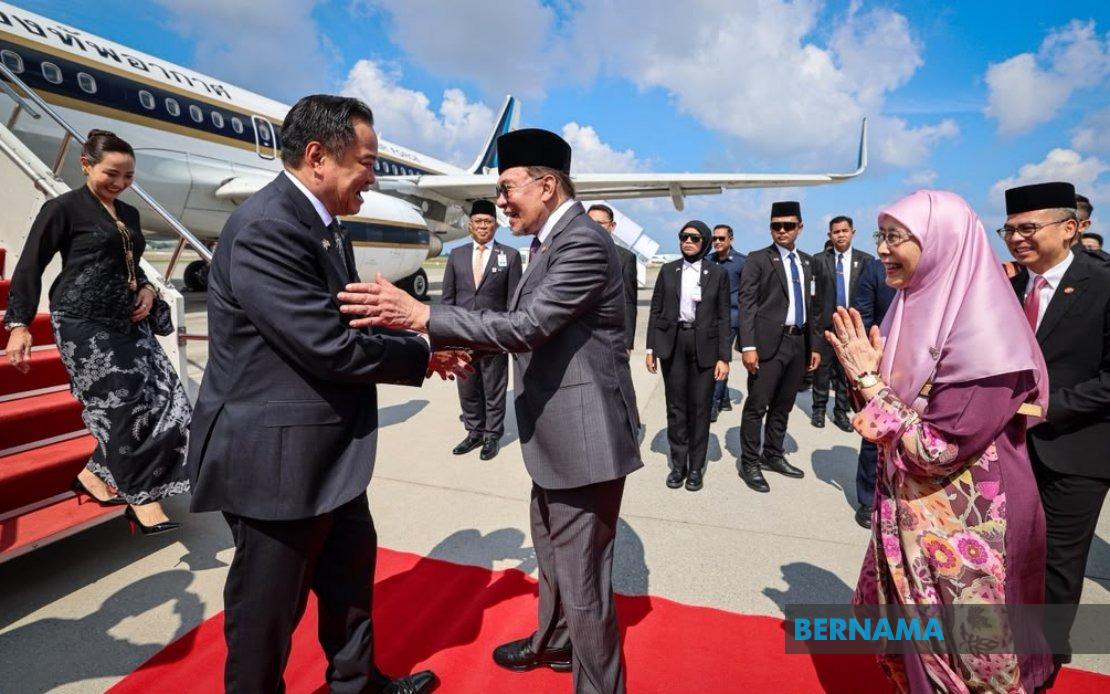
Thailand's Prime Minister Anutin Charnvirakul touched down at Kuala Lumpur International Airport on July 9, beginning a significant two-day official visit to Malaysia at the invitation of Prime Minister Datuk Seri Anwar Ibrahim. The arrival of Anutin and his spouse, Thananon Charnvirakul, at the Bunga Raya Complex marked an important moment in Malaysia-Thailand diplomatic relations, underscoring the two nations' commitment to deepening their partnership across multiple sectors and addressing shared challenges in the Southeast Asian region.
The formal reception extended to Anutin reflected the significance Malaysia places on the bilateral relationship. Anwar himself greeted the Thai leader upon arrival, accompanied by his wife Datuk Seri Dr Wan Azizah Wan Ismail and Communications Minister Datuk Fahmi Fadzil, who served as the official receiving minister. The ceremonial welcome featured a full guard of honour comprising 34 officers and personnel from the First Battalion of the Royal Ranger Regiment, led by Major Muhammad Nur Addeen Mustaza, followed by the simultaneous playing of both nations' national anthems—a diplomatic gesture emphasising the equality and respect between the two countries.
This visit represents Anutin's maiden trip to Malaysia since his reappointment as Thailand's Prime Minister in March 2026, making it particularly noteworthy for the agenda it carries. The timing of the visit coincides with a period of robust economic engagement between the two neighbouring countries, with bilateral trade reaching significant levels that underscore the depth of their commercial relationship. For Malaysian policymakers and business interests, the visit signals Thailand's continued priority placement in the country's ASEAN diplomatic strategy and economic outlook.
The substantive elements of Anutin's visit centre on a bilateral meeting scheduled at Perdana Putra, where he and Anwar will assess the trajectory of Malaysia-Thailand relations and identify areas for expanded cooperation. A key highlight involves the signing and exchange of a memorandum of understanding focused on agricultural cooperation, reflecting both governments' recognition of farming and food production as critical sectors for regional food security and economic development. This agricultural MoU carries particular relevance for Malaysian farmers and agribusiness operators who see opportunities for technology transfer, market access, and supply chain integration with Thailand's significant agricultural sector.
The economic dimension of this engagement cannot be overstated. In 2025, Thailand ranked as Malaysia's sixth-largest trading partner globally and second-largest among ASEAN member states, with bilateral trade totalling RM118.57 billion, equivalent to US$27.73 billion. These figures demonstrate the extensive economic interdependence between the two countries, spanning manufacturing, agriculture, and services sectors. More recently, trade momentum has accelerated, with the first quarter of 2026 recording bilateral trade of RM31.33 billion (US$7.90 billion), representing notable growth compared to the corresponding period in 2025, which saw RM27.35 billion (US$6.15 billion). This upward trajectory indicates strengthening commercial bonds and suggests both governments are succeeding in their efforts to facilitate business-to-business engagement.
Beyond bilateral economic matters, the visit encompasses regional infrastructure development that will benefit both economies and enhance cross-border connectivity. On July 10, Anutin and Anwar will jointly travel to Bukit Kayu Hitam in Kedah to inaugurate a critical road linking the Immigration, Customs, Quarantine and Security (ICQS) Complex on the Malaysian side with the Customs, Immigration and Quarantine (CIQ) Complex in Sadao, Thailand. This infrastructure project exemplifies practical cooperation aimed at improving border management, reducing transit times for goods and people, and fostering seamless trade flows that benefit businesses and travellers across both nations.
The ceremonial aspects of the visit, including the luncheon that Anwar will host in honour of Anutin and his delegation at the Seri Perdana Complex, serve broader diplomatic purposes. Such events provide informal settings for senior officials and ministers to build personal relationships, discuss sensitive matters off the record, and reinforce the people-to-people connections that underpin lasting international partnerships. For Thailand, the visit affirms its continued engagement with Malaysia despite broader regional geopolitical shifts, while for Malaysia, it reaffirms the centrality of Thailand in its ASEAN strategy and Southeast Asian regional architecture.
The timing and substance of Anutin's visit also reflect both countries' commitment to addressing transnational challenges through coordinated action. Border security, labour migration, tourism facilitation, and environmental management represent areas where Malaysia and Thailand increasingly find common cause. The elevation of these matters through prime ministerial visits demonstrates how both governments view bilateral cooperation not merely as commercial transaction but as essential to regional stability and prosperity.
For Malaysian stakeholders, particularly those in agricultural exports, manufacturing, logistics, and tourism, Anutin's visit signals policy continuity and a reopening of dialogue channels after what may have been periods of limited engagement. The agricultural MoU signals potential opportunities for Malaysian companies to access Thai markets, collaborate in food processing and distribution, and participate in regional supply chain initiatives. Conversely, Thai investors and businesses may find new pathways to Malaysian markets through the expanded bilateral framework being established during this visit.
The geopolitical context surrounding this visit merits attention. At a time when ASEAN faces various pressures—from great power competition to transnational issues like climate change and pandemic preparedness—bilateral partnerships between core ASEAN members like Malaysia and Thailand become more critical. These relationships form the foundation upon which ASEAN cohesion rests, making diplomatic visits of this magnitude important signals to the wider region about the bloc's internal solidarity and commitment to collective prosperity.
Looking forward, the outcomes of Anutin's visit will likely shape Malaysia-Thailand engagement for months to come. The agricultural MoU, the infrastructure opening, and any additional agreements or understandings reached during the bilateral meeting will establish new parameters for cooperation and potentially unlock opportunities across multiple sectors. Malaysian businesses should monitor the details emerging from these negotiations, as they may present avenues for expansion, partnership, or market access in one of Southeast Asia's most vibrant economies.

