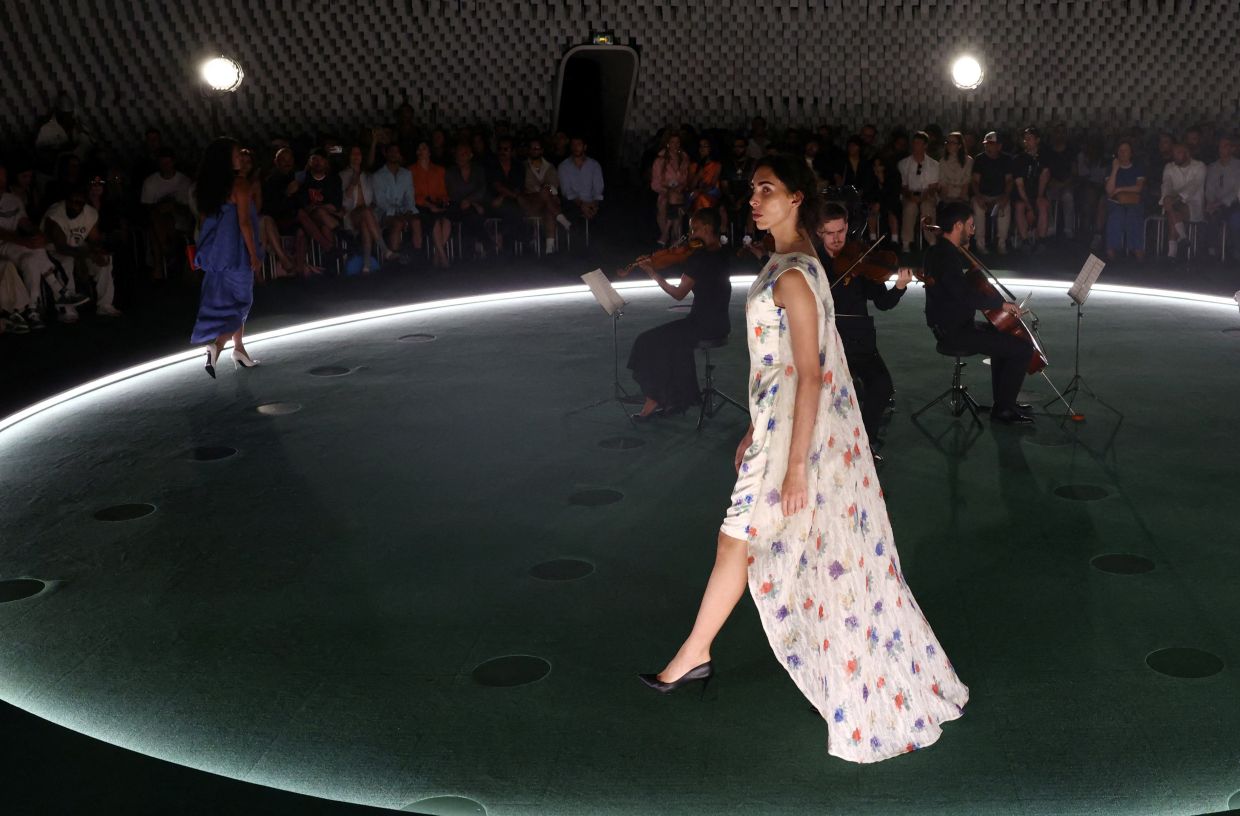
The sleeveless silhouette has become impossible to ignore on fashion runways and television screens alike. From Paris catwalks to prime-time news broadcasts, the armless look increasingly dominates contemporary style conversations. This phenomenon extends far beyond aesthetic preference—it represents a substantial shift in how the fashion industry produces and markets clothing, with profound implications for how women navigate professional and social spaces.
The commercial momentum behind sleevelessness is striking. According to Cognitive Market Research, the global sleeveless apparel market stood at approximately RM99.38 billion in 2021, with projections reaching RM209.65 billion by 2033. This doubling of market value in little over a decade signals that major fashion houses view sleeveless designs as central to their future revenue streams. Alexandra Van Houtte, founder of the fashion search engine Tagwalk, documented a 133 percent increase in sleeveless offerings across Spring 2026 collections compared to Spring 2025, providing quantifiable evidence of this industry-wide pivot. Designer Willy Chavarria, who prominently featured sleeveless dresses during his Paris Fashion Week presentation, confirmed that "the past two seasons our sleeveless has outperformed sleeved substantially," suggesting this is not a fleeting trend but a fundamental restructuring of how clothes are cut.
Understanding what drives this transition reveals deeper currents reshaping fashion. Climate change plays an undeniable role—as global temperatures climb and summer seasons become increasingly oppressive, lighter fabrics and minimal coverage emerge as practical responses to environmental stress. Beyond climatic factors, the fitness industry's explosion has normalized displaying muscular arms, particularly as gym culture becomes mainstream across urban Asia. Simultaneously, evolving gender norms have challenged historical restrictions on female bodily display, gradually dismantling arbitrary codes about what constitutes "appropriate" exposure in different contexts.
Yet the embrace of sleevelessness remains complicated for many women, particularly in mature demographics. Arms function as a chronological marker in ways faces increasingly do not. Modern aesthetic medicine can smooth skin and erase wrinkles, but the upper arm presents particular challenges—the loss of elasticity in triceps, the accumulation of subcutaneous fat at the armpit, the visible transformation of ligaments and muscles all conspire to betray age. A prominent retailer once shared with fashion observers that she abandoned sleeveless garments upon reaching 40, illustrating how anxiety about arm appearance operates across socioeconomic strata. This concern extends beyond vanity; it touches upon entrenched attitudes about female aging and desirability.
The politics of arm exposure demands historical perspective. For decades, powerful female arms were stigmatized as masculine or threatening, even as male muscularity remained celebrated. The international reaction to Michelle Obama's preference for sleeveless designs provides instructive context—her decision to wear a sleeveless sheath for her official White House portrait sparked intense debate about whether such exposure was empowering or inappropriate. This racialized and gendered scrutiny reflected deeper prejudices about whose arms could legitimately be displayed. American congresswomen did not secure the right to wear sleeveless clothing in the House until 2017, with the Senate following suit only in 2019. These recent institutional changes underscore how recently women's right to dress their bodies according to personal preference has been contested in formal settings.
For women ambivalent about the sleeveless trend, strategic styling offers middle ground. Designer Antonin Tron of Balmain advocates reframing the conversation: "There is this idea that women's sexuality stops when they get older, and I don't agree with that." He proposes beginning modestly—pairing a simple sleeveless piece with bold jewelry that draws attention upward, creating visual interest that redirects focus from any perceived arm imperfection. Cold-shoulder designs and cap-sleeve alternatives occupy the space between full coverage and complete exposure, providing psychological comfort while participating in the contemporary aesthetic. Placing a sheer or transparent layer over a sleeveless garment creates texture and visual complexity without the constraint of full sleeves.
Fit and cut matter considerably more than many realize. A high armhole that sits comfortably without binding offers flattery across body types and ages, avoiding the unflattering gaping that occurs when armholes sit too low. The geometry of sleeve attachment profoundly affects silhouette; attention to these technical details transforms how a garment reads on the body. Testing these styling choices through gradual exposure rather than immediate full commitment allows women to build confidence incrementally.
Beyond technical styling considerations lies a philosophical reorientation. Arms carry accumulated meaning—they have typed professional documents, lifted children and household goods, embraced loved ones, and enabled countless acts of labor and care. The visible strength and capability arms represent extends far beyond their appearance. Reclaiming arms as worthy of display requires recognizing what they have accomplished and continue to accomplish. In Asian contexts particularly, where professional dress codes have traditionally emphasized conservative coverage, the ability to choose one's own level of arm exposure represents genuine autonomy.
The sleeveless movement ultimately reflects broader cultural shifts regarding female autonomy, bodily acceptance, and the right to self-determination in presentation. Whether one embraces sleevelessness fully, adapts it strategically, or declines the trend entirely, the underlying principle remains crucial: women should decide how much of their bodies they display based on personal comfort and choice, not arbitrary social restrictions. The proliferation of sleeveless options simply expands the range of possibilities available. For those willing to experiment, the rewards may surprise—discovering that arms, in all their imperfect reality, deserve celebration as much as any other part of the body.

