A hospital administrator's simple gesture—offering to peel a mandarin orange—sparked a profound realisation about the deeply human ways we express compassion. In a modest office in northwest England, this small act of consideration transported a healthcare professional back to Malaysia, unlocking a treasury of memories about how food has always functioned as the currency of care within families and communities. What began as a casual acknowledgement of a missed meal evolved into a meditation on whether the language of nourishment might be one of humanity's oldest and most universal dialects.
Within Malaysian households, the connection between food and emotional expression runs particularly deep. Growing up, the author experienced this intimately through the patient, repetitive rituals of preparation and service performed by family members. The paternal grandmother who spent years peeling green apples after dinner established a tradition so consistent that when that responsibility transferred to the mother, the gesture retained its original meaning unchanged. Similarly, the late father's meticulous extraction of crab flesh—a task requiring significant skill and patience—represented an investment of time and attention that communicated something words alone could not. These weren't merely meals; they were declarations of devotion rendered in the everyday language of kitchen and table.
The quirks and preferences that accumulate across a childhood become the vocabulary through which family members continue to speak their care into adulthood. A grandmother's insistence on hand-feeding a stubborn child who refused to abandon storybooks during meals reflected not just concern about choking hazards, but a determination that nourishment happen regardless of distraction. Years later, when the author moved away from Malaysia, the mother's continued purchase of blue packet Hup Seng Teddy biscuits—despite perpetual disagreements about which flavour was actually preferred—demonstrated how love persists in these small, intentional choices. The mother's inability to remember that tomato was the favoured crisp flavour, year after year, somehow underscored rather than diminished the gesture's sincerity.
Beyond the nuclear family, this food-based communication extends into the broader tapestry of Malaysian community life, particularly around religious and cultural celebrations. An aunt who automatically included extra potatoes in Deepavali chicken curry because she knew they would be devoured while the meat languished on the plate engaged in a form of culinary attentiveness that acknowledged individual preference as worthy of accommodation. The ritual arrival of a colleague's legendary chocolate moist cake every Deepavali season represented a commitment so reliable that its absence would have been conspicuous. These weren't spontaneous gestures but rather embedded practices that became part of the seasonal rhythm, transforming festivals into exchanges of care that crossed religious boundaries.
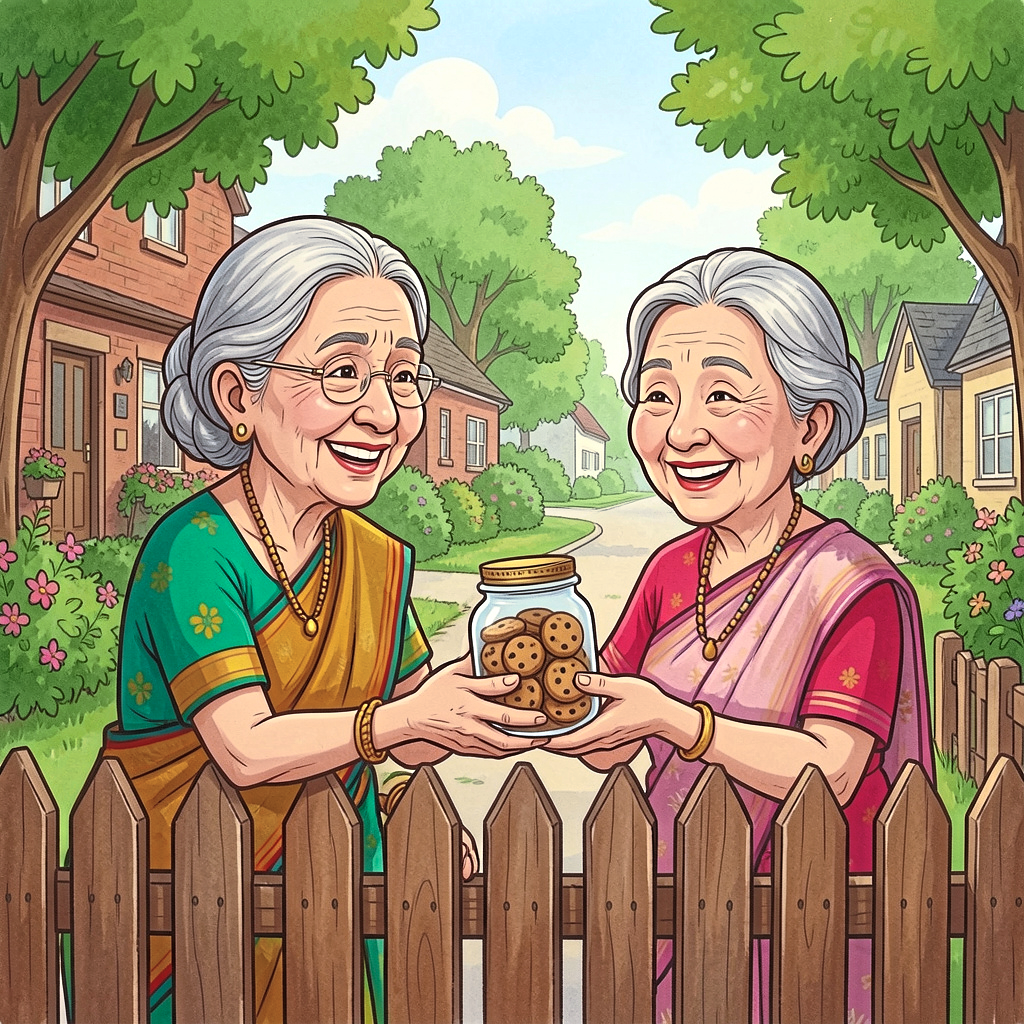
The exchange of food across religious lines in Malaysian neighbourhoods reveals something essential about how communities function when they choose coexistence and mutual respect. An aunt's distribution of cookies to Chinese neighbours on Deepavali day, followed by the reciprocal arrival of Chinese New Year treats at the family home, established a gentle dialogue conducted entirely through culinary offerings. A retired colleague who, after decades, still appears at Chinese New Year with mandarin oranges while the author's mother similarly arrives at his house with cookies demonstrates how these habits become self-perpetuating systems of care that survive retirement and the passage of years. Such practices resist the tide of modernisation and convenience; even as store-bought items increasingly replace homemade preparations, the fundamental ritual persists.
The 50-year relationship with a next-door neighbour whose stroke eventually prevented her from cooking altogether illustrates how deeply food becomes intertwined with personal identity and the way we remember those we love. The sweet upma that appeared over the fence from this neighbour for decades remains the author's definitive version of that dish, suggesting that the associations we build around food—the hands that prepared it, the intention behind its sharing, the moments when we consumed it—become inseparable from taste itself. The contrast between this neighbour's previous generous offerings and her current inability to cook underscores an uncomfortable truth: the loss of capacity to express care through food can feel like a diminishment of self.
What emerges from this catalogue of food-centred memory is the recognition that Malaysian culture, at least as experienced in this particular household and neighbourhood, treats feeding others as a primary mechanism for demonstrating relationships matter. This isn't unique to Malaysia, though the intensity and consistency of the practice may vary across cultures. The act of peeling fruit for someone too busy to do it themselves, of remembering preferences with annual consistency, of crossing cultural and religious boundaries through food exchange—these represent a universalised script of care that appears with variations across human societies.
The revelation that an English colleague would offer to peel a mandarin orange with the same genuine concern prompted a recalibration of what had seemed distinctively Malaysian. Perhaps the impulse to nourish others, to remember what they prefer, to spend time on the small preparations that make eating easier or more pleasant, taps into something more fundamental than any single cultural tradition. The willingness to invest effort in these small gestures appears across geography and cultural contexts. A Japanese mother's careful bento box preparations, an Italian grandmother's endless pasta making, an Indian family's insistence on home-cooked meals—all speak the same underlying language, even if the vocabulary differs.
Yet recognising universality doesn't diminish the particular forms that care takes within specific cultures and families. The Malaysian version of food-as-care carries its own inflections: the specific fruits chosen, the dishes associated with particular celebrations, the multi-generational continuity of practices, and the cross-religious participation that characterises urban Malaysian neighbourhoods. These specifics matter precisely because they are learned early and practised consistently, becoming the texture of belonging itself. When the author eats Deepavali chicken curry with extra potatoes, she isn't simply consuming nutrients; she's participating in a family's particular language of attention.
For those living far from home, these food memories acquire additional weight. The mother's continued purchase of childhood biscuits and the careful annual timing of sweets at festival seasons represent a thread that spans distance. When people maintain these practices across years and geographical separation, they resist the assumption that migration necessarily severs cultural continuity. Instead, food becomes one of the most portable ways to keep these languages alive. The author living in England still recognises and responds to these gestures because the vocabulary was learned so thoroughly in childhood.
The deeper implication extends beyond nostalgia or cultural preservation. In an increasingly atomised world where traditional communities fray and extended family networks disperse, the language of food-as-care offers a mechanism for expressing connection that requires minimal explanation. When someone offers to peel fruit for a stranger—or a colleague—they're accessing something so fundamentally human that it transcends both linguistic and cultural barriers. This language doesn't require eloquence, formal education, or cultural initiation; nearly everyone understands what it means to be hungry, to be tired, to be fed with care.
For Malaysian and Southeast Asian readers, this reflection carries particular resonance. The household practices described—the hand-feeding, the preference accommodation, the cross-cultural food exchanges—likely resonate with lived experience rather than seeming exotic or sentimental. In a region where food still anchors social life despite rapid modernisation and urbanisation, the recognition that these practices are simultaneously universal and intimately particular offers both validation and perspective. The care expressed through food isn't a luxury of agricultural societies with time for elaborate meal preparation; it persists in hospitals, offices, and urban neighbourhoods wherever people choose to invest attention in one another's wellbeing through feeding.

