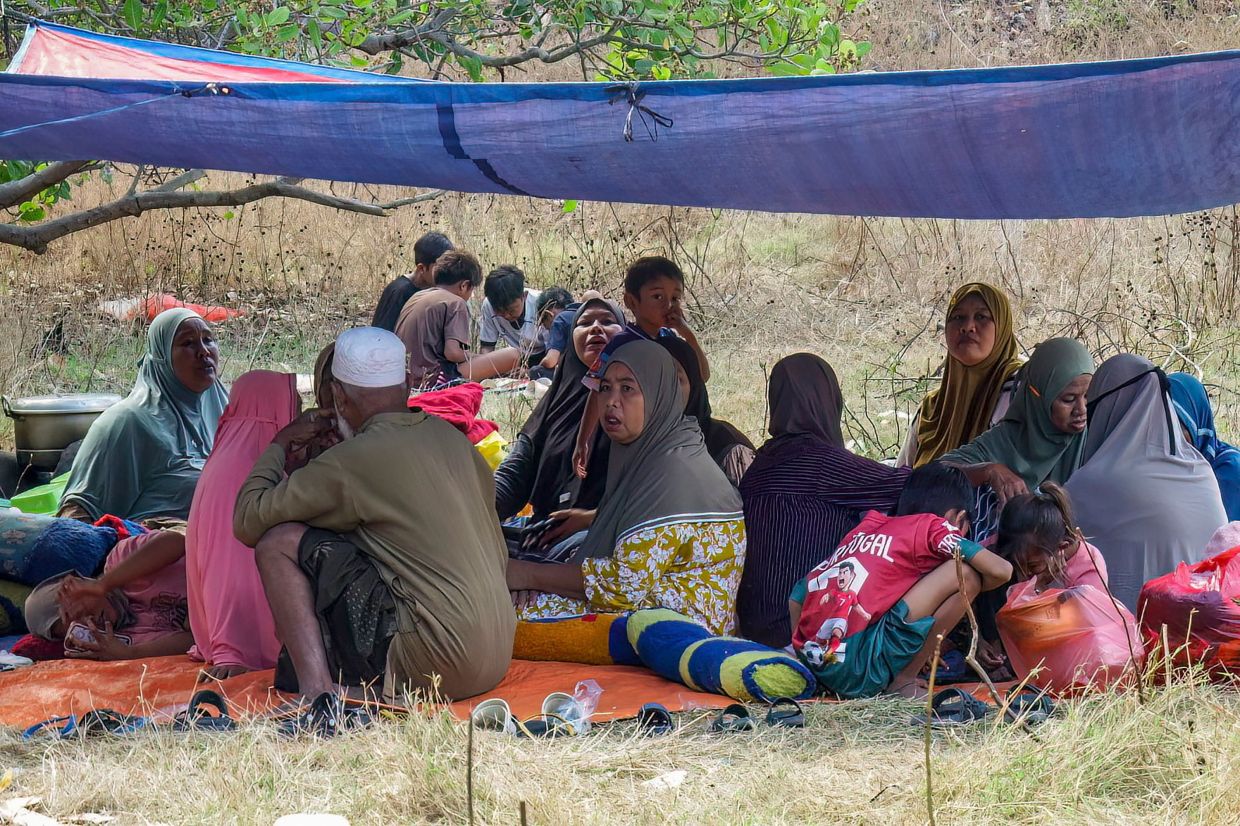
The Indonesian island of Flores faces a humanitarian crisis following a catastrophic earthquake that claimed 48 lives and displaced thousands of residents, with survivors waiting desperately for emergency assistance in temporary shelters and makeshift encampments across the devastated region. The 7.7-magnitude tremor struck early on Saturday morning offshore from Flores' north coast, triggering a relentless barrage of 341 aftershocks that kept residents in constant fear and prevented them from safely returning to their homes or assessing the full extent of damage to their communities.
Approximately 5,000 people abandoned their homes in panic as the ground shook violently, according to spokesman Berton Suar Pelita Panjaitan of Indonesia's national disaster agency BNPB. Many residents fled to high ground out of instinctive fear, particularly after witnessing the ocean's unusual retreat—a warning sign that previously preceded a catastrophic tsunami in this region's traumatic recent history. Umri, a villager from Nangahale on the island's northern coast, remained huddled on a hillside well into Sunday morning alongside other displaced families, still too frightened to venture back down. "We need food, drink, medicines, and diapers for the children," Umri explained, articulating the immediate survival concerns facing thousands in similar circumstances throughout the affected areas.
The psychological impact of this disaster has been compounded by collective memory. Nurhidayati, 55, spent the previous night sleeping on a thin mat alongside other evacuees on the hilltop, her trauma deepened by recollection of the devastating 1992 earthquake that struck Flores with identical force and killed approximately 2,500 people through a combination of ground movement and subsequent tsunami waves. "I'm still terrified; my heart is pounding hard remembering yesterday's tremor. I don't dare to go home," she said, revealing the deep-seated anxiety that historical precedent has created among older residents who witnessed that earlier catastrophe firsthand. Her determination to remain in makeshift shelter rather than risk returning to her damaged home reflects a rational assessment of ongoing danger, as aftershocks continued to rattle the island throughout Sunday.
The earthquake's physical destruction has been staggering and comprehensive. Official assessments documented at least 914 houses suffering severe structural damage, with hundreds more sustaining moderate or minor harm. Critical infrastructure has similarly been compromised—the disaster damaged 93 educational facilities, 36 health centres, and 38 government offices, effectively dismantling the institutional frameworks necessary for coordinating relief efforts and providing medical treatment. The shallow nature of the quake, combined with the offshore epicentre location, concentrated destructive energy efficiently through the island's relatively vulnerable building stock. Hundreds of additional residences and commercial buildings sustained lesser damage that will nonetheless require repair before inhabitants can safely occupy them again.
Communications infrastructure failure has severely hampered emergency response efforts in certain localities. Multiple communities remain cut off from electricity supplies and telecommunications networks, preventing residents from contacting relatives or receiving official information about relief operations. At least one critical access road has become impassable, creating logistical bottlenecks that complicate the delivery of humanitarian assistance to isolated population centres. These infrastructure failures compound the already challenging terrain and geographically dispersed settlement patterns characteristic of Flores, forcing relief coordinators to improvise alternative distribution routes and communication methods.
The casualty figures, while tragic, could have been substantially worse. At least 101 residents sustained injuries ranging from minor to serious, and remarkably, no persons were reported as buried beneath collapsed structures or missing by Sunday afternoon. Fathur Rahman, a local search and rescue coordinator, emphasized that rescue teams were continuing systematic sweeps through affected areas as a precautionary measure, though the apparent absence of mass casualty scenarios suggested that residents' rapid evacuation to elevated terrain had prevented entrapment and crushing injuries. This fortunate outcome likely reflects both the island's low building density and population's deep familiarity with earthquake hazards, which prompted immediate protective action.
The disaster response mobilization has been rapid and substantial. The government dispatched 50,000 aid packages totalling 275 tonnes of supplies to affected zones, providing essential materials including emergency tents, blankets, clean water, camp beds, food rations, medications, and electricity generators. The International Federation of Red Cross and Red Crescent Societies activated preparation protocols for establishing and supplying temporary shelters housing thousands of evacuees. The East Nusa Tenggara provincial administration, which encompasses Flores, initiated bureaucratic procedures to formally declare a 14-day emergency response status, enabling enhanced government resource allocation and suspension of normal administrative constraints on relief spending.
International support has also materialized swiftly. European Union chief Ursula von der Leyen announced that the bloc would deploy its Copernicus Earth observation satellite system to support search and rescue operations, providing real-time satellite imagery to help identify collapsed structures and guide rescue teams to areas requiring urgent attention. This technological contribution represents valuable assistance given the damaged roads and communications systems constraining conventional coordination methods. Europe's demonstrated solidarity underscores the global recognition of Indonesia's vulnerability to seismic hazards and the international community's commitment to assisting when major disasters strike.
The tsunami threat, while initially terrifying residents who witnessed the ocean's sudden retreat, ultimately dissipated without generating significant coastal surge. The BMKG geological agency recorded wave heights reaching up to 1.6 metres in certain coastal regions, but these were insufficient to cause major additional damage or casualties. Nevertheless, authorities have cautioned evacuees against returning to damaged buildings prematurely, as ongoing aftershocks threaten to destabilize already-compromised structures and potentially trigger secondary collapses. This precaution has kept thousands in temporary shelters awaiting structural engineers' assessments of building safety.
Flores' exposure to this earthquake reflects Indonesia's inherent geographical vulnerability to seismic catastrophe. The archipelago straddles the Pacific Ring of Fire, an arc of volcanic and seismic activity encompassing Japan, Southeast Asia, and the entire Pacific basin perimeter. Indonesia's location at the convergence of multiple tectonic plate boundaries—the Indo-Australian, Philippine, and Eurasian plates—creates conditions for frequent strong earthquakes and occasional tsunamis. This 7.7-magnitude event represents a typical manifestation of the tectonic forces continuously reshaping Indonesia's geology and threatening its population.
Historical perspective underscores Flores residents' justified anxiety. The catastrophic 1992 earthquake of identical 7.7 magnitude that devastated the same island killed roughly 2,500 people, establishing a traumatic historical precedent that shapes contemporary responses to seismic events. More broadly, Indonesia experienced a far more devastating 9.1-magnitude earthquake in 2004 that originated offshore from Sumatra and generated a massive tsunami killing 220,000 people throughout the region, with approximately 170,000 casualties occurring within Indonesian territory alone. That tragedy remains among recorded history's deadliest natural disasters, reinforcing the devastating potential that earthquake hazards pose to densely populated areas throughout Southeast Asia.
The current relief phase will gradually transition into longer-term reconstruction as the emergency concludes. Engineers must systematically assess thousands of damaged structures, categorizing them as salvageable through repair or requiring complete demolition and rebuilding. This process typically extends across many months, requiring substantial financial resources and sustained international donor attention beyond the immediate humanitarian crisis phase. Flores residents will face prolonged displacement, temporary housing, and the psychological burden of rebuilding lives and communities in an environment where catastrophic earthquakes represent permanent geological reality rather than exceptional anomalies.

