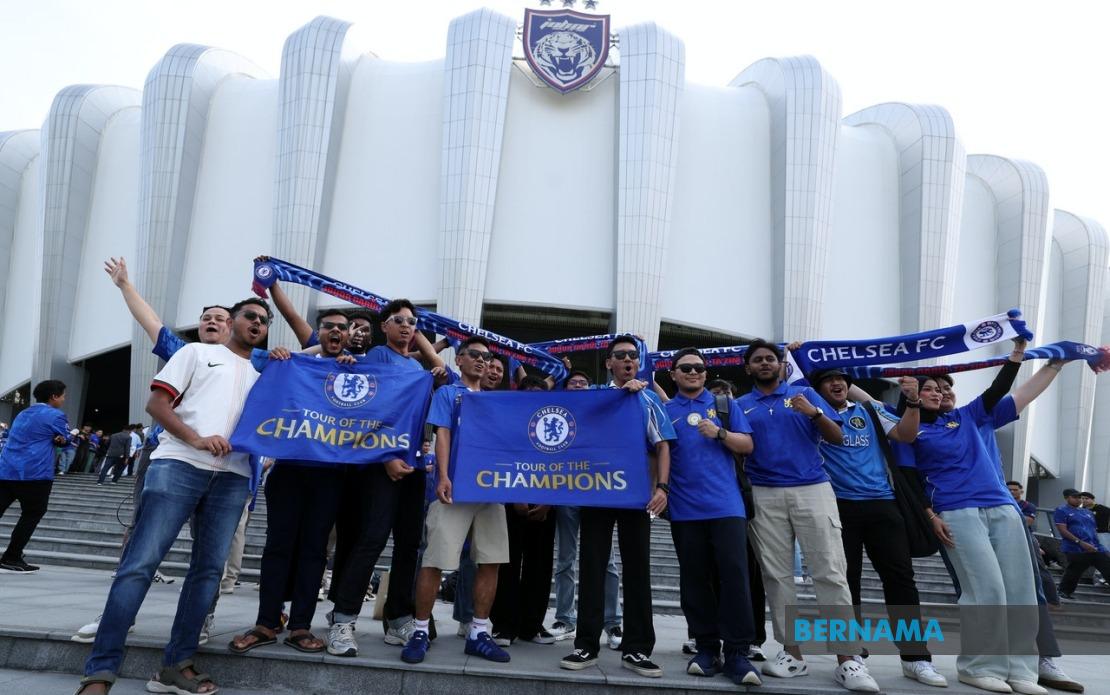
The Sultan Ibrahim Stadium in Iskandar Puteri transformed into a vibrant tapestry of red and blue on August 9 as supporters began assembling hours before kickoff for one of Malaysian football's most significant fixtures. From mid-afternoon onwards, waves of fans wearing the colours of Johor Darul Ta'zim and Chelsea FC converged on the venue, creating an atmosphere crackling with anticipation for the evening's clash between the Southern Tigers and the English Premier League powerhouse.
The demographic diversity of attendees reflected the broad appeal of the occasion. Families with children mingled alongside veteran supporters who had followed their respective clubs for decades, while groups of younger fans brought an infectious energy to the grounds. Many took advantage of the pre-match atmosphere to capture photographs at iconic vantage points around the stadium, creating social media moments that would extend the event's reach far beyond those physically present.
Commercial activity hummed throughout the afternoon as official merchandise outlets became focal points of activity. Queues stretched between stalls as supporters sought limited-edition items commemorating what many viewed as a watershed moment for Malaysian football. The availability of exclusive merchandise underscored the commercial significance of hosting a club of Chelsea's stature, with genuine enthusiasm driving purchasing decisions rather than obligatory consumption.
The geographic reach of the crowd extended well beyond Johor's borders. Supporters from across Malaysia, including enthusiasts from Kuala Lumpur and Melaka, had made the journey, while the proximity to Singapore meant that cross-border attendance added another dimension to the event. The weekend timing proved strategic in enabling international visitors to participate without requiring work leave, and some Singaporean fans had departed early to navigate border crossing procedures smoothly.
Traffic management presented the inevitable logistical challenge for an event of this magnitude. By early evening, main arterial routes feeding the stadium experienced congestion, though authorities maintained orderly conditions through coordinated deployment of Royal Malaysia Police personnel. The capacity to manage large-scale crowd movements without compromising safety or creating gridlock reflected decades of experience hosting major sporting events, with the security apparatus operating invisibly to most spectators while maintaining vigilance throughout the approach to the 8 pm kickoff.
For established Premier League supporters like Ahmad Danial Muhammad, a 28-year-old Chelsea devotee from Bangsar in Kuala Lumpur, the fixture represented something genuinely exceptional. His connection to the club stretched back to Didier Drogba's era, and the prospect of witnessing current squad members perform live without the expense and logistical burden of travel to London represented a rare convergence of accessibility and authenticity. His decision to secure a ticket reflected a calculated choice that such opportunities rarely materialised, particularly at affordable prices.
Cross-border participation from Singapore added a regional dimension to the event. Tan Wei Sheng, a 34-year-old supporter who crossed the Johor Causeway with family members at midday, articulated appreciation for both the stadium's infrastructure and the intangible elements that defined the occasion. His observation about world-class facilities extended beyond mere physical infrastructure to encompass the broader organisation and atmosphere, suggesting that Chelsea's willingness to play in Malaysia conferred legitimacy on Malaysian football environments that sometimes remained invisible to international audiences.
JDT's perspective on hosting Chelsea crystallised around the competitive and diplomatic implications. Mohd Khairul Anuar Ismail, a 41-year-old supporter from Melaka, framed the fixture as evidence of ascending international recognition for Malaysian clubs. This interpretation extended beyond the single match to encompass broader positioning of domestic football on the global stage, suggesting that international clubs choosing to compete in Malaysia validated the quality and credibility of local competition.
The symbolic significance of the fixture resonated particularly for supporters invested in Malaysian football's trajectory. Safiyah Rosli, a 32-year-old JDT enthusiast from Batu Pahat, explicitly connected Chelsea's visit to Tunku Mahkota Ismail's stewardship of Malaysian football governance. This framing positioned the match within a narrative of institutional commitment and strategic development, suggesting that international fixtures functioned as visible manifestations of longer-term ambitions to elevate the domestic game's standing.
The convergence of international prestige and domestic pride created a distinctive atmosphere that transcended typical sporting event conventions. For many attendees, the occasion represented an intersection of several currents: access to globally recognised talent, validation of local footballing institutions, and participation in a moment that might reshape perceptions of Malaysian football beyond the country's borders. The magnitude of attendance and the demographic breadth of supporters indicated that the appeal extended across traditional football constituency boundaries.
The Chelsea-JDT fixture emerged as more than a single ninety-minute match. It functioned as a statement about Malaysian football's evolution, the regionalisation of sporting culture across Southeast Asia, and the continued power of elite football clubs to mobilise communities across geographical and national boundaries. The images of thousands of supporters in red and blue provided visual testimony to football's capacity to unite disparate groups around shared enthusiasm, transcending the immediate competition to become a cultural moment with implications extending well beyond the final whistle.

