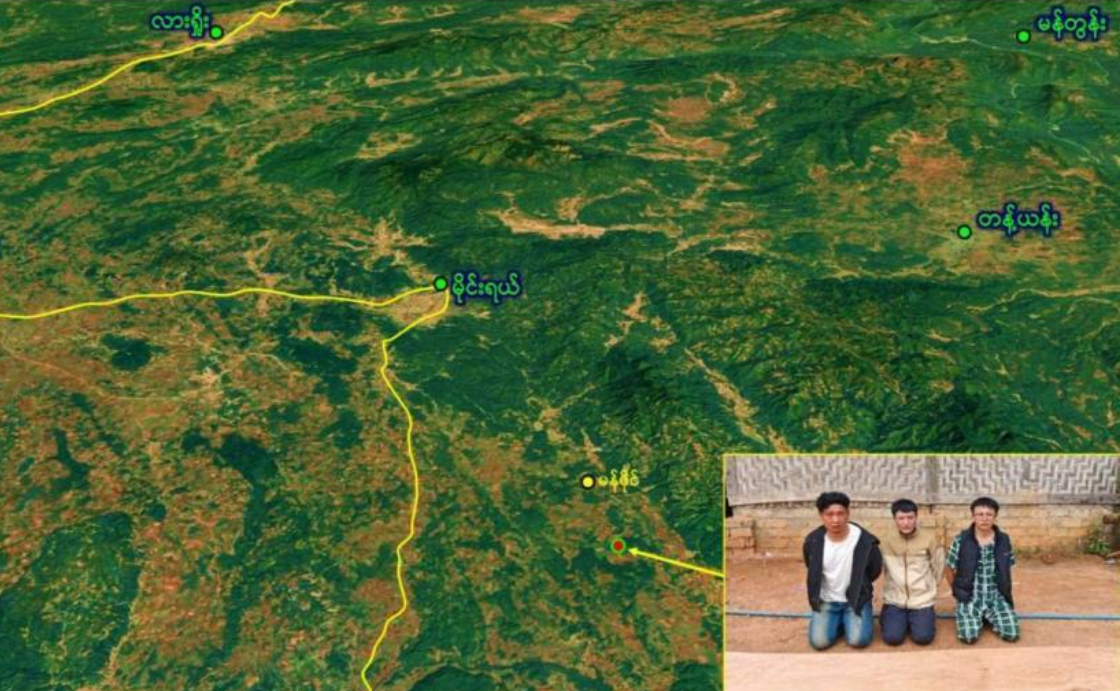
Myanmar's military has intensified crackdowns on transnational cybercrime networks, moving against three Chinese nationals who allegedly operated an illegal online gambling scam operation from makeshift camps in Mongyai Township in Shan State's remote borderlands. The August 26 operation represents the latest enforcement action in a broader national campaign targeting the proliferation of such schemes, which exploit vulnerable populations across Southeast Asia and beyond through sophisticated digital deception.
The three suspects, who allegedly crossed into Myanmar illegally, were apprehended approximately 26 kilometres southeast of Mongyai town and roughly 5 kilometres south of Manphai Village. The location reflects a troubling pattern: border regions and areas with weak governance have become havens for transnational scam operations, which exploit porous boundaries and limited oversight to establish clandestine networks far from urban law enforcement presence. These zones offer the dual advantage of relative anonymity and proximity to escape routes into neighbouring countries.
Security operations uncovered a surprisingly sophisticated infrastructure for what appeared to be a small-scale operation. Authorities seized one substantial corrugated iron structure measuring 50 by 20 feet, along with five temporary shelters fashioned from tarpaulin sheeting. The arrested individuals had established what amounted to a functioning business compound, suggesting these were not opportunistic criminals but rather part of a more organized syndicate with established protocols for site selection and operational security.
The confiscated equipment reveals the technological sophistication underlying such schemes. Investigators recovered 25 mobile devices, five all-in-one desktop computers, two portable power stations, one Starlink satellite internet terminal, and ten communication radios. This inventory demonstrates how scammers leverage multiple communication channels and redundant power systems to maintain operational continuity and resist disruption. The inclusion of Starlink equipment is particularly significant, as satellite internet provides independence from local infrastructure and complicates law enforcement's ability to trace communications.
These operations typically function by targeting individuals through social media and messaging applications, fabricating elaborate scenarios—often involving romantic relationships or financial opportunities—to extract money from victims across multiple countries. Myanmar's border regions have become increasingly attractive to such networks precisely because they offer refuge from their countries of origin while remaining sufficiently close to Southeast Asian markets where many victims reside. The shift from traditional cybercrime hubs to distributed border operations represents an evolution in criminal tactics, making interdiction considerably more challenging for regional authorities.
Myanmar's campaign against online scam gambling responds partly to regional pressure. Thailand and other neighbouring states have pressed for action against networks operating from Burmese territory, as scammers routinely target Thai and Southeast Asian citizens. The Myanmar government recognizes that permitting such operations to flourish damages its international standing and creates humanitarian costs, as victims—often economically disadvantaged—lose substantial sums to deception.
The investigation originated from community intelligence, underscoring how grassroots awareness becomes crucial when formal law enforcement capacity is limited. Local residents reported the presence of individuals engaged in suspicious activities, providing the initial lead that prompted security personnel to conduct surveillance and initiate the operation. This community-oriented approach suggests authorities are deliberately cultivating public cooperation, recognizing that identifying clandestine camps in remote areas requires sustained vigilance from ordinary citizens.
While the apprehension represents a tactical success, it also illustrates the systemic challenge facing Myanmar and the broader region. The ease with which international criminal syndicates can establish operations—coupled with the relative simplicity of relocating elsewhere if detected—means that individual arrests rarely dismantle entire networks. The three detained individuals will face prosecution under Myanmar's existing criminal laws, but their employers and the network's leadership likely remain at large, potentially reorganizing operations elsewhere along the porous border.
The Starlink device merits particular analytical attention, as it represents a significant technological escalation. By accessing global satellite internet, scammers achieve communications independence from Myanmar's state-controlled telecoms infrastructure, complicating both surveillance and signal tracing. This development suggests that transnational scam operations are becoming increasingly sophisticated in their operational security, potentially outpacing law enforcement adaptation in the region.
Myanmar's authorities have pledged to systematically dismantle illegally constructed shelters and intensify prevention efforts, yet sustaining such operations across Myanmar's vast and often inaccessible borderlands remains logistically formidable. The country faces competing security priorities, including internal conflicts and insurgencies, which limit resources devoted to cybercrime enforcement. Regional cooperation mechanisms remain underdeveloped, meaning that suspects often exploit jurisdictional gaps to evade prosecution.
For Malaysian readers and Southeast Asian observers, this operation underscores how transnational cybercrime flows through interconnected regional networks. Many Malaysian victims of online scams are targeted by networks operating from precisely these border regions. Strengthening Myanmar's law enforcement capacity, improving information-sharing protocols among ASEAN nations, and targeting the financial flows underlying such operations remain essential steps toward disrupting these criminal ecosystems more comprehensively.

