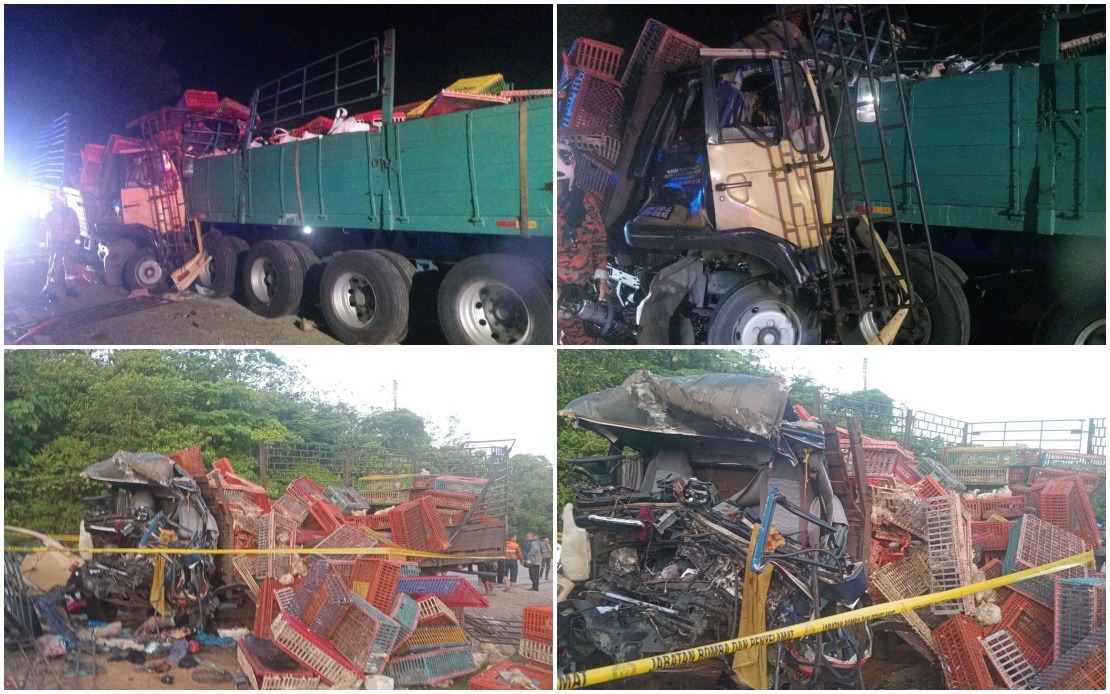
A tragic road accident claimed three lives in the early hours of Sunday when a five-tonne lorry transporting chicken collided with a trailer that was parked along the roadside on the East-West Highway near Tanah Merah in Kelantan. The collision occurred at approximately 4.30 am, leaving emergency services to recover three bodies from the mangled vehicle. The victims were identified as Norazeman Abdul Aziz, 42, who was operating the lorry, alongside passengers Mohammad Zakwan Mohd Nor, 16, and Mohd Haikal Hanifah, 29.
The Kelantan Fire and Rescue Department received notification of the incident through the NG999 emergency line at 4.26 am, prompting a rapid mobilisation of rescue teams. Personnel from both the Kemahang and Tanah Merah fire stations were dispatched to the scene, arriving within fifteen minutes to assess the damage. What confronted the firefighters was a severe collision that had left all three occupants of the lorry trapped within the crushed cabin, necessitating a full-scale extrication operation to recover the bodies.
The rescue operation, which ultimately involved twelve firefighters operating two engines from the respective fire stations, proved challenging owing to the extent of vehicle deformation. Rescue personnel worked methodically to free each victim from the wreckage, a process that extended beyond the initial arrival at the scene. Once all three bodies had been extracted, Health Ministry officials pronounced them deceased at the location. The recovery operation underscored the dangers posed by overnight transport operations and the vulnerability of drivers navigating highways during low-visibility conditions.
The circumstances surrounding the collision point to the hazard created by parked vehicles on highway verges, particularly during night hours when visibility is severely compromised. The trailer's position alongside the roadway, combined with potential reduced visibility or driver fatigue during pre-dawn hours, created conditions conducive to such catastrophic outcomes. The incident raises questions about roadside parking protocols and whether adequate warning measures were in place to alert approaching traffic to the stationary obstacle.
This accident forms part of a recurring pattern of heavy commercial vehicle incidents on Malaysian highways, where chicken transport lorries operating across the peninsula's arterial routes frequently find themselves involved in collisions. The East-West Highway, which traverses through Kelantan and connects major towns in the region, has witnessed multiple such tragedies in recent years. The early-morning timeframe, when many transport operators choose to operate to avoid daytime traffic congestion, compounds the risk profile for such routes.
The involvement of a juvenile passenger, sixteen-year-old Mohammad Zakwan Mohd Nor, in the vehicle raises additional concerns about passenger safety protocols in commercial transport operations. Whether this individual was an apprentice, family member, or informal crew member remains unclear, but the presence of a minor in a commercial vehicle involved in a fatal accident warrants scrutiny into occupational safety standards within the poultry transport sector.
Following the recovery of all victims, police assumed custody of the bodies for standard investigative procedures and coroner's examination. Such inquiries typically examine vehicle condition, driver records, road conditions, and weather factors to establish the precise sequence of events leading to the collision. The inquiry may also determine whether the parked trailer displayed appropriate reflectors, lights, or warning markers as mandated by road safety regulations.
The tragedy affects not merely the immediate families of the deceased but also resonates across the commercial transport industry, where drivers and operators operate under significant economic pressures to maintain tight delivery schedules. The incident serves as a sobering reminder of the operational hazards faced by those engaged in overnight transport across the peninsula's highway network. Kelantan, as a major poultry-producing region, sees substantial volumes of such traffic moving through its territory daily.
For Malaysian road safety advocates, this collision exemplifies the convergence of multiple risk factors: commercial time pressures, nocturnal driving conditions, inadequate roadside parking protocols, and the inherent vulnerabilities of heavy vehicles operating at speed. The incident invites reflection on whether current enforcement of highway parking regulations, driver fatigue management systems, and vehicle maintenance standards adequately protect both transport workers and the broader motoring public.
The Kelantan Fire and Rescue Department's response, whilst ultimately unable to prevent fatalities, demonstrated effective emergency coordination and rapid resource deployment. However, the tragedy underscores that reactive emergency response, however well-executed, cannot substitute for proactive prevention of such incidents through regulatory compliance, driver training standards, and infrastructure improvements designed to separate moving traffic from stationary obstacles on busy highways.

