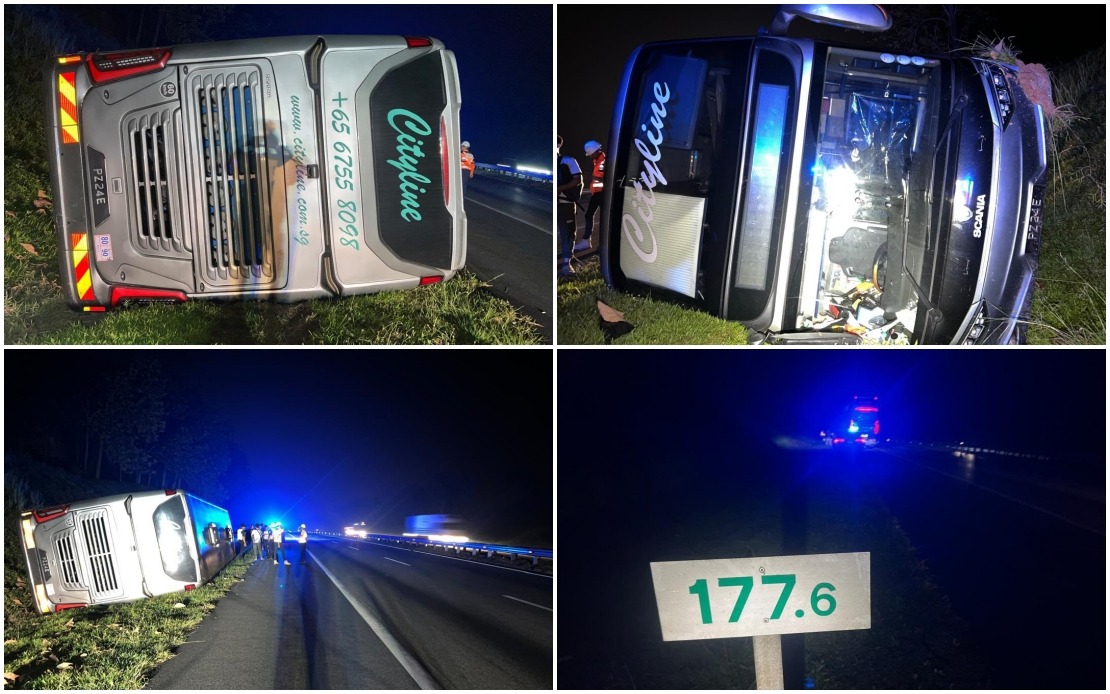
A tour bus operating between Singapore and Kuala Lumpur veered off the left side of the North-South Expressway and overturned at Kilometre 177.6 near Jasin on Tuesday morning, resulting in injuries to three passengers. The incident, which occurred at approximately 5 am, involved a vehicle carrying 12 occupants including the driver and tour guide. Jasin district police chief Supt Lee Robert provided details of the accident, which has renewed concerns about road safety on Malaysia's busy expressway network.
The three injured parties comprised passengers of varying nationalities and ages, reflecting the diverse clientele of cross-border tour operations in Southeast Asia. A 59-year-old Malaysian tour guide sustained injuries, along with a 62-year-old Singaporean passenger and a 42-year-old British national. All three victims reported head and leg injuries and were transported to Jasin Hospital for immediate medical attention. The nationality composition of the injured passengers underscores the regional nature of tourism traffic on major Malaysian highways, with Singapore-Kuala Lumpur routes serving as vital commercial and leisure corridors.
According to Supt Lee Robert's investigation, the accident unfolded when the tour bus encountered slowing traffic ahead. A lorry travelling in front of the bus had reduced speed, prompting the bus driver to take evasive action to prevent a collision. In attempting to avoid the vehicle ahead, the driver steered the bus to the left, causing it to veer off the roadway. The loss of control resulted in the bus overturning, a sequence of events that highlights the hazards faced by drivers making split-second decisions on high-speed expressways where reaction times and road conditions interact in unpredictable ways.
The North-South Expressway remains one of Malaysia's most critical transportation arteries, connecting Johor Bahru with the Klang Valley and beyond. The Jasin segment in Melaka state carries considerable traffic volume, particularly during peak hours and when cross-border movement between Malaysia and Singapore intensifies. Incidents of this nature raise questions about traffic flow management, vehicle spacing compliance, and the adequacy of safety margins maintained by commercial vehicles operating at expressway speeds.
Tour bus operations constitute a significant component of the region's travel and hospitality sector, facilitating movement between major urban centres and tourist destinations. The Singapore-Kuala Lumpur route in particular handles thousands of passengers monthly, encompassing tourists, business travellers, and regional visitors. Safety protocols for commercial passenger vehicles operating on expressways are therefore consequential not only for individual travellers but for the broader tourism economy and cross-border mobility that characterises Southeast Asian travel patterns.
The immediate response from police and emergency services reflected established procedures for expressway incidents. Officers attended the scene and coordinated victim transportation to the nearest medical facility, while initiating the investigation that documented the circumstances leading to the rollover. The gathering of eyewitness accounts and examination of the accident site form part of the standard protocol that guides subsequent safety recommendations and enforcement actions.
Expressway rollovers involving commercial vehicles warrant particular scrutiny given their potential severity. The confined quarters of a tour bus, combined with the forces generated during an overturning incident, create hazardous conditions for occupants. That only three passengers sustained injuries in this instance may reflect both the relatively moderate speed at which the evasive manoeuvre occurred and the protective features of modern vehicles, though comprehensive injury assessments would be pending at the time of reporting.
The causes identified—a following vehicle's sudden deceleration and the resulting need for rapid avoidance—point to systemic factors affecting expressway safety. Adequate spacing between vehicles, particularly larger commercial units, remains essential for preserving the safety margins necessary for emergency manoeuvres. Driver fatigue, vehicle maintenance standards, and compliance with speed restrictions also form part of the complex equation determining accident risk on high-speed corridors.
For tour operators and the broader commercial transport sector, incidents of this type prompt reviews of operational practices, driver training protocols, and vehicle specifications. Companies operating cross-border routes must balance schedule efficiency with safety imperatives, a tension that becomes acute when traffic conditions demand rapid decision-making. The investigation findings will likely inform discussions among industry stakeholders regarding best practices and safety enhancement measures.
The accident also underscores vulnerabilities that regional travellers face when utilising commercial transport across borders. International passengers, particularly those less familiar with local driving conditions and road patterns, depend on professional operators to maintain safety standards. The incident will likely feature in ongoing conversations among tourism boards and transport regulators about passenger safety and the reliability of major transit corridors serving the region.

