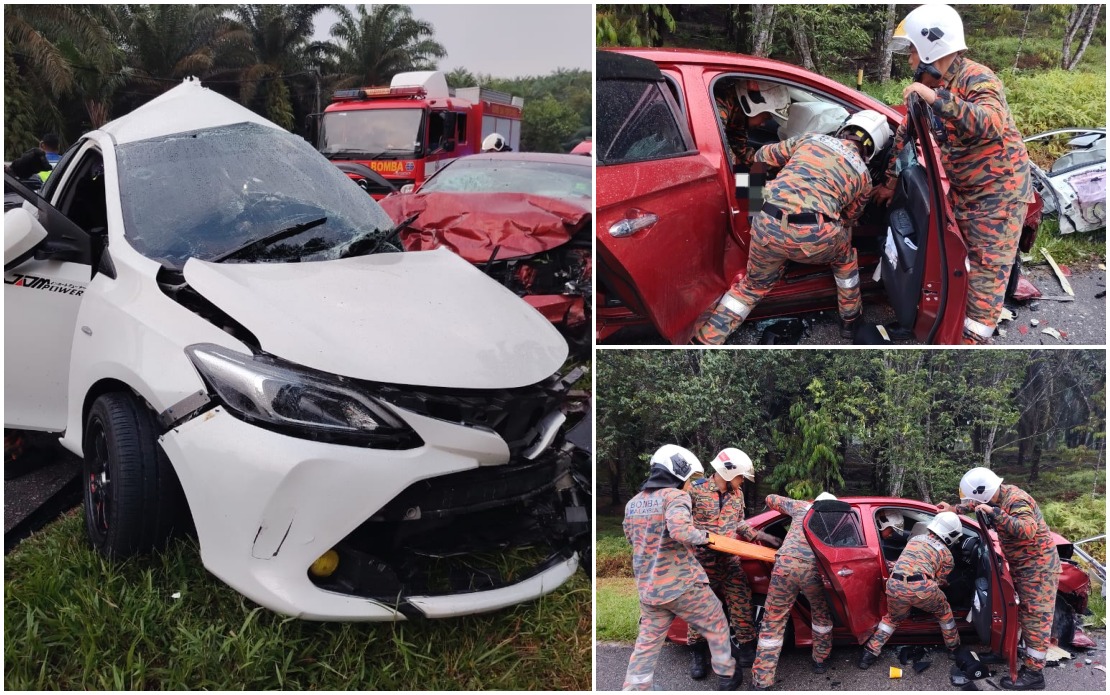
A fatal collision on a Johor highway claimed three lives on Sunday afternoon when two vehicles crashed near a petrol station in Tanjung Leman, a residential area along Jalan Jemaluang in Kota Tinggi district. The incident highlights the continuing toll of serious road accidents across Malaysia's major thoroughfares, particularly in busy commercial corridors linking urban and rural communities.
Fire and Rescue operations personnel reached the scene at approximately 5.10 pm, roughly five minutes after emergency services received notification of the crash. The incident location lay approximately 45 kilometres from the nearest fire station, underscoring the logistical challenges emergency responders face when attending accidents in semi-urban areas. A contingent of eight firefighters mobilised to conduct rescue operations and manage victim recovery.
Upon arrival, rescue teams discovered a collision between a Honda City and a Toyota Vios, two popular compact sedan models commonly seen throughout Malaysia's transportation landscape. The crash proved fatal for all three occupants involved: a 21-year-old man and 20-year-old woman travelling in the Honda City, alongside a 31-year-old man in the Toyota Vios. Medical personnel from the Health Ministry pronounced all three deceased at the scene, eliminating the possibility of surviving the collision's impact.
Emergency personnel faced the challenging task of extracting trapped victims from the wreckage. Firefighters employed hydraulic rescue cutters to access victims within the crushed vehicles, a procedure requiring considerable time and technical expertise. Once extraction concluded, teams transported the deceased to waiting ambulances using standard stretchers before relinquishing custody to police authorities for the formal documentation and investigation process.
Operations commander Senior Fire Officer II Azlan Hamzah oversaw the emergency response. In his official statement, he confirmed the sequence of events and confirmed the operation concluded at 6.59 pm, indicating roughly two hours elapsed from initial notification to operation conclusion. The extended timeframe reflects the complexity inherent in managing multiple fatalities and conducting comprehensive scene recovery in a two-vehicle incident.
Kota Tinggi district police assumed investigative authority following the handover of victims and scene documentation. Superintendent Othman, the district police chief, acknowledged the ongoing nature of the inquiry in a separate statement issued Monday. Police typically examine factors including vehicle maintenance records, driver behaviour preceding impact, weather conditions, visibility, road surface conditions, and potential mechanical failure when determining causation in fatal accidents.
This collision contributes to an unsettling pattern of serious vehicle accidents along Malaysia's network of main roads and highways. The fatality rate in Malaysia consistently ranks among Southeast Asia's highest, with two-vehicle crashes at particular risk of severity given the limited ability for collision avoidance and the concentration of kinetic energy released upon impact. Young adults aged between 20 and 31 years—the age range of these victims—comprise a disproportionately large demographic in fatal Malaysian road accidents.
The intersection of commercial activity and through-traffic near petrol stations, rest areas, and similar roadside facilities creates friction points where accident risk escalates. Drivers may become distracted by approaching service facilities, undergo sudden lane changes, or exhibit fatigue after extended driving periods. The proximity of such amenities can paradoxically increase danger rather than provide safety, particularly during afternoon and early evening hours when traffic volumes build toward evening congestion patterns.
Vehicle safety features in both the Honda City and Toyota Vios include modern airbag systems and reinforced cabin structures designed to protect occupants during moderate-speed impacts. The severity of this particular collision—resulting in immediate fatalities for all three people involved—suggests either very high-speed impact, multiple sequential collisions, or impact geometry that concentrated forces on occupant compartments despite engineering safeguards. Forensic examination of wreckage patterns typically provides investigators with crucial velocity and angle-of-impact information.
Police will likely request witness statements from petrol station staff, nearby motorists, or other individuals at the scene. Vehicle data recorders, increasingly common in modern vehicles, may retain information about speed, braking application, and acceleration profiles immediately preceding impact. Traffic camera footage from nearby commercial establishments might capture the moments leading to collision, assisting investigators in reconstructing the sequence of events.
The investigation's progression will determine whether contributory factors include mechanical defects, driver impairment, weather-related reduced visibility, or violations of traffic regulations. Preliminary findings typically emerge within weeks, though comprehensive accident reconstruction analysis may require several months. Such investigations inform road safety policy discussions at state and federal levels, potentially leading to infrastructure modifications, enforcement emphasis adjustments, or public awareness campaigns targeting high-risk behaviours.
For Malaysian road safety advocates, incidents such as this underscore the critical importance of sustained investment in emergency response capabilities, particularly in semi-urban areas where fire stations serve dispersed populations across extensive geographic areas. Enhanced driver education programmes targeting young adults, stricter enforcement of speed regulations near commercial zones, and improved road design at high-risk locations collectively contribute to accident prevention strategies.

