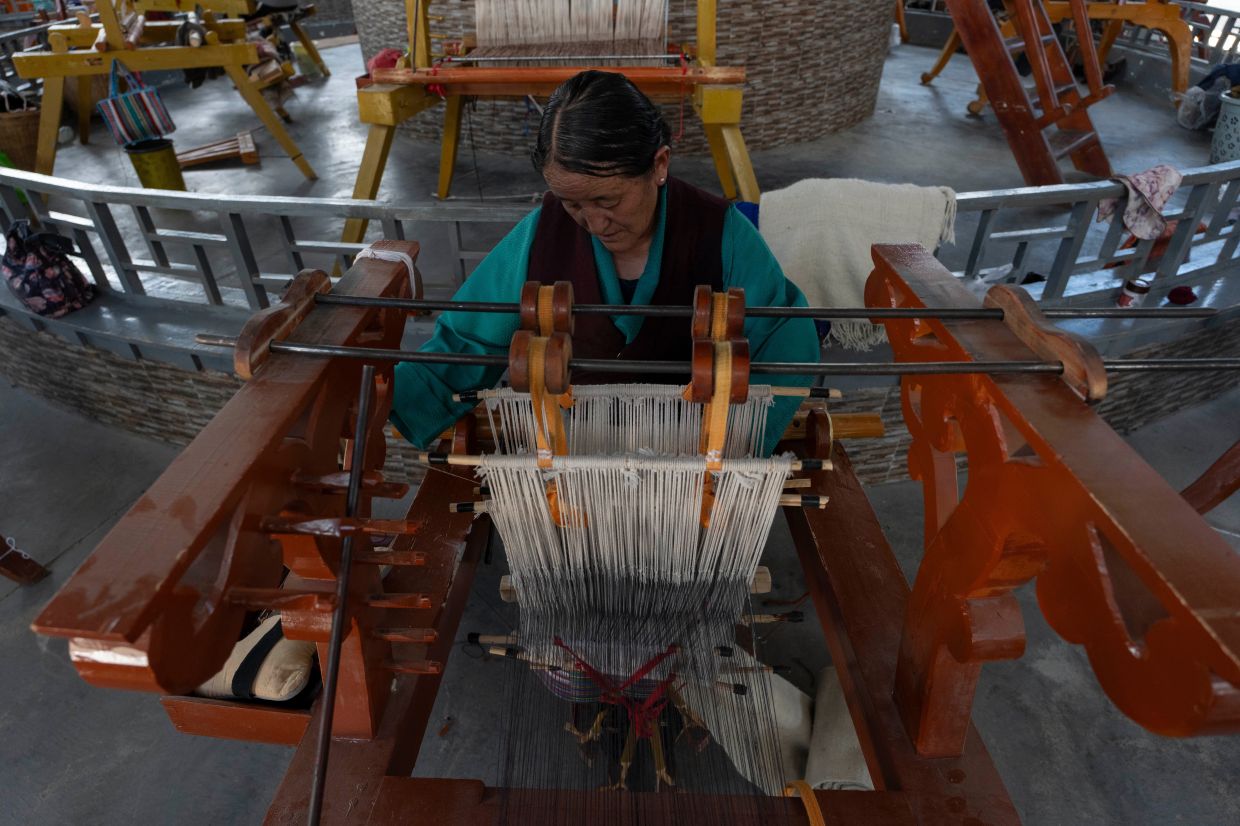
In the high-altitude town of Shannan, where the air grows thin at 3,700 meters above sea level, a group of weavers continues a craft that has sustained Tibetan communities for more than a thousand years. Inside the Ethnic Huaji Handwoven Cooperative, dozens of artisans work methodically at wooden looms, their hands moving in practiced rhythm as they thread shuttles through rows of wool yarn, creating Pulu—the distinctive woolen fabric that has protected inhabitants of the Tibetan plateau from harsh mountain weather since ancient times. This seemingly humble workshop represents something far more significant than simple textile production: it is a bulwark against cultural erosion and a lifeline for a community seeking meaningful employment in a remote region.
The cooperative was established in 2008 by Pasang, a dedicated Tibetan artisan who recognized that a living tradition was vanishing. When he began learning the craft from his parents, fewer than ten people across the entire region still possessed the knowledge to weave Zeter, the finest and most delicate variant of Pulu. This premium variety, crafted from the exceptionally soft wool harvested from the necks and backs of mountain sheep, demands a level of skill and patience that has become increasingly rare. Rather than allow this expertise to disappear entirely, Pasang transformed his family knowledge into an institutional structure capable of employing and training new generations of weavers. Today, the cooperative provides work for more than 100 local residents, including individuals with disabilities who might otherwise face severe employment barriers in this economically challenging region.
What distinguishes Zeter from ordinary Pulu is not merely aesthetic but rooted in the material properties of the wool itself. The finer fibers require more delicate spinning techniques, and the resulting fabric possesses a lightness and suppleness that made it historically valuable enough to present as imperial tribute. According to documented history, Zeter held such prestige during the Ming dynasty that it was offered as a gift from Tibet to the Chinese imperial court, testament to its quality and cultural significance. This historical pedigree has not been forgotten; the cooperative has secured recognition of its craft as part of China's national intangible cultural heritage, providing both cultural validation and potential market advantages for its products.
The workshop itself carries symbolic weight beyond its economic function. At its center stand statues of Tibet's 7th century King Songtsen Gampo and Princess Wencheng, his Chinese bride, representing a crucial chapter in Tibetan cultural history. According to local tradition, the princess introduced advanced weaving techniques to Tibet upon her marriage, seeding the textile traditions that persisted through centuries of isolation and social change. This narrative, whether historically precise or culturally constructed, emphasizes how Zeter weaving represents a synthesis of different cultural influences that created something distinctly Tibetan. For Pasang and his artisans, this history infuses their daily work with meaning beyond economic necessity—they see themselves as custodians of cultural integration and artistic heritage.
The economic sustainability of the cooperative extends beyond the looms themselves. The cooperative operates a small but strategically important showroom where scarves, shawls, jackets, bags, and other finished products appeal to both traditional consumers and contemporary markets. While most sales currently occur within Tibet itself, the cooperative has begun reaching customers throughout mainland China, suggesting growth potential as Tibetan handicrafts gain prominence in Chinese consumer consciousness. This market expansion represents a delicate balance—the cooperative must preserve authenticity and craftsmanship while adapting to modern commercial expectations.
The human dimension of the cooperative reveals its genuine social impact. Tsering Yangchen, an 80-year-old weaver who has worked at the cooperative for seven years, embodies the transformative potential of this initiative. She relocated from another county searching for employment but encountered severe difficulties in the local job market until joining the workshop, where patient instructors taught her and dozens of others the complex skill of weaving. For someone her age, in a remote region with limited economic opportunities, the cooperative provided not merely income but renewed social purpose and community integration. Tsering's perspective transcends commercial calculation—she speaks of Pulu as something woven from pure wool that communities typically wear themselves, emphasizing the cultural embeddedness of this craft rather than treating it as merely a commercial commodity.
For Southeast Asian observers, the Ethnic Huaji Handwoven Cooperative offers instructive lessons about cultural preservation in contexts of economic pressure and modernization. Many ASEAN nations face similar challenges: traditional crafts and indigenous knowledge systems confront displacement by industrial production and globalized consumer culture. The Tibetan model—combining cooperative enterprise structures with cultural heritage recognition and job creation—demonstrates that cultural preservation need not remain confined to museums or academic study but can generate sustainable livelihoods. This integration of cultural conservation with economic development addresses a persistent tension in developing regions where communities often face false choices between material welfare and cultural survival.
The recognition of Zeter weaving as national intangible cultural heritage carries implications extending beyond ceremonial acknowledgment. Such designation can attract government support, facilitate marketing, and provide legitimacy when younger Tibetans consider whether to pursue traditional crafts or pursue alternative economic strategies. For Pasang, this recognition validates his conviction that younger generations should continue practicing a craft he feared was disappearing. The challenge remains substantial, however, as globalization and education systems increasingly orient young people toward urban employment and modern professions rather than traditional handicrafts. The cooperative's success in training younger artisans will ultimately determine whether Zeter weaving survives another generation or becomes historical artifact rather than living practice.
The broader context reveals how remote communities can leverage distinctive cultural resources to build resilient economies less dependent on external capital flows or industrial investment. The Ethnic Huaji Handwoven Cooperative demonstrates that authentic craftsmanship, grounded in specific places and cultural histories, possesses economic value in contemporary markets increasingly saturated with mass production. As consumers throughout China and potentially beyond develop stronger interest in cultural authenticity and heritage products, Tibetan weavers producing Pulu and Zeter occupy a strategically advantageous position. This advantage, however, remains contingent on maintaining quality standards, preserving traditional techniques, and avoiding the pitfalls of commercialization that can undermine the cultural integrity that makes these products valuable in the first place.

