Malaysia's political leadership has underscored the significance of this year's Tokoh Maal Hijrah awards, framing the recognition as a catalyst for broader national reflection on Islamic values and public service. Deputy Prime Minister Datuk Seri Dr Ahmad Zahid Hamidi and Deputy Prime Minister Datuk Seri Fadillah Yusof both used the occasion to emphasise how individual achievement in advancing Islamic knowledge and community welfare should inspire the wider population to pursue similar paths of contribution and dedication.
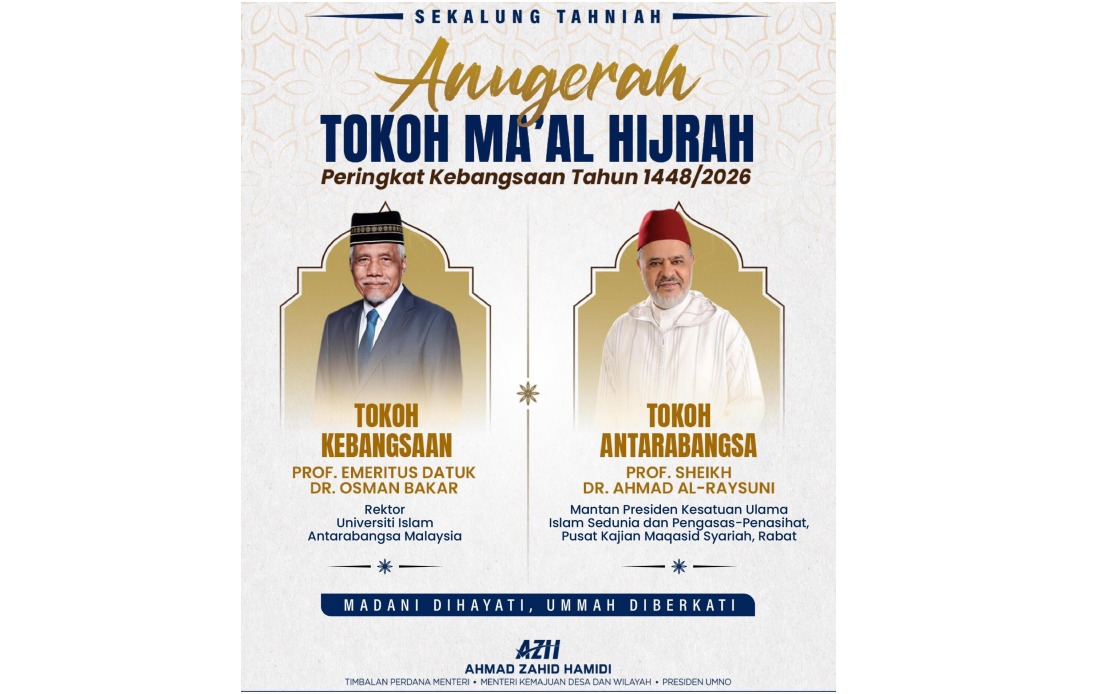
The awards, presented at the national Maal Hijrah celebration held at Masjid Putra in Putrajaya, recognised two distinguished figures for their work in strengthening Islamic scholarship and societal development. Prof Emeritus Datuk Dr Osman Bakar was named recipient of the National Tokoh Maal Hijrah Award, whilst Prof Sheikh Dr Ahmad Al-Raysuni, an Islamic jurisprudence specialist from Morocco, received the International variant. Sultan Nazrin Shah, the Sultan of Perak, conferred the honours, presenting each recipient with cash prizes, trophies and certificates of appreciation in recognition of their accomplishments.
Ahmad Zahid characterised the awards as reflecting tangible evidence of the laureates' impact on Muslim communities across various domains. He highlighted their role in empowering believers, elevating intellectual discourse within Islamic circles, and disseminating religious teachings that embody core Islamic principles of compassion, practical wisdom and societal benefit. His remarks positioned the awards not merely as ceremonial recognitions of past achievement but as markers of exemplary conduct that should resonate with the broader Muslim population in Malaysia.
The Deputy Prime Minister called upon Malaysian Muslims to channel inspiration from these recipients into sustained engagement with knowledge acquisition, community service and contributions toward the wellbeing of the ummah, the nation state and Islamic civilisation more broadly. This framing suggests an understanding that individual excellence in Islamic scholarship and social contribution represents a shared responsibility extending across society rather than remaining confined to elite academic or religious circles.
Fadillah Yusof similarly championed the awards as motivational touchstones for all Malaysians, emphasising their relevance beyond the Muslim community. His interpretation centred on how the recipients embody values that transcend religious boundaries—principally the commitment to serving others and advancing national interests through sustained dedication and high ethical standards. By directing his congratulations toward all Malaysians rather than Muslims exclusively, Fadillah suggested the award recipients' contributions carry significance for the nation's broader development trajectory.
Crucially, Fadillah recontextualised the Islamic concept of hijrah—the Prophet Muhammad's migration from Mecca to Medina—as a governing principle extending far beyond its historical specificity. Rather than treating hijrah as a singular religious event, he positioned it as an enduring philosophical framework that enshrines sacrifice, communal cohesion, perseverance and commitment to constructive transformation. This reframing allows contemporary Malaysian society to draw practical lessons from Islamic historical experience and apply them to modern governance and nation-building challenges.
The Deputy Prime Minister explicitly connected hijrah's spiritual and moral dimensions to the practical project of building a prosperous, progressive society anchored in shared values. His emphasis on developing a values-based nation indicates official recognition that economic growth and technological advancement, whilst important, require grounding in ethical foundations and collective commitment to social wellbeing. This perspective aligns with broader Southeast Asian conversations about balancing development imperatives with preservation of cultural and spiritual identity.
Both officials framed the awards within a context of national aspiration and collective responsibility. Their statements moved beyond perfunctory congratulations to position the recipients as exemplars of the qualities Malaysia requires as it navigates contemporary challenges. The emphasis on knowledge-seeking, community engagement and ummah consciousness reflects official priorities regarding how Islamic values should shape public discourse and individual conduct within a Muslim-majority but multi-religious nation state.
Osman Bakar's prominence in Malaysian Islamic intellectual circles makes his recognition particularly significant domestically. His scholarly work on Islam and science, philosophy and interfaith dialogue has contributed substantially to conversations about Islam's compatibility with modernity and pluralism—debates central to Malaysia's identity as a Muslim nation balancing development aspirations with religious commitment. Ahmad Al-Raysuni's Moroccan background and international standing indicate Malaysia's engagement with broader Islamic intellectual networks and recognition that Islamic scholarship transcends national boundaries.
The timing of the awards during Malaysia's Maal Hijrah celebration cycle positions them within annual rituals of religious reflection and national recommitment to Islamic values. This institutional embedding suggests the awards function as mechanisms through which state authorities reinforce particular narratives about Islam's role in society and the qualities government seeks to cultivate among the Muslim population and society broadly. The awards thus serve functions extending beyond individual recognition to encompass nation-building objectives and value formation.
For Malaysian observers and Southeast Asian analysts, the awards highlight ongoing efforts by Malaysia's leadership to demonstrate that Islamic faith and modern governance, scholarship and social development, spiritual commitment and national progress need not exist in tension. The recognition of individuals who have contributed substantially across these domains suggests official vision of Islam as a generative force for positive social transformation rather than a constraint upon development or modernity.