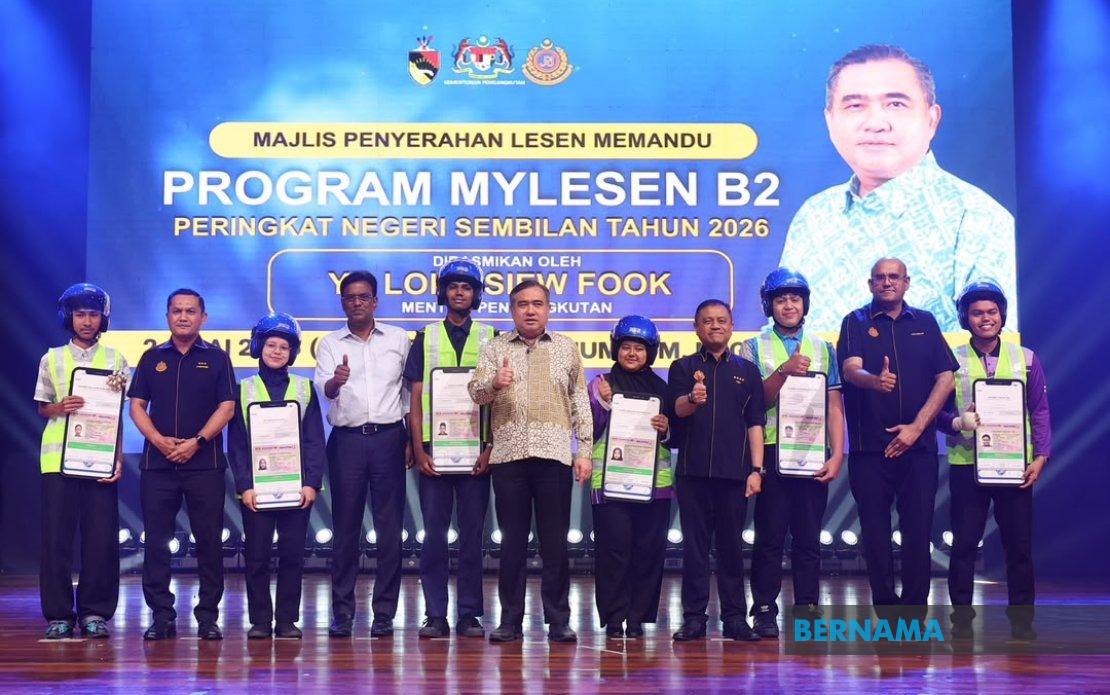
Transport Minister Anthony Loke has delivered a pointed message to young motorcyclists receiving licences through the MyLesen B2 Programme: the certificate in their hands represents a legal responsibility to ride prudently, not a licence to engage in reckless behaviour on Malaysian roads. Speaking during a ceremony in Seremban where Negeri Sembilan participants received their driving licences, Loke stressed that the government's investment in providing free motorcycle credentials comes with an implicit social contract requiring riders to prioritise safety and lawful conduct.
The urgency behind the minister's admonition reflects a sobering reality about road trauma in Malaysia. Approximately 60 per cent of annual road fatalities involve motorcyclists and pillion riders, with the majority of victims under the age of 30. This demographic pattern underscores why the Transport Ministry has chosen to focus its safety messaging directly at younger licence holders, who statistically face the highest risk on Malaysian highways and urban streets. The concentration of deaths among this age group suggests that inexperience, overconfidence, and susceptibility to peer pressure all play roles in fatal accidents involving two-wheelers.
Loke explicitly addressed what he characterised as misconceptions about weekend recreational riding, warning young motorcyclists that leisure time should not become an opportunity for illegal street racing or speed testing. The minister's remarks acknowledge a persistent subculture of illegal racing in Malaysian cities and towns, where unregulated groups organise impromptu competitions on public roads, endangering themselves and other road users. By framing such activities as incompatible with the privileges granted through MyLesen B2, Loke positioned responsible riding as the price of accessing the scheme's benefits.
The MyLesen B2 Programme itself represents a significant government initiative designed to democratise motorcycle licensing in Malaysia. Since its inception in 2023, the scheme has enabled more than 100,000 Malaysians to obtain legal riding credentials at no financial cost, removing a traditional barrier to mobility for lower-income Malaysians. In Negeri Sembilan specifically, participation has surged dramatically, with the 2024 quota nearly doubling to 2,300 participants from 1,000 the previous year. To date, nearly 1,880 Negeri Sembilan participants have completed training and passed competency assessments to receive their Probationary Driving Licence, demonstrating substantial uptake across the state.
Beyond its immediate road safety objectives, the MyLesen B2 Programme operates as a social mobility instrument. By providing legal access to motorcycle transport, the scheme enables young Malaysians to commute to educational institutions and employment opportunities that might otherwise remain geographically inaccessible. For individuals in rural or semi-urban areas where public transport infrastructure remains limited, motorcycle ownership represents a practical gateway to economic participation and educational advancement. The government frames this accessibility as essential to reducing socio-economic disparities and fostering inclusive development across Malaysian communities.
Loke's comments arrive amid evolving legislative efforts to strengthen road safety enforcement mechanisms. The Dewan Rakyat recently passed the Road Transport (Amendment) Bill 2026, which significantly escalates penalties for illegal racing and speed testing across all vehicle categories. Under the new legislative framework, individuals apprehended by the Road Transport Department or police for engaging in illegal racing will face not merely financial penalties but potential imprisonment, positioning such conduct as a serious criminal offence rather than a minor traffic violation. This legislative escalation signals the government's determination to dismantle the infrastructure supporting street racing culture in Malaysia.
The Transport Ministry's approach reflects a multi-layered strategy combining education, infrastructure development, and enforcement. While the MyLesen B2 Programme addresses access and opportunity, regulatory amendments target the behavioural extremes that endanger riders and the broader motoring public. Simultaneously, safety messaging directs young licence holders toward prosocial interpretations of their privileges. This integrated approach acknowledges that road safety emerges from interaction between opportunity structures, legal frameworks, and individual decision-making.
Present at the Seremban ceremony were senior Transport Ministry and Road Transport Department officials, including Secretary-General Datuk Seri Jana Santhiran Muniyan, JPJ Director-General Datuk Aedy Fadly Ramli, and JPJ Deputy Director-General (Planning and Operations) Datuk Jazmanie Shafawi. Their attendance underscored the importance attached to the MyLesen B2 initiative within government hierarchies and signalled institutional commitment to the programme's expansion and refinement.
Loke also emphasised the importance of protective equipment compliance, specifically urging all new licence holders to wear SIRIM-certified helmets whenever riding or travelling as pillion passengers. This safety requirement reflects evidence demonstrating that proper helmet use substantially reduces injury severity and fatality risk in motorcycle accidents. By coupling licensing privileges with protective equipment mandates, the Transport Ministry articulates a comprehensive safety framework encompassing both rider behaviour and material safeguards.
For Malaysian parents and educators, the minister's message carries implicit guidance about youth engagement with motorcycle culture. Rather than viewing motorcycle ownership as inherently problematic, Loke's framing suggests that supervised, regulated, and safety-conscious riding represents a legitimate form of mobility for young Malaysians. The challenge lies in channelling youthful enthusiasm for motorcycles toward lawful and prudent use rather than attempting prohibition, which research suggests proves ineffective in discouraging illegal street racing.
The expansion of MyLesen B2 across states suggests that similar ceremonies and ministerial addresses will continue throughout Malaysia as more young people enter the motorcycle-riding population. Each such occasion presents an opportunity to reinforce safety messaging and embed responsible conduct norms within cohorts of new riders. Over time, consistent messaging from government officials may influence cultural perceptions of motorcycle ownership, shifting attitudes away from racing and recklessness toward viewing motorcycles primarily as practical transportation tools deserving careful, lawful operation.

