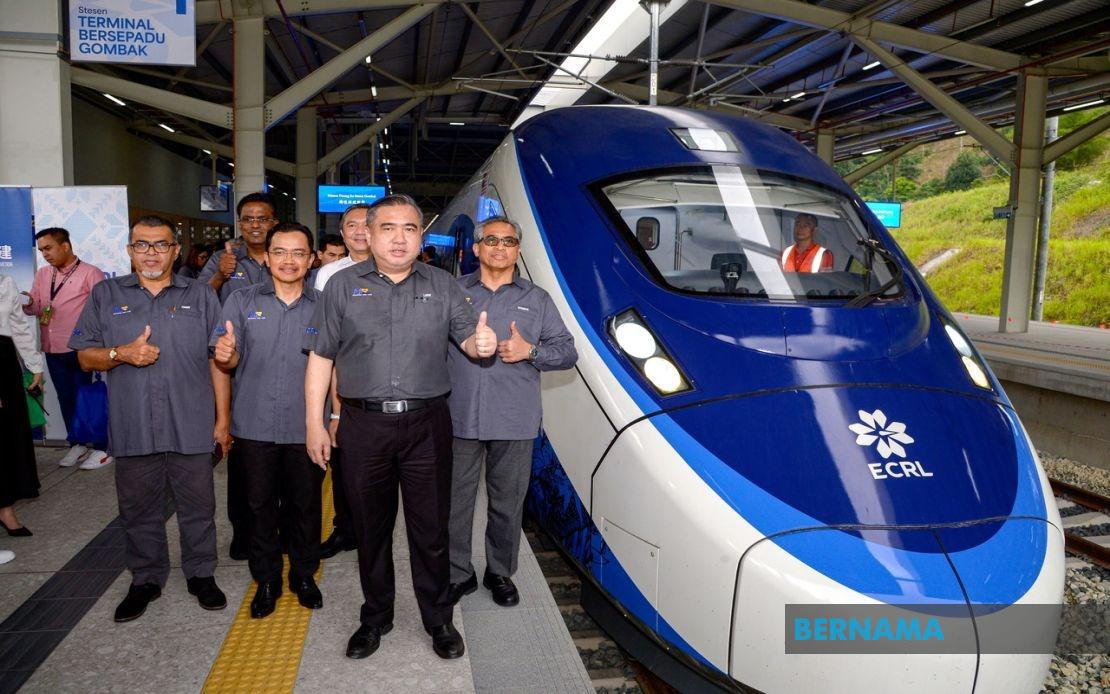
Transport Minister Anthony Loke Siew Fook has set an accelerated target of December for the East Coast Rail Link Phase 1 to commence operations between Kota Bharu and Gombak, representing a significant compression of the original January 2027 timeline announced for this major infrastructure corridor connecting Kelantan and Selangor.
The ambitious acceleration hinges critically on the successful completion of rigorous testing protocols currently underway, particularly the System Integration Testing and Fault-Free Run phases. Loke emphasised during an event at Gombak Integrated Terminal Station that this expedited schedule does not involve any relaxation of safety standards, a reassurance likely aimed at public concerns given the high-profile nature of the project and its regional significance as a flagship belt-and-road infrastructure initiative.
Malaysia Rail Link Sdn Bhd and the primary contractor China Communications Construction Company Ltd face the responsibility of maintaining momentum through these critical validation stages. The minister indicated that the Land Public Transport Agency will explore mechanisms to streamline certification processes that typically consume two to three months, potentially compressing this timeframe without sacrificing the integrity of safety assessments. This coordination between government agencies reflects the political priority attached to delivering the project on an accelerated timeline.
The System Integration Testing commenced this month will validate the interconnection of critical systems including electrical infrastructure and signalling mechanisms. Following this phase, the Fault-Free Run is scheduled for September, during which the first train set and E-Loco will traverse 8,000 kilometres under regulatory supervision to confirm that operational safety and reliability meet established international and domestic standards. This comprehensive validation process occurs before any commercial passenger service begins.
Loke acknowledged the inherent tension between acceleration and safety verification, stating that all preliminary testing conducted at manufacturing facilities in China provides confidence in the train's readiness. He underscored that no shortcuts in safety protocols would occur regardless of schedule pressures, using personal language to convey commitment: "We are more afraid than you. I am more afraid than you if there is a risk."
The broader ECRL project has achieved 95.08 per cent completion for Phase 1 as of July, suggesting that the December target remains technically feasible if testing proceeds without significant complications. Phase 2, extending from Gombak to Port Klang, operates on a separate timeline with December 2027 completion targeted and January 2028 operational commencement planned, indicating a staggered commercial rollout across the corridor.
For Malaysian observers and regional stakeholders, the December timeline carries substantial implications. The ECRL represents a transformational transport investment for the East Coast, offering direct rail connectivity that could reshape logistics networks and passenger mobility patterns across Peninsular Malaysia. Expedited commencement would allow the government to demonstrate project delivery capability and potentially unlock economic benefits sooner than previously anticipated, particularly for Kelantan's industrial and commercial sectors.
The presence of senior government officials, including Chief Secretary Tan Sri Shamsul Azri Abu Bakar and Chinese Ambassador Ouyang Yujing, underscores the bilateral importance of the project and the diplomatic dimensions of infrastructure cooperation. For Malaysia-China relations, timely delivery of flagship projects strengthens broader strategic partnerships and validates confidence in joint development initiatives.
The Comprehensive Inspection Train launch and System Integration Testing commencement mark tangible progress indicators that will likely feature prominently in government communications regarding project advancement. However, the December target depends substantially on no major technical issues emerging during testing phases—a scenario that remains inherently uncertain despite pre-export factory testing in China.
For regional rail operators and transport planners across Southeast Asia observing the ECRL's trajectory, successful acceleration would demonstrate that large-scale infrastructure projects involving Chinese contractors can achieve operational timelines competitive with international standards. Conversely, any delays would reinforce narratives about implementation challenges in complex cross-border projects.
The ministry's emphasis on APAD's facilitation role reflects recognition that bureaucratic processes can become bottlenecks in infrastructure deployment. By proactively identifying certification timelines as potential constraints and seeking streamlining opportunities, Malaysian authorities are attempting to prevent regulatory procedures from becoming obstacles to the December launch target.
Beyond the immediate ECRL context, this acceleration effort signals the government's commitment to infrastructure-led development and transport modernisation. For commuters and businesses in corridors between Kota Bharu and Gombak, successful December commencement would deliver service years earlier than historically expected, potentially reshaping travel patterns and logistics economics across the region.

