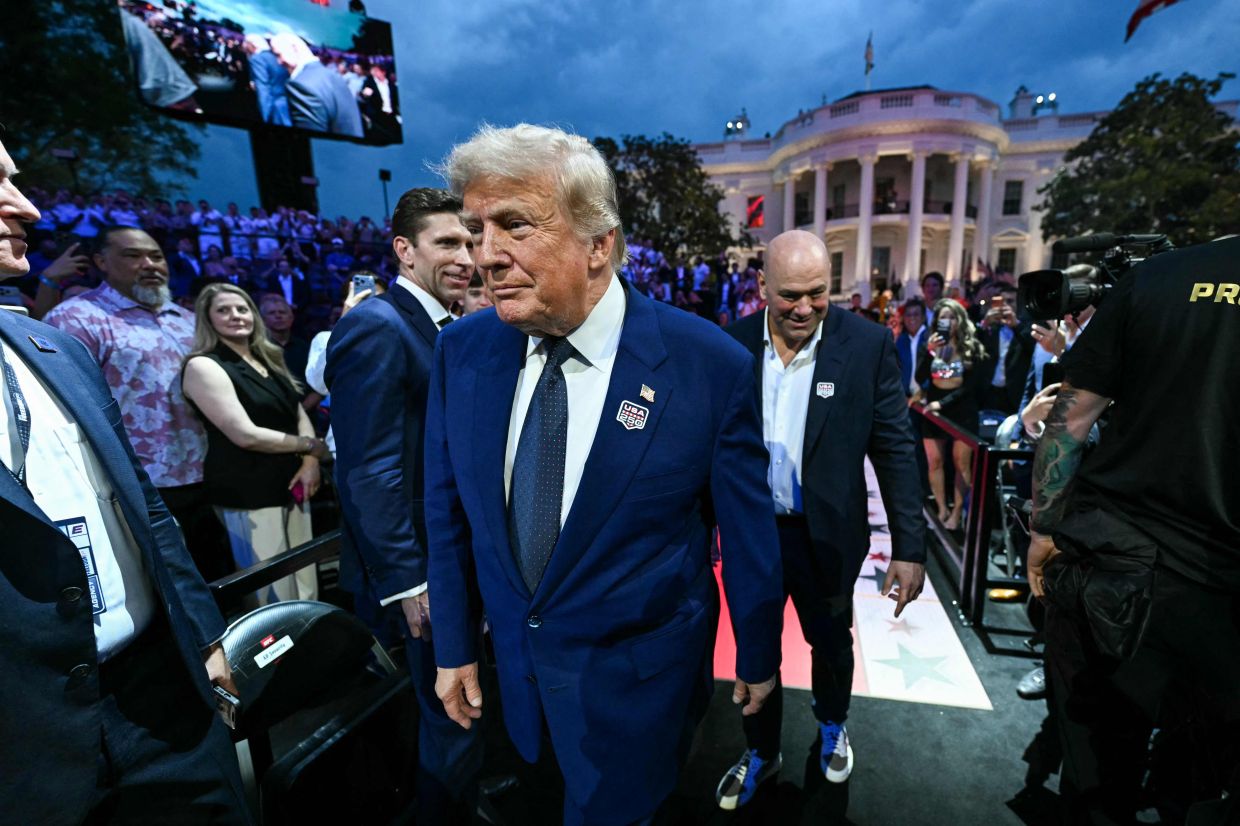
Donald Trump rang in his 80th birthday with a high-octane sporting spectacle that transformed the White House South Lawn into a battle arena, hosting the Ultimate Fighting Championship on Sunday evening before departing for France to meet with Group of Seven leaders. The unprecedented event, organised in partnership with TKO Group Holdings Inc. and presided over by UFC President Dana White, marked a striking departure from the traditional ceremonial functions typically hosted at the presidential residence, signalling Trump's willingness to blur the lines between political theatrics and entertainment in ways that challenge historical precedent.
The fights commenced just before 8:30pm, with Trump and White entering through the White House corridors to reach the arena, an arrangement that underscored the intimate connection between the president and the sporting franchise. Weather complications threatened to derail the evening, as lightning and thunder swept across Washington, D.C., forcing organisers to delay proceedings slightly as they waited for conditions to stabilise. The centerpiece of the operation was a nearly 100-foot-tall structure known as the Claw, which exceeded the White House itself in height and housed seven cage matches, with seating for 4,300 spectators on the South Lawn itself, while an additional 120,000 people were expected to gather at the Ellipse nearby through a lottery system distributing complimentary tickets.
The guest list reflected Trump's influence across tech, finance, and entertainment spheres. Mark Zuckerberg, chief executive of Meta Platforms Inc., David Ellison, who leads Paramount Skydance Corp., and Treasury Secretary Scott Bessent were among those in attendance, alongside members of Trump's family. Joe Rogan, the podcast host whose influence among young male voters proved instrumental in Trump's 2024 election success, provided live commentary throughout the matches. The administration also arranged for military personnel and Medal of Honor recipients to participate, with servicemembers from bases worldwide, including Okinawa, Japan, watching the proceedings through organised viewing parties, thereby extending the event's symbolic reach across the global military apparatus.
The celebration was framed as part of a larger commemoration of the United States' 250th anniversary, incorporating elements that ranged from commemorative gold coins bearing Trump's likeness to a planned IndyCar race through Washington's streets in August. However, the event also represented something more strategically significant: a deliberate cultivation of the UFC's core demographic, which skews heavily toward young men who formed a crucial voting bloc in Trump's electoral coalition. The administration had already begun formalising this alignment, with the State Department and Federal Bureau of Investigation signing partnership deals with the company, suggesting that the relationship extends beyond entertainment into institutional channels.
Despite the star-studded attendance and significant logistical investment, the event proved deeply polarising among the American public. A YouGov poll released on June 5 found that 51 percent of Americans surveyed disapproved of the White House fight, while only 27 percent expressed approval, revealing a substantial gap between the enthusiasm of Trump's base and broader public sentiment. A lawsuit filed by the Public Integrity Project attacked the event as a "volcano of corruption," reflecting concerns about the appropriate use of presidential resources and the messaging conveyed by hosting combat sports at the nation's most iconic residence.
The financial dimensions of the spectacle were substantial. UFC expended more than US$60 million to stage the event, with the White House confirming that the organisation covered all costs and handled sponsorship arrangements. More than seven federal agencies allocated what court filings described as "significant resources and manpower" to the operation, a commitment that raised questions about government resource allocation. Corporate partners lined up to associate with the event, including Crypto.com and Dodge's Ram truck brand, both listed on the UFC Freedom 250 website. Additionally, World Liberty Financial, a Trump family venture, provided a supplementary US$250,000 bonus to the top two fighters, further intertwining the president's commercial interests with the spectacle.
The symbolic geography of the event reinforced its significance as a cultural statement. The news conference preceding the fights was held at the Lincoln Memorial, one of Washington's most historically resonant sites, where fighters engaged in the traditional trash-talking and victory predictions associated with combat sports. Michael Chandler articulated the event's patriotic dimension, suggesting that his performance on the White House lawn would showcase the best of himself in service of America's 250th anniversary. The use of historically significant White House spaces for practical purposes, including the Indian Treaty Room for locker rooms normally reserved for official ceremonies, underscored how thoroughly the event penetrated the institution's traditional operations.
The physical transformation of the South Lawn itself prompted broader questions about precedent and permanence. Trump suggested, at least partly in jest, that the Claw might remain in place indefinitely, comparing it favourably to the Eiffel Tower in Paris and noting its aesthetic appeal. However, the administration later clarified that dismantling would commence at 10am Monday, with Trump already en route to France bearing a UFC championship belt as a souvenir. This sequence—celebrating the sport at the White House, then taking the championship belt to international diplomatic meetings—seemed designed to project an image of American power and unconventionality to international audiences.
The event illustrated how thoroughly Trump has integrated entertainment and political symbolism, using presidential resources and platforms to reinforce connections with demographic groups critical to his political fortunes. The UFC's young, predominantly male audience provided a natural constituency aligned with his electoral success, and the White House event functioned simultaneously as celebration, political messaging, and commercial promotion. Where previous administrations hosted the Easter Egg Roll or Congressional Picnic, Trump brought organised violence, celebrity patronage, and cryptocurrency sponsors to the South Lawn, each element signalling a fundamental recalibration of what the presidency could project.
For Southeast Asian observers, the event offers insights into Trump's governance style and priorities. The willingness to subordinate traditional presidential decorum to direct entertainment and demographic cultivation suggests an approach to power that prioritises electoral coalition maintenance over institutional conventions. The participation of military personnel from bases like Okinawa, Japan, indicates how thoroughly the Trump administration weaves international military presence into domestic political messaging. Moreover, the explicit commercial partnerships and the family venture's financial involvement raise questions about the boundaries between state resources, commercial interests, and political messaging that extend beyond American concerns into broader questions about governance standards in developed democracies.