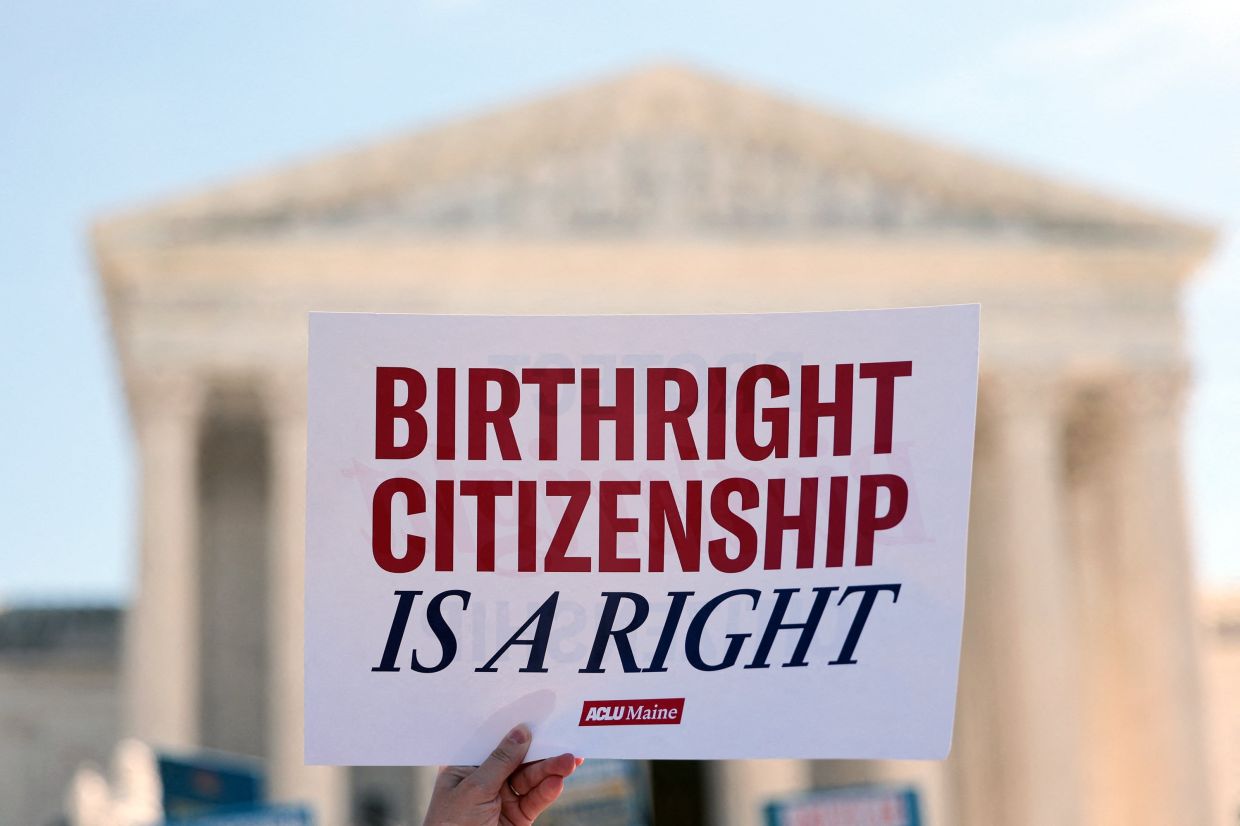
The Trump administration's effort to restrict birthright citizenship suffered a significant setback when the United States Supreme Court rejected a constitutional challenge to the long-standing citizenship policy. Rather than accept the defeat, President Donald Trump pivoted his attention toward what his government now frames as the real threat: women travelling to America specifically to give birth. In a sarcastic social media post, Trump congratulated China's President Xi Jinping on a "massive Birthright Citizenship WIN", signalling that Beijing would become central to the administration's new approach to the citizenship question.
Within days of the court's decision, the Department of Justice took concrete action, instructing federal prosecutors to prioritise investigations into what prosecutors call birth tourism schemes. House Speaker Mike Johnson simultaneously indicated that lawmakers were exploring legislation to address foreign women entering the country for childbirth purposes. These coordinated moves reveal a strategic shift: unable to overturn citizenship through constitutional means, the administration and its congressional allies are now pursuing immigration enforcement and legislative remedies, with China increasingly cast as the primary culprit despite the lack of compelling evidence.
The absence of comprehensive federal data on birth tourism presents a significant challenge to the administration's narrative. No single government dataset directly measures how many women enter the United States primarily to deliver babies, and the statistics that do exist suggest that births to mothers born in China represent an infinitesimal portion of overall American births. This data gap has not stopped officials from claiming widespread abuse, but it does highlight the disconnect between rhetoric and measurable reality that characterises the current debate.
President Trump initiated this push on his first day back in office by signing an executive order that would have denied citizenship documents to children born to undocumented parents or those present under temporary visas. Federal courts blocked the policy before implementation, and the Supreme Court's subsequent rejection of the constitutional challenge effectively ended that particular avenue for reform. The birthright citizenship provisions of the 14th Amendment, enacted after the Civil War to protect freed slaves and their descendants, remain firmly entrenched in American constitutional law.
It is important to note that merely giving birth while visiting the United States is not a crime. Prosecutions characterised as birth tourism cases have typically relied on allegations of visa fraud, conspiracy, money laundering, or other offences involving travellers who allegedly concealed their true intentions and businesses that assisted them. Joseph Kwon, a business immigration lawyer, articulated a concern about this approach: "A pregnant traveller with a valid visa shouldn't have to prove she isn't a stereotype. When that becomes routine, the harm is real even if a case is never filed." This observation underscores how enforcement rhetoric can create a chilling effect on legitimate travel even without convictions.
The Department of Justice has argued that organised schemes involving pregnant travellers constitute fraud and constitute abuse of the immigration system. In official communications, DOJ officials have claimed that thousands of foreigners enter under false pretences to secure citizenship for their children. Colin McDonald, the assistant attorney general overseeing fraud enforcement, vowed that the department would "zealously protect the sanctity of United States citizenship by investigating and prosecuting those who fraudulently exploit our immigration system." The department has cited specific cases, including a 2020 prosecution of Chao "Edwin" Chen, who operated a business advertising a 100-person team based in China and claimed to have served more than 500 birth tourism clients in the United States, for which he received a 37-month prison sentence.
While the administration's earlier rhetoric focused on children born to undocumented parents, the new emphasis on birth tourism, particularly involving China, represents a notable recalibration. This shift is mirrored in congressional proceedings. Republican congressman Chip Roy has argued that when "foreign adversaries like the Chinese Communist Party can leverage birth tourism and visa-less programmes to gain influence within our borders, we must restore integrity to our immigration system and defend the sovereignty of our Republic." Such framing elevates birth tourism from a potential immigration enforcement matter to a national security concern, a rhetorical escalation that may exceed what the available evidence supports.
China has become the rhetorical centrepiece of this effort, but other nations including Turkey, Russia, and Mexico have also faced accusations of engaging in birth tourism. Trump has repeatedly singled out China in social media posts, claiming at one point that birthright citizenship is being exploited by "rich people from China, and the rest of the World, who want their children, and hundreds of thousands more, FOR PAY, to ridiculously become citizens of the United States of America." The president has also made the false claim that America stands alone in granting automatic citizenship to children born on its soil, when in fact 32 other countries maintain birthright citizenship laws substantially similar to those of the United States, including neighbouring Canada and Mexico.
Estimates of the birth tourism phenomenon vary dramatically, often reflecting the political perspective of those citing them. Peter Schweizer, president of the Government Accountability Institute, made an extraordinary claim during congressional testimony that approximately one million American citizens are being raised in China today as a result of birth tourism. Legal scholar Peter Spiro dismissed this figure as "wildly inflated", telling the South China Morning Post that while the practice has grown over recent decades, "the best that one can say is that it's risen over the last few decades to become a non-trivial phenomenon." The gap between these assessments suggests profound disagreement about the actual scope of the issue.
However, the statistical data available paint a far more modest picture. The National Centre for Health Statistics recorded only 27,476 births to mothers born in China during 2023, representing a fraction of the 852,470 births to foreign-born mothers and just 0.74 percent of the 3.7 million total births in the United States. More tellingly, only 113 of these births involved mothers who were non-US residents from China. Comparing this to 2018 figures, the numbers have actually declined: that year saw 267 births to non-US resident mothers from China out of 3.9 million total births. The Northern Mariana Islands, frequently cited as a birth tourism hotspot, recorded just two births to foreign-resident mothers in 2023 out of 581 total births, down substantially from 697 foreign residents' births in 2018.
For Malaysian and Southeast Asian observers, the Trump administration's approach to this issue carries several implications. First, it demonstrates how selective interpretation of data can shape immigration policy in major economies, potentially affecting travel and business patterns across the region. Second, the singling out of China for rhetorical criticism, despite the absence of comprehensive evidence that China represents a disproportionate share of birth tourism cases, reflects broader geopolitical tensions that may influence how other nations are treated in American immigration enforcement. Third, the shift from constitutional challenges to prosecutorial enforcement suggests that even when major policy objectives fail in courts, administrations may pursue them through enforcement mechanisms that receive less public scrutiny. For regional governments and citizens, this illustrates the importance of monitoring enforcement priorities in major trading partners, as these can affect travel, visa policies, and bilateral relations.

