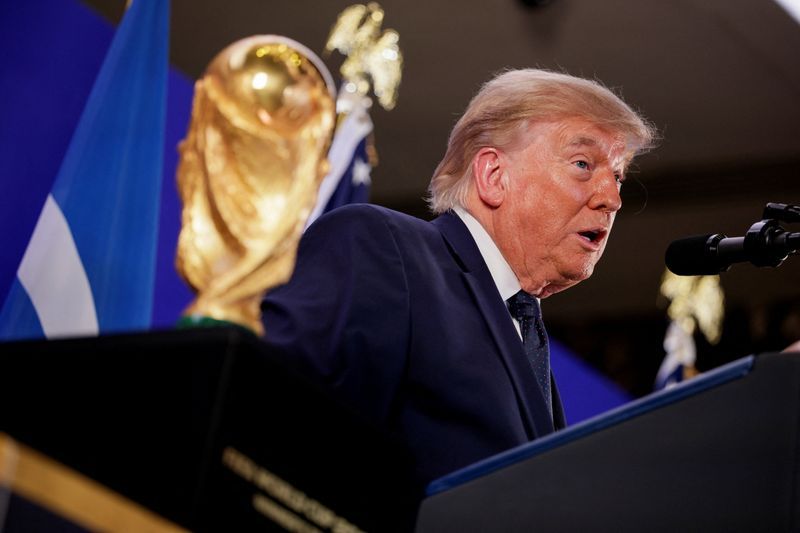
U.S. President Donald Trump will return to the centre of global soccer's biggest stage on Sunday, when he presents the trophy to winners of the World Cup final between Argentina and Spain at New York/New Jersey Stadium. The appearance comes at a pivotal moment for the tournament, which has drawn record-breaking crowds throughout its run across the United States, Canada and Mexico—and places Trump once again in an international spotlight that has become increasingly central to his political strategy during his second term.
Trump's prominent role at the final crystallises a remarkable relationship between the American leader and FIFA President Gianni Infantino that has deepened substantially over the past year. Infantino confirmed that Trump will sit alongside him during the championship match and perform the ceremonial trophy presentation, mirroring his involvement at last year's Club World Cup. This level of ceremonial prominence at international sporting events reflects Trump's deliberate strategy of seeking high-profile moments in sports, a tactic he has pursued with notable intensity over the past 18 months as his approval ratings have faced headwinds during his second presidential term.
The political dimensions of Trump's World Cup involvement became unmistakably clear days before the final, when the American president confirmed he had asked Infantino to review a red card issued to U.S. striker Folarin Balogun. The revelation ignited significant controversy regarding the independence of tournament officiating and the appropriate boundaries between political leadership and sporting governance. FIFA officials have strenuously insisted that Trump played no role in the subsequent decision to suspend Balogun's ban, yet the episode has raised enduring questions about the perception of fair play at a global competition increasingly influenced by political actors.
The warmth between Trump and Infantino was on full public display on Friday at an exclusive reception held within Trump Tower in Manhattan, where FIFA has maintained an office since the previous year. Standing before approximately 300 attendees—including Brazilian soccer legend Ronaldo and various FIFA dignitaries—Infantino offered effusive praise of the American president. "This World Cup would not have been such a success without you," Infantino declared, crediting Trump's role in the tournament's unprecedented commercial performance and record attendance figures. Trump, in turn, commented that "it turned out we were a soccer country," suggesting a personal investment in transforming American attitudes toward football.
The mutual admiration masks a more complex reality regarding Trump's relationship with international sport and multilateral institutions. Prior to and during the tournament, FIFA faced considerable pressure regarding Trump's immigration policies and his administration's travel restrictions on several nations—concerns that made international visitors understandably anxious about their reception in the United States. The Trump administration subsequently threatened to relocate matches away from Democratic-controlled cities, prompting FIFA to publicly clarify that such decisions would remain entirely within the international federation's authority rather than any national government's discretion. Trump's Friday suggestion that the U.S. should host the tournament again but "this time we'll leave Mexico and Canada out" underscored ongoing tensions within the tri-national partnership.
Trump's intensive cultivation of sports-related public appearances reflects a calculated political calculation. Following comparatively positive receptions at last year's Ryder Cup on Long Island, where American crowds enthusiastically cheered his presence, Trump has strategically sought similar moments. These appearances serve multiple purposes: they provide opportunities to address friendly audiences, generate media coverage, and project an image of presidential authority and international influence. However, such attempts at image-building have encountered substantial resistance in other venues, suggesting divided public sentiment regarding his presence at major sporting events.
Trump's sports visibility has yielded decidedly mixed results across different contexts. He was loudly booed at Game 3 of the NBA Finals last month, an unusually hostile reception for any sitting president at a major American sporting event. Additionally, Trump's security requirements at last year's U.S. Open men's tennis final at Flushing Meadows caused significant operational disruptions, with international fans stranded outside the venue well after match commencement—a logistical nightmare that underscored the tensions his presence can generate even in apolitical sporting environments.
The broadcasting logistics surrounding Trump's World Cup appearance present distinctive challenges for Fox Sports, the tournament's U.S. broadcaster. Because Fox utilizes the FIFA world feed for international match coverage, the network technically possesses no control over camera positioning or cutaways. Play-by-play announcer John Strong acknowledged this reality, explaining that whether cameras capture Trump sitting alongside Infantino remains entirely FIFA's decision rather than the broadcaster's. This technical arrangement paradoxically insulates Fox Sports from accusations of either amplifying or suppressing Trump's visibility, though it also means viewers will encounter his presence without editorial mediation.
The broader implications of Trump's World Cup involvement extend beyond immediate sporting governance into fundamental questions about the intersection of national politics and international sporting institutions. FIFA formally awarded the tournament to the United States, Mexico and Canada during Trump's first presidential term in 2018—an achievement the Republican has repeatedly referenced as evidence of his ability to secure major international events. Yet the decision to provide Trump such ceremonial prominence at the final raises philosophical questions about appropriate boundaries between political leadership and sports administration, particularly given the established principle that major sporting events should exist somewhat insulated from domestic political controversies.
Strong's candid assessment captures the essential challenge facing broadcasters and FIFA officials alike. "When it comes to President Trump, there are no neutral opinions," he observed, noting that segments of the global audience will be enthusiastically pleased to witness Trump's presence, while substantially larger portions may feel discomfited by seeing one of contemporary politics' most polarising figures commanding prominent television time during a supposedly apolitical global celebration of sport. This observation underscores how thoroughly Trump's involvement has transformed the World Cup from a purely sporting spectacle into a contested political space.
For Malaysian and Southeast Asian viewers, Trump's prominence at the World Cup final illustrates broader patterns in contemporary international relations: the increasing tendency of national political leaders to use global sporting platforms as stages for advancing domestic political agendas, and the difficulty multilateral sporting institutions face in maintaining independence from powerful member nations. The tensions evident in FIFA's management of Trump's involvement—simultaneous courting and distance—reflect the complex diplomatic calculations required when hosting nations possess substantial political leverage over international organisations.
The World Cup final will thus inevitably function simultaneously as a sporting competition and a political event, with Trump's trophy presentation serving as a symbolic punctuation mark on a tournament marked as much by controversies surrounding fairness, governance and national influence as by athletic excellence. Whether viewers encounter Trump's appearance as an inspiring presidential endorsement of American soccer or as an unwelcome intrusion of divisive domestic politics may ultimately depend less on FIFA's or Fox Sports' intentions than on the deeply entrenched political perspectives that each observer brings to their television screen.

