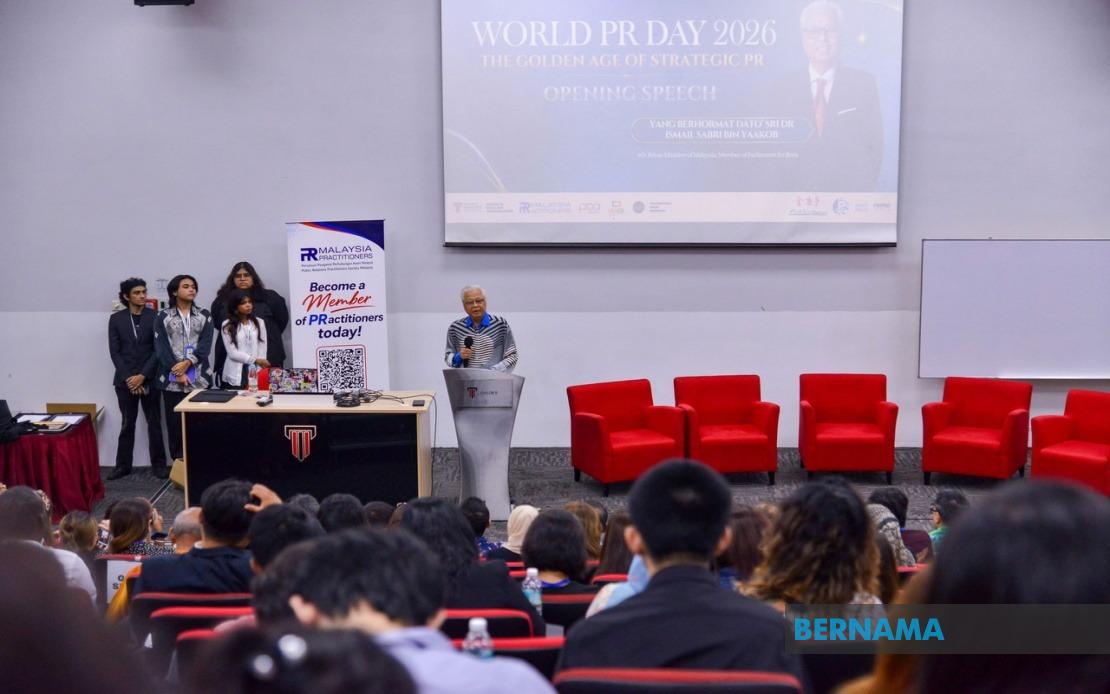
The nature of institutional leadership and public confidence has fundamentally shifted, according to Datuk Seri Dr Ismail Sabri Yaakob, who outlined the critical intersection between communication strategy and organisational credibility at the World PR Day 2026 launch held at Taylor's University in Subang Jaya. Speaking to reporters on July 16, the former Prime Minister articulated a vision where success in the contemporary landscape extends far beyond traditional metrics of financial performance or operational efficiency, encompassing instead the capacity to engage stakeholders authentically across multiple channels and touchpoints.
The transition from the twentieth to the twenty-first century has redefined competitive advantage in ways that challenge conventional business thinking. Where previous generations competed primarily on economic output and technological capability, today's organisations contend in what Ismail Sabri characterised as a "trust competition"—one that cannot be won through marketing spin or polished messaging alone. This reframing has profound implications for Malaysian businesses and government institutions navigating an increasingly sceptical public sphere. Trust, he argued, has become the singular most valuable asset an organisation can cultivate, yet it remains fragile and difficult to restore once compromised. The difference between thriving and faltering entities often hinges not on their resources but on their willingness to communicate with transparency and consistency during both triumphant and turbulent periods.
The elevation of public relations from a tactical communications function to a strategic partnership role represents another crucial evolution that Ismail Sabri identified. Practitioners operating in this space no longer serve merely as conduits for top-down messaging; they have become architects of institutional narrative, guardians of organisational reputation, and advisors to leadership on the reputational implications of decisions made in boardrooms and cabinet offices. This expanded remit demands deeper integration with organisational strategy and a more sophisticated understanding of how external perceptions shape internal culture and external partnerships. For Malaysian firms competing regionally and globally, this means investing in communicators who possess both technical competence and strategic acumen.
Ismail Sabri drew upon his experience managing the nation's response to the COVID-19 pandemic to illustrate how communication serves as a decisive policy lever. During that period of unprecedented uncertainty, the government faced the dual challenge of implementing rapidly evolving health protocols while maintaining public compliance and confidence in institutional guidance. The former Prime Minister recalled his frequent appearances before the media, emphasising the necessity of providing clear and consistent information about changes to standard operating procedures. This direct engagement served not simply to announce policy adjustments but to build and maintain the public trust essential for policies to succeed. The pandemic experience demonstrated that effective communication transcends mere information dissemination; it functions as a foundational mechanism for legitimising government action and securing voluntary compliance from citizens.
However, the technological landscape that enables rapid and widespread communication also creates unprecedented challenges that contemporary organisations must navigate carefully. Ismail Sabri highlighted the proliferation of fake news, doctored content, deepfake videos, and the sheer volume of competing information flooding digital platforms—dynamics that have rendered it exponentially more difficult for ordinary citizens to discern credible information from deliberate falsehoods. This environment of information chaos has created what some scholars term an "attention economy" where sensational and emotionally resonant content often gains traction regardless of factual accuracy. Malaysian society, with its diverse communities and multiple language groups, proves particularly vulnerable to divisive misinformation campaigns that exploit existing social fault lines.
To address these emerging threats, Ismail Sabri advocated for PR practitioners to develop proficiency with artificial intelligence technologies that can rapidly assess public sentiment and identify emerging narratives in real time. The integration of AI-driven analytics into communications strategy allows organisations to respond more dynamically to shifting perceptions and to identify potential reputational threats before they escalate. However, he stressed a crucial caveat: technological sophistication must remain subordinate to human values and ethical principles. The tool should serve human judgment, not replace it. This distinction carries particular weight in the Malaysian context, where questions of digital governance and the appropriate boundaries of surveillance technology remain contested.
Governmental efforts to establish an AI Governance Bill represent, in Ismail Sabri's assessment, an essential regulatory framework for managing the risks posed by unchecked technological development. Such legislation must address questions of digital ethics, establish accountability mechanisms for the misuse of AI systems, and create protective barriers against the weaponisation of artificial intelligence for spreading disinformation. Malaysia's approach to these regulatory challenges will likely influence how other Southeast Asian nations approach similar governance questions. The region's regulatory decisions could establish precedents affecting how tech companies operate across the area for years to come.
The intersection of technological capability and ethical practice defines the contemporary challenge for communications professionals in Southeast Asia. Malaysian PR practitioners operating in government, corporate, and civil society contexts must simultaneously harness advanced analytical tools while maintaining fidelity to principles of honesty, accuracy, and respect for public intelligence. This balance proves particularly difficult in highly polarised environments where different segments of the population consume information through fundamentally different channels and interpret events through divergent worldviews. Building trust under such conditions requires sustained commitment to consistency, transparency about limitations and uncertainties, and demonstrated responsiveness to public concerns.
The broader implications of Ismail Sabri's remarks extend beyond the communications profession to encompass questions about institutional legitimacy more broadly. As social media platforms continue fragmenting information ecosystems and AI systems become increasingly sophisticated at generating convincing false content, the traditional gatekeeping role of credible institutions becomes paradoxically more important even as it becomes harder to maintain. Organisations—whether government agencies, commercial enterprises, or non-profit bodies—that invest in building genuine relationships with their stakeholders through consistent, integrity-grounded communication will possess significant competitive advantages over those that attempt to manipulate perception or obscure inconvenient truths.
For Malaysian organisations grappling with these challenges, the lessons Ismail Sabri articulated carry immediate practical relevance. Building institutional trust requires moving beyond episodic communication campaigns to establish ongoing, authentic dialogue with stakeholders. It demands cultural shifts within organisations that empower communications professionals to raise concerns about proposed actions that might undermine trust, rather than relegating them to the role of post-hoc damage control. It requires acknowledging mistakes forthrightly rather than attempting to obscure them, recognising that transparency about failure often enhances long-term trust more effectively than apparent perfection. These principles apply whether the organisation is a government ministry, a multinational corporation, a financial institution, or a local enterprise.

