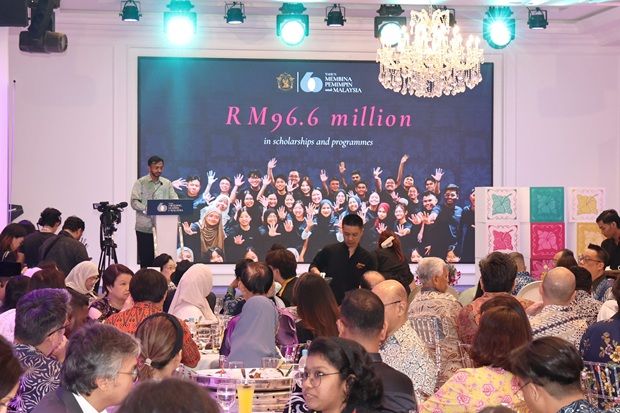
The Tunku Abdul Rahman Foundation reached a significant milestone on Aug 13, commemorating six decades of commitment to nurturing Malaysia's potential through education. The anniversary celebration took place at Bangunan Sultan Abdul Samad, bringing together the institution's stakeholders, scholars and beneficiaries to reflect on its enduring impact since its establishment in 1966.
The foundation's origins reveal a touching narrative of national solidarity. It emerged from a grassroots initiative launched by Utusan Melayu on Tunku Abdul Rahman Putra al-Haj's birthday, seeking to establish an education fund honouring Malaysia's first Prime Minister. The public response was overwhelming, with contributions totalling M$60,170.20—equivalent to approximately RM380,000 in contemporary value. This community-driven effort caught the attention of the Education Minister at the time, Tan Sri Mohamed Khir Johari, who championed the cause to the Federal Government. The result was the formal establishment of the Tunku Abdul Rahman Foundation through Act 43 of 1966, transforming a spontaneous public gesture into a permanent national institution dedicated to expanding higher education access.
The foundation was deliberately constructed to address Malaysia's nation-building imperatives in the early decades of independence. During a period when access to tertiary education remained limited for many talented youth, YTAR provided loans and scholarships enabling Malaysians to pursue studies abroad. Many of these scholars subsequently returned to contribute their expertise and leadership across diverse sectors, creating a multiplier effect that strengthened national development. This model of investing in human capital proved prescient, establishing education as a cornerstone of Malaysia's progress long before it became central to contemporary development discourse.
Over the past 60 years, YTAR's reach has been remarkably inclusive and extensive. The foundation has supported more than 12,000 Malaysian youths irrespective of ethnicity, religion or background, channelling RM96.6 million through scholarships, loans, financial assistance and employability initiatives. National Unity Minister Datuk Aaron Ago Dagang, speaking at the ceremony, emphasised that YTAR's evolution reflects changing national needs. The foundation has transcended its original role as merely a scholarship provider to become an institution that identifies emerging talent, creates access pathways and systematically develops the potential of Malaysian youth. In an increasingly competitive global environment, this comprehensive approach to talent development carries particular significance for Malaysia's aspirations.
Datuk Aaron Ago also extended an appeal to Malaysia's corporate sector, urging businesses to prioritise education and talent development within their corporate social responsibility frameworks. By partnering with established foundations like YTAR, companies can amplify their social impact while contributing to a more structured ecosystem for developing Malaysia's human resources. This call reflects recognition that education financing cannot rely solely on government resources, necessitating broader societal participation from the private sector to meet growing demand.
CEO Kularetnam Vijayakumar underscored a fundamental philosophy underpinning YTAR's longevity: the institution has never been a one-person undertaking but rather a collective endeavour sustained by successive generations of Malaysians. He traced the foundation's intellectual lineage to a conviction held by the citizens who created it in 1964—that education possesses transformative power capable of reshaping individual lives and national trajectories. This belief persists unchanged, though its expression has become more sophisticated. The foundation remains steadfast in its conviction that investing in young people represents Malaysia's most strategic investment, a principle that transcends economic cycles and political transitions.
Datin Sri Sharifah Menyalara Syed Hussein, chairperson of YTAR and granddaughter of Tunku Abdul Rahman, provided intimate perspective on the late Prime Minister's vision. She recalled his counsel that before pursuing ambitious endeavours, one must build strong foundations—particularly in education. For Tunku, this was never merely about academic credentials but rather education as the bedrock for character development and purposeful citizenship. Over six decades, YTAR has evolved from providing transactional financial aid toward a more holistic empowerment model. Contemporary scholarship recipients receive not only capital and educational opportunities but also skills training and values development, positioning them to construct meaningful futures for themselves, their communities and Malaysia.
The distinction Sharifah drew between memorials and living institutions illuminates YTAR's significance. While monuments invite retrospection, enduring institutions demand active participation and renewal of founding ideals. By this measure, YTAR transcends commemoration, instead embodying a dynamic commitment to translating Tunku's educational philosophy into contemporary practice. The foundation's continued relevance rests on this willingness to evolve while maintaining unwavering dedication to its core mission.
Two distinguished YTAR alumni featured prominently in the anniversary celebration, their life trajectories illustrating the scholarship's transformative power. Ch'ng Kim See received her scholarship award in 1967 during profound financial hardship, describing the opportunity as providential. She subsequently became among Malaysia's most prominent librarians and a regional authority in Southeast Asian history, library science and information management. Her professional contributions have extended far beyond personal advancement; her career exemplifies how educational access converts talent into national capability.
Dr Zakaria Ali, a pioneering figure in Malaysian fine arts, followed a different pathway to his scholarship. An American instructor from Texas recognised his potential while Zakaria worked as a processing assistant, eventually writing to the King, education minister and prime minister on his behalf to facilitate his attendance at Southwestern University in Austin. This narrative underscores an essential characteristic of Malaysia's scholarship era—the significant role played by individual champions who identified talent across conventional boundaries and mobilised institutions to nurture potential. Both Zakaria and Ch'ng exemplify how YTAR's early recipients channelled their educational privileges into leadership roles spanning education, civil service, law, medicine and frontline governance, creating a cohort bound by shared commitment to nation-building.
The foundation's six-decade trajectory offers instructive lessons for Malaysia's contemporary challenges. At a moment when regional competition for talent intensifies and education costs escalate, YTAR's model of inclusive talent identification and sustained development remains highly pertinent. The institution demonstrates that strategic investment in youth produces compound returns across generations, particularly when scholarships target not merely academic excellence but character development and civic purpose. As Malaysia navigates complex transitions in its economy and society, the principles animating YTAR's founding—that equitable educational access strengthens national resilience and that investments in youth yield disproportionate national benefits—retain considerable force.
Looking forward, the foundation announced the opening of nominations for the 2026 Pingat Tunku Award commencing Aug 31 through Sept 30. Significantly, this year marks the first instance of allowing self-nominations from graduates of both public and private higher education institutions throughout Malaysia. This procedural expansion democratises recognition by removing barriers that previously required institutional endorsement, potentially identifying exceptional candidates who might otherwise escape formal attention. The decision reflects YTAR's ongoing evolution toward more inclusive systems while preserving rigorous standards for merit-based recognition.
As Malaysia advances through its seventh decade of independence, the Tunku Abdul Rahman Foundation's sustained commitment to education and talent development provides an enduring institutional embodiment of the nation's founding aspirations. The anniversary celebration affirmed that the most durable national monuments are not those of stone and steel, but rather institutions that continuously invest in human potential. By nurturing successive cohorts of scholars who become educators, physicians, civil servants, artists and leaders across Malaysian society, YTAR perpetuates a legacy that extends far beyond the individuals it supports to strengthen the entire nation's capability for navigating future challenges.

