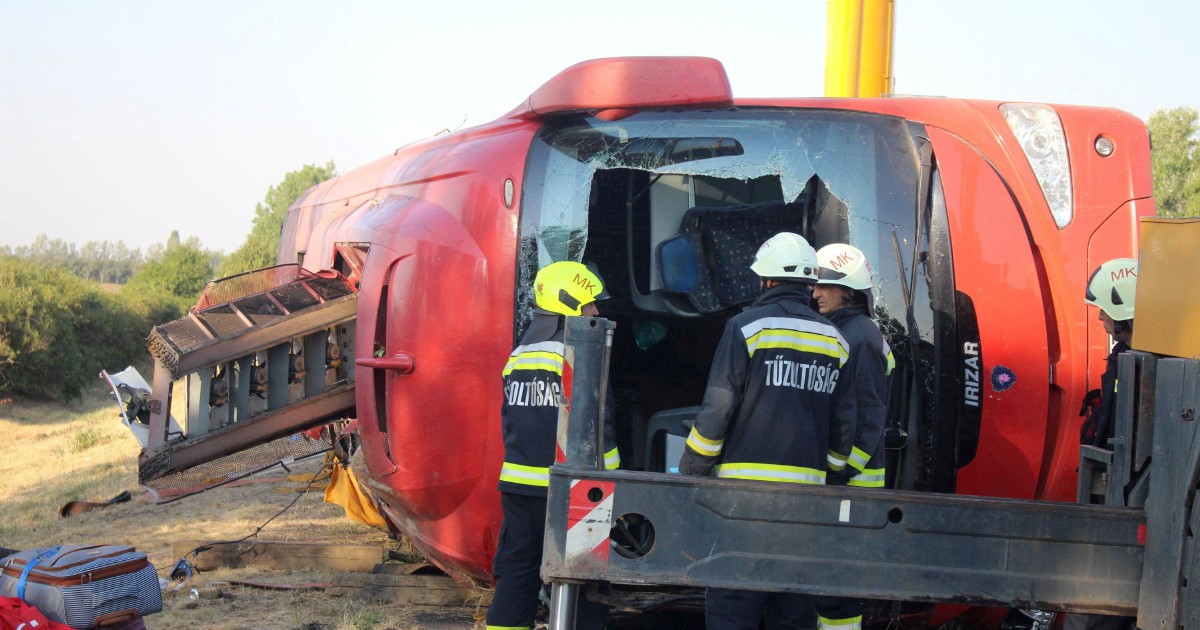
A major transport tragedy unfolded on a Hungarian motorway in the early hours of Sunday when a coach bus carrying Polish passengers left the roadway and overturned, resulting in the deaths of twelve people aboard. Prime Minister Peter Magyar and other state officials confirmed the extent of the incident, which left a further ten passengers with serious injuries requiring immediate medical intervention.
The accident occurred during the overnight hours when road conditions and visibility are typically at their poorest, potentially contributing to the severity of the crash. The bus, travelling on what officials identified as a highway in Hungary, went off the road surface before rolling over in what emergency responders described as a catastrophic collision. The force of the impact trapped several passengers within the vehicle, hampering initial rescue efforts and complicating the emergency response.
Emergency medical teams converged on the accident scene following alerts from other motorists and highway patrol units. The scale of the incident required coordinated assistance from multiple ambulance services and hospitals across the region to manage the influx of casualties. Among those injured, ten individuals were classified as having sustained serious injuries, indicating trauma significant enough to warrant specialised medical care and hospitalisation.
The nationality of the passengers—Polish nationals travelling on a Polish-registered coach—immediately elevated the significance of the incident beyond a routine highway accident. Such coach services are common throughout Eastern and Central Europe, ferrying passengers across international borders on long-distance routes. The presence of substantial loss of life among Polish citizens raised immediate diplomatic considerations, prompting official statements from government authorities in both Hungary and Poland.
Highway accidents involving coach buses typically result in higher casualty rates than incidents involving smaller vehicles, owing to the concentration of passengers and the difficulty in securing occupant safety during rollovers. The extended length and height of coach vehicles create an elevated centre of gravity, making them prone to dramatic instability when drivers lose control on curves or wet surfaces. Investigations into the precise cause would naturally focus on factors such as speed, road conditions, driver fatigue, and potential mechanical failure.
This incident represents another chapter in the ongoing transportation safety challenges facing Europe's road networks. Coach travel, whilst economical and popular among budget-conscious travellers crossing the continent, carries inherent risks that statistics consistently demonstrate. The Hungarian section of motorway infrastructure, like many European highways, carries substantial through-traffic comprising both local and international vehicles.
The immediate aftermath of such a tragedy typically involves extensive scene documentation by accident investigation units, medical examinations to identify victims, and notification of next-of-kin across international borders. Hungarian authorities would coordinate with Polish consular officials to facilitate proper identification and repatriation of deceased passengers. The emotional and logistical burden on emergency services and local communities is substantial in incidents of this magnitude.
For Malaysian readers with family or business connections in Europe, this accident serves as a sobering reminder of transportation risks when travelling overseas. Many Southeast Asian nationals utilise affordable coach services for cross-border European travel, and such incidents warrant consideration of safer alternatives when available. Comprehensive travel insurance, whilst cannot prevent accidents, does provide crucial financial protection for medical treatment and repatriation.
The investigation that follows will likely examine numerous factors: mechanical condition of the bus, driver qualifications and rest-period compliance, road maintenance standards, and weather conditions at the time. European Union standards govern coach safety requirements, and investigators will determine whether this particular vehicle met all applicable regulations. Such findings often lead to regulatory refinements aimed at preventing similar tragedies.
Tragic events like this underscore the importance of rigorous international standards for passenger transport. The coach industry operates across multiple countries with varying enforcement mechanisms, and harmonised safety protocols remain challenging to implement uniformly. Operators' financial pressures sometimes create temptation to compromise on vehicle maintenance, driver working conditions, or route safety choices.
The Hungarian Prime Minister's public acknowledgement of the tragedy, combined with official casualty figures, indicates government attention to the incident's severity and international ramifications. Regional transport safety records will inevitably come under scrutiny following such a high-fatality event. Insurance companies, transport regulators, and safety advocacy groups will analyse the circumstances to extract lessons applicable to accident prevention.

