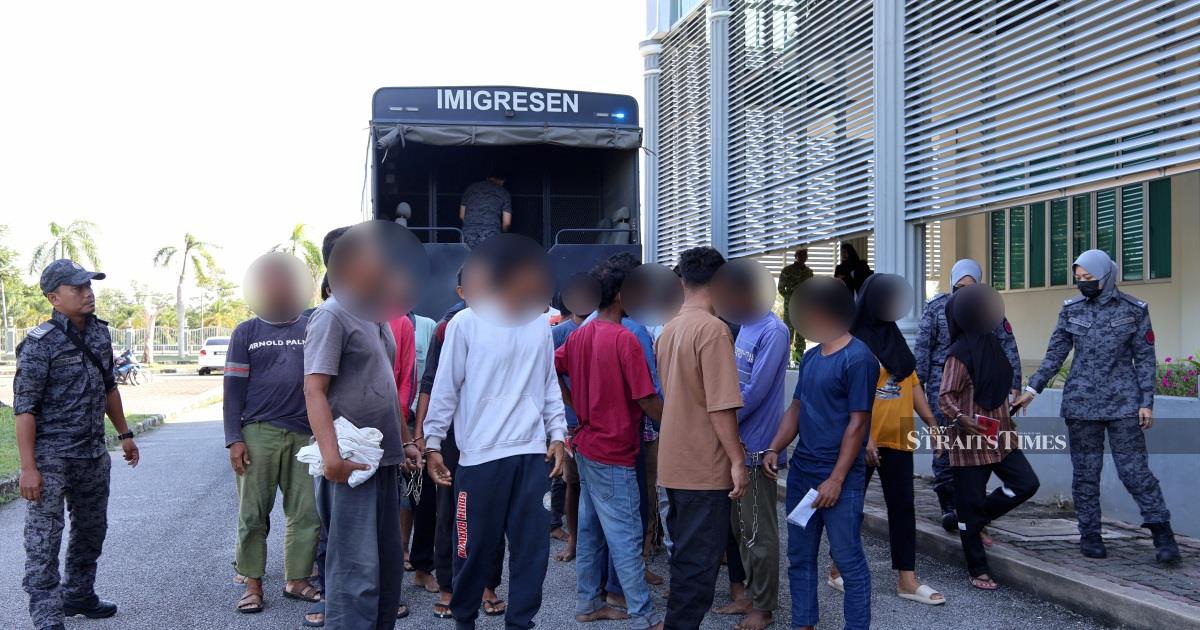
Twenty-nine undocumented migrants faced the Sessions Court in Pasir Mas today, where they pleaded guilty to a range of immigration offences and received financial penalties as punishment. The fines imposed by the court varied significantly, ranging from RM1,000 on the lower end to RM10,000 for the most serious cases, reflecting the varying degrees of violation and circumstances of each individual brought before the bench.
The charges against the group encompassed three primary categories of immigration breaches that remain persistent enforcement challenges across Malaysia's borders and inland regions. These included illegal entry into Malaysian territory, a violation that strikes at the heart of the country's border security and sovereignty. The second charge involved overstaying beyond authorised periods, which represents a failure to comply with the terms of admission granted by immigration authorities. The third charge centred on the misuse of travel and identity documents, including passes and permits obtained fraudulently or used in violation of their stated purposes.
This enforcement action in Pasir Mas, a town in Kelantan near the Thai border, underscores the ongoing vigilance required to manage irregular migration flows in the northern peninsula. The border region between Malaysia and Thailand has historically served as a transit corridor for migrants seeking work opportunities in Malaysia's manufacturing, construction, and service sectors, making it a focal point for immigration enforcement operations.
The court's differentiated sentencing approach—with fines scaling from RM1,000 to RM10,000—suggests that the judiciary considered various aggravating and mitigating factors specific to each case. These might have included the duration of overstaying, the nature of document misuse, whether individuals had previously been convicted of similar offences, and whether they cooperated with authorities during investigation. Such graduated penalties reflect judicial discretion within sentencing guidelines and demonstrate efforts to match punishment proportionately to individual culpability.
Malaysia's immigration enforcement landscape has become increasingly sophisticated in recent years, with authorities deploying integrated databases, biometric screening, and intelligence sharing across agencies. However, the sheer volume of irregular migrants—estimated in the hundreds of thousands—continues to present operational challenges. Cases like this one in Pasir Mas represent a small fraction of detected violations and typically occur following intelligence-led operations or routine checks at workplaces, residential areas, or transport hubs.
The financial penalties imposed serve multiple policy objectives beyond simple punishment. Fines create a deterrent effect intended to discourage both migrants considering illegal entry and employers who might be tempted to hire undocumented workers. The revenue collected also partially offsets government enforcement costs. However, critics argue that penalties alone prove insufficient without complementary measures addressing the underlying demand for migrant labour in Malaysia's labour-intensive industries.
For the individuals concerned, the financial burden of these fines may prove substantial, particularly given that many migrants earn modest wages in low-skilled occupations. Following payment or serving alternative sentences if unable to pay, these individuals typically face deportation proceedings to their countries of origin, usually in Southeast Asia or South Asia, though implementation varies depending on bilateral agreements and available transport capacity.
The case highlights the persistent tension between Malaysia's significant reliance on migrant workers—who constitute roughly 20 percent of the workforce in key sectors—and the government's stated commitment to maintaining immigration order and protecting employment opportunities for Malaysian citizens. This balancing act remains complicated by the reality that many employers prefer hiring undocumented migrants due to cost advantages and reduced regulatory burden, effectively creating markets for irregular labour that incentivise illegal migration.
Beyond Pasir Mas, this pattern of enforcement and conviction repeats across Malaysia's immigration courts with remarkable consistency. The Department of Immigration processes thousands of immigration cases annually, with irregular entry and overstaying representing the largest categories. Each prosecution represents administrative resource investment, court time, and detention facility capacity that authorities must continually manage within budgetary constraints.
Regionally, Malaysia's immigration challenges reflect broader Southeast Asian migration dynamics, where millions move across borders in pursuit of economic opportunity, often through irregular channels due to barriers in formal migration processes. Neighbouring countries including Thailand, Indonesia, and Cambodia face similar enforcement dilemmas, though with varying institutional capacities and policy responses.
For Malaysia specifically, the Pasir Mas case exemplifies authorities' efforts to maintain visible enforcement presence in border regions, signalling to potential migrants and employers alike that immigration violations carry legal consequences. Yet enforcement alone cannot address the structural factors—economic disparities between Malaysia and source countries, persistent labour shortages in certain sectors, and the profitability of human smuggling networks—that drive irregular migration flows.
Moving forward, analysts suggest that comprehensive solutions require coordinated approaches combining enforcement with formal migration pathway expansion, employer compliance mechanisms, and regional cooperation frameworks. Until such measures address root causes effectively, immigration courts across Malaysia will likely continue processing comparable caseloads of undocumented migrants facing fines and deportation for the overlapping offences of illegal entry, overstaying, and document misuse.

