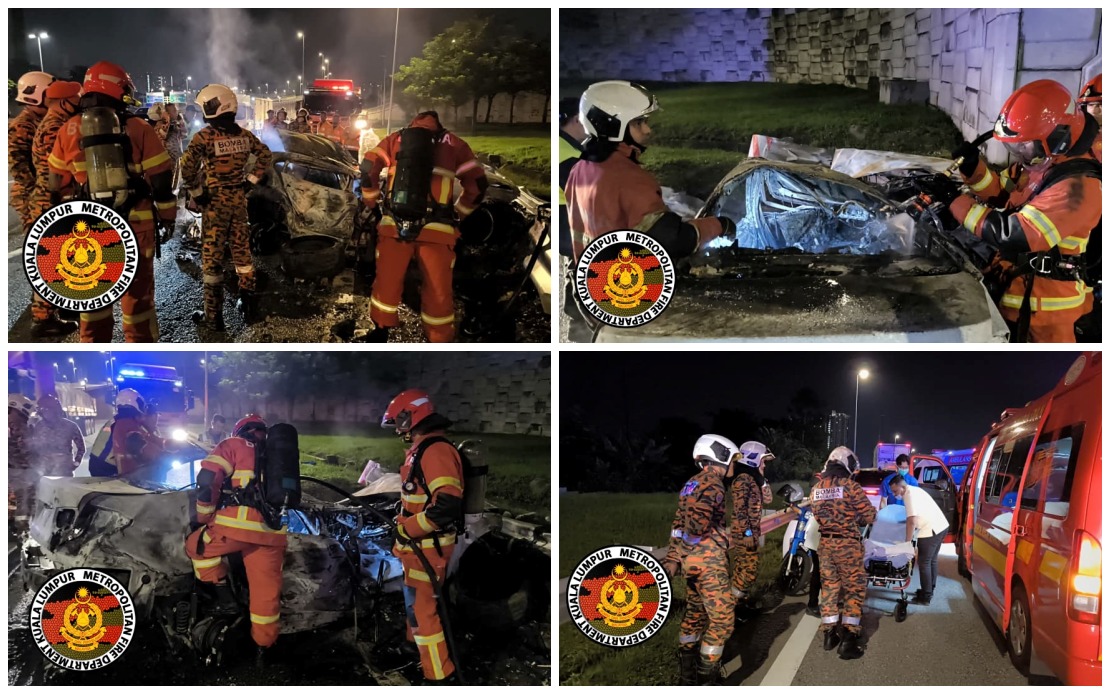
A tragic accident on the Duta-Ulu Kelang Expressway in the early hours of Wednesday claimed the lives of two Malaysian university students when their vehicle collided with a road divider and erupted in flames. The incident, which occurred at the Jalan Kuching exit ramp, has renewed concerns about speeding and vehicle safety on one of the capital's busiest expressway routes. Traffic police are actively investigating the circumstances surrounding the crash, which left a third occupant with minor injuries.
According to ACP Mohd Zamzuri Mohd Isa, chief of the Kuala Lumpur Traffic Investigation and Enforcement Department, the BMW 328i Sport was moving from Jalan Duta in the direction of Selayang when the driver apparently exceeded safe speed limits. As the vehicle approached the exit ramp area, control was lost, causing the car to veer across lanes before striking the left-side barrier with considerable force. The impact ruptured the fuel system or electrical circuits, immediately triggering a fire that rapidly consumed the vehicle's interior.
The two fatalities have been identified as a 22-year-old male enrolled at Queensland University of Technology in Australia and a 21-year-old male attending Sunway University locally. Both young men were trapped within the burning vehicle and were declared dead at the scene. The severity of the fire and the confined nature of the accident site made immediate rescue impossible, highlighting the dangers inherent in high-speed crashes on major urban expressways where emergency response times, while professional, cannot always prevent tragedy.
A third passenger, a 20-year-old male student from Singapore, managed to survive the initial impact with only minor injuries. He was promptly transported to Kuala Lumpur Hospital, where medical staff assessed his condition and provided necessary treatment. His survival, contrasted sharply with the fate of his companions, underscores the unpredictable nature of such accidents and the role that seating position and other chance factors play in determining outcomes.
Identification of the two deceased victims will proceed through DNA analysis, a necessary procedure given the extent of fire damage to their remains. This forensic approach, while scientifically reliable, also reflects the grim reality of fatal traffic accidents where conventional identification methods become impossible. The families of both deceased students will need to endure this additional delay before they can formally lay their loved ones to rest.
Police have launched a comprehensive investigation into the circumstances of the crash, examining all available evidence and witness accounts. Crucially, officers are reviewing closed-circuit television footage from cameras positioned along the expressway corridor, which may capture the vehicle's behavior in the moments preceding the collision. The survivor's account has been documented, and further statements will likely be sought as the inquiry progresses.
The case is being pursued under Section 41(1) of the Road Transport Act 1987, which governs motor vehicle incidents resulting in death or serious injury. This statutory framework enables traffic authorities to establish whether the driver's conduct—particularly the apparent excessive speed—constituted a criminal offense beyond mere traffic violation. Should evidence confirm dangerous or reckless driving, the deceased driver's family may face additional legal complications even as they grieve.
The incident has prompted authorities to appeal for additional information from the public. Drivers and commuters who were in the vicinity at the time are encouraged to come forward with any eyewitness accounts or dashcam recordings that might shed light on the accident sequence. Such civilian evidence often proves invaluable in reconstructing the precise mechanics of crashes and establishing contributing factors that might not be apparent from physical evidence alone.
This tragedy occurs against a backdrop of persistent concerns about speeding on Malaysian expressways, particularly during late-night and early-morning hours when traffic volumes are lower and drivers may feel emboldened to drive at dangerous velocities. The DUKE Expressway, while generally well-maintained and properly signposted, experiences regular accidents attributable to speed-related loss of control. Road safety experts frequently cite driver behavior as the primary variable, noting that infrastructure improvements alone cannot compensate for unsafe driving practices.
For the Malaysian and broader Southeast Asian community, the incident serves as a sobering reminder of the fragility of young lives and the devastating consequences of momentary lapses in judgment behind the wheel. Both deceased students represented significant investments in education and human potential, with one pursuing advanced studies abroad and the other established in local higher education. Their deaths represent not merely statistics but the loss of individuals with families, ambitions, and futures now terminated.
The families of the two deceased Malaysian students, as well as the injured Singaporean passenger and his family, now face extended periods of grief and recovery. For the local university community, particularly Sunway University where one victim was enrolled, the incident will likely trigger discussions about student welfare, safe transportation practices, and the pressures that may lead young drivers to take unreasonable risks on the road.
As the police investigation continues to gather evidence and analyze the circumstances, the case will ultimately contribute to the growing body of accident data that informs road safety policy in Malaysia. Whether this particular tragedy catalyzes renewed emphasis on speed enforcement, driver education campaigns, or infrastructure modifications remains to be seen. What is certain is that two promising young lives have been extinguished, and the expressway where it occurred will remain marked by this loss for those who knew them.

