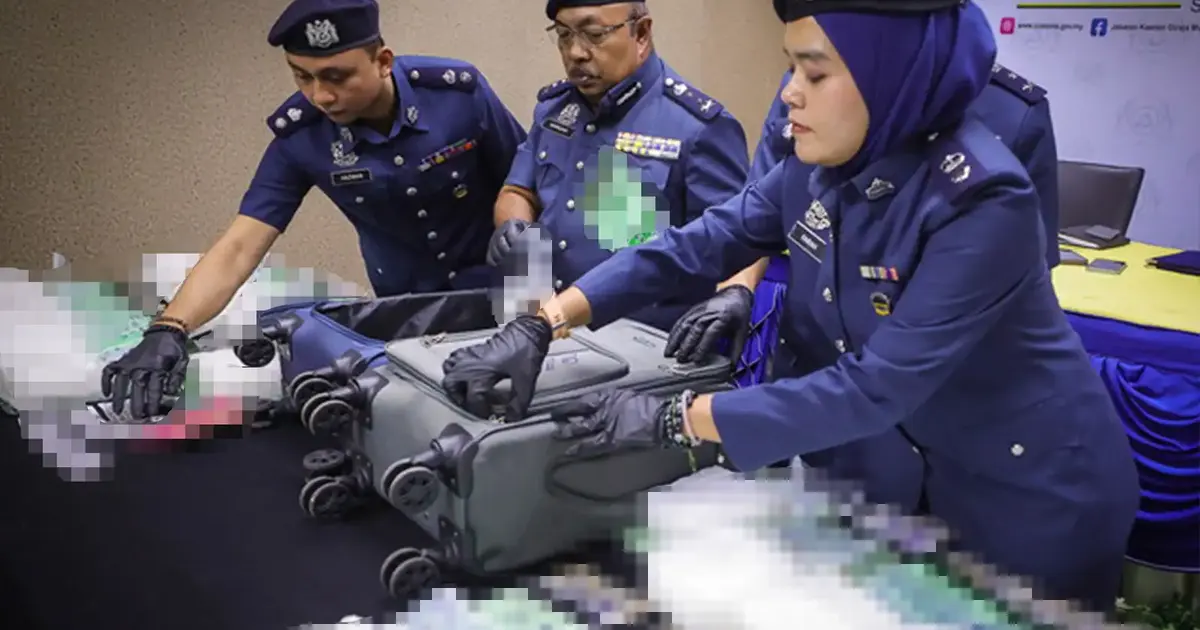
Law enforcement officials at Kuching International Airport have successfully intercepted a significant drug smuggling operation, apprehending two men who arrived on a flight from Johor Bahru on July 9. The arrests represent a notable enforcement success in Sarawak's ongoing struggle against transnational drug trafficking networks that increasingly leverage air transport routes to move illicit substances across Malaysia's interior regions.
The detained suspects were identified during routine immigration and customs procedures as passengers disembarked from their Peninsular Malaysia flight. Authorities conducting standard baggage screening and passenger profiling flagged the individuals for secondary inspection, during which concealed narcotics were discovered. The contraband seized has been valued at RM1.32 million, indicating a sophisticated smuggling attempt involving substantial quantities of controlled substances destined for regional distribution networks.
This seizure underscores the persistent challenge facing Malaysian law enforcement agencies tasked with monitoring air cargo and passenger luggage across the country's extensive airport network. Kuching International Airport, serving as Sarawak's primary aviation hub and a major connector between Peninsular Malaysia and East Malaysia, has increasingly become a focal point for anti-narcotics operations. The strategic location creates both operational challenges and enforcement opportunities, as traffickers attempt to exploit the volume of daily passenger movements.
The Johor Bahru to Kuching route represents a critical corridor for legitimate commerce and travel, but it has also attracted criminal networks seeking to transport drugs from production or transshipment centres in Peninsular Malaysia to distribution points in Sarawak and beyond. The relatively shorter flight duration and multiple daily services create windows of opportunity for smugglers attempting to move merchandise across state boundaries while avoiding detection through more heavily monitored overland checkpoints.
Sarawak's geographical position as Malaysia's largest state, coupled with its porous borders with Brunei and Indonesian Kalimantan, has established the region as a strategic transit point for narcotics destined for Australian and Asian markets. Law enforcement agencies have consistently highlighted the need for enhanced intelligence sharing and coordinated operations to address the scale of drug trafficking activity. This particular airport seizure demonstrates that border security measures continue to yield results, though enforcement officials acknowledge that disrupting supply chains requires sustained pressure across multiple interdiction points.
The apprehension of the two suspects follows heightened anti-drug enforcement initiatives launched across Malaysian airports in recent months. Customs and narcotics units have implemented enhanced screening protocols, advanced detection technologies, and intelligence-led operations targeting known smuggling methodologies. The Kuching airport bust aligns with broader patterns observed by law enforcement, where traffickers increasingly attempt concealment through carry-on luggage and personal baggage rather than relying solely on cargo compartments.
Investigators will now focus on establishing whether the detained individuals were acting as couriers for larger trafficking syndicates or possessed independent distribution networks in Sarawak. The circumstances of the arrest, including the specific timing and routing of the flight, may provide crucial intelligence regarding supplier networks operating in Johor Bahru and anticipated recipient locations in Kuching or surrounding districts. Forensic analysis of the seized substances will confirm the drug composition and purity levels, further informing law enforcement understanding of current market trafficking patterns.
The RM1.32 million valuation represents the street value of the narcotics, reflecting both the quantities involved and the potency of the substances seized. Such significant seizures deplete criminal organisations' working capital and disrupt carefully planned distribution operations, imposing costs that extend beyond the immediate loss of merchandise. However, enforcement experts note that individual seizures, while important for public safety, must form part of comprehensive strategies addressing demand reduction, rehabilitation services, and community awareness.
The case highlights ongoing cooperation between various Malaysian law enforcement agencies, including immigration authorities, customs officials, and anti-narcotics units, whose coordinated efforts at airports have proven instrumental in identifying and intercepting trafficking attempts. Intelligence exchange between federal agencies and Sarawak state enforcement bodies remains essential for maintaining effective oversight of the state's borders and transportation hubs.
Looking ahead, this arrest sequence will likely prompt authorities to review passenger manifests and travel patterns on the Johor Bahru-Kuching route to identify potential associates or related trafficking activity. The investigation may extend to examining financial records, communications data, and vehicle movements in Kuching that could illuminate the distribution infrastructure awaiting the seized narcotics. Such intelligence-gathering exercises frequently uncover broader criminal networks operating across multiple states, contributing to longer-term enforcement strategies.
The successful interdiction at Kuching International Airport reinforces Malaysia's commitment to combating drug trafficking despite resource constraints and the sophistication of criminal operations. As narcotics organisations adapt their methods and routes in response to enforcement pressure, law enforcement agencies must continue innovating their detection and intelligence capabilities to maintain operational effectiveness. The apprehension of the two suspects serves as a reminder that vigilance at key transportation chokepoints remains a critical component of Malaysia's multi-faceted approach to narcotics control.

