Two residents were pulled from a burning apartment in Singapore's Jurong West neighbourhood in the early morning hours of June 17, following a fire that broke out on the 13th floor of Block 842 Jurong West Street 81. The Singapore Civil Defence Force (SCDF) received the emergency call shortly after 3.35am and arrived to find flames consuming the living room of the affected unit, forcing firefighters to battle through heavy smoke to reach and extinguish the blaze using water jets.
The incident highlighted how quickly residential fires can escalate in high-rise settings, where the proximity of multiple households and vertical building design create particular challenges for emergency response. In this case, the close presence of an alert neighbour proved crucial to averting a potentially worse outcome. Four family members from the burning unit were hospitalised at Singapore General Hospital, while approximately 40 residents from surrounding flats were evacuated from the building as a safety precaution, reflecting standard protocol in such incidents.
According to accounts published by Lianhe Zaobao, the family occupying the burning unit had been asleep when the fire began. The alarm was first raised by an 18-year-old student living directly above, who was awake in the early hours playing video games. Upon detecting the smell of smoke and noticing wisps emerging from the windows of the unit below his own, he took action, descending to investigate the source of the danger.
Finding the door to the affected unit scorching to the touch, the teenager began forcefully knocking on doors throughout the corridor to wake neighbours and alert them to the emergency. He then raced back to his own home to warn his family to evacuate immediately. His mother subsequently contacted police and emergency services, setting the rescue operation in motion. The teenager's swift thinking and decisive action likely prevented the situation from becoming significantly more catastrophic, underscoring the critical role that vigilant residents can play in building safety.
Before the teenage student's family abandoned their home, a young woman from the burning unit came to their door seeking towels, explaining that she needed them to treat her father's injuries. Both she and the man exhibited visible signs of severe burns. Her hair was charred from the heat, and soot blackened her face, while the man's back and arms bore the distinctive bright red appearance of acute thermal injuries. These observations provided early indication of the fire's intensity and the physical trauma the residents had sustained.
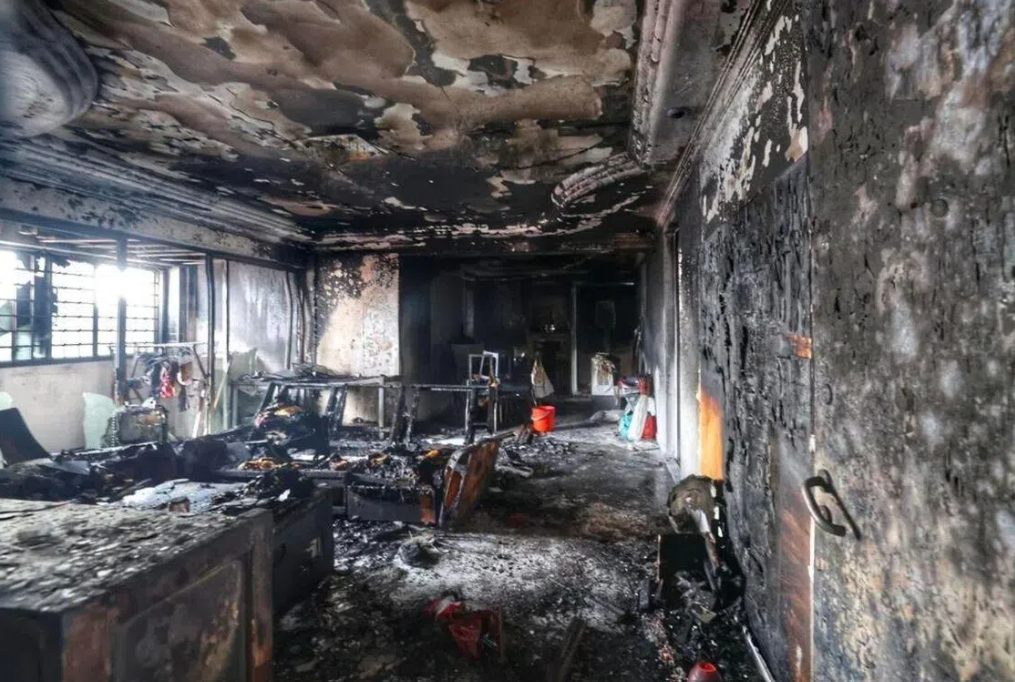
Visual documentation of the scene hours later revealed the extent of damage inflicted by the blaze. When Lianhe Zaobao reporters visited the site around 4pm on June 17, the walls and ceiling of the affected unit remained heavily blackened by soot and smoke, while windows had been shattered by the heat. The destroyed interior stood as a stark reminder of the destructive power of residential fires and the narrow margin between tragedy and successful rescue in such emergencies.
Initial investigations by the SCDF concluded that the fire most likely originated from an electrical fault located in the living room. Such incidents underscore ongoing concerns about electrical safety in residential settings, particularly in densely populated urban environments like Singapore where many households rely on multiple electrical devices running simultaneously. A 12th-floor resident who witnessed the emergency response described seeing at least five fire engines stationed below the block, illustrating the scale of resources mobilised to contain and suppress the flames.
In response to this incident and the broader pattern of residential fires in Singapore, the SCDF has reinforced public guidance on electrical safety practices. The agency emphasises the critical importance of avoiding the overloading of electrical outlets, which remains a significant fire risk factor in modern homes where power demands continuously increase. Residents are advised to switch off appliances when they are not in active use, a simple measure that can substantially reduce the likelihood of electrical faults igniting fires during periods when homes are occupied or unoccupied.
The authorities also stress the necessity of using only electrical appliances and power plugs that carry the Safety Mark, a certification standard issued by Singapore's Consumer Product Safety Office to verify compliance with established safety specifications. Additionally, the SCDF warns against leaving batteries and rechargeable devices charging unattended overnight or for extended periods, a practice that has been implicated in a growing number of residential fires across the region. These preventive measures represent straightforward steps that households can implement to substantially diminish their exposure to electrical fire risks.
The incident in Jurong West arrives against a backdrop of rising fire incidents across Singapore. According to the SCDF's most recent annual statistics released in February, the total number of fires increased by 3 per cent, climbing from 1,990 recorded incidents in 2024 to 2,050 in 2025. Of particular concern is the concentration of fires within residential buildings, which accounted for 1,051 of these incidents. This trend suggests that electrical safety and fire prevention in residential settings warrant heightened attention from both authorities and the public, especially given the density of housing in urban areas and the ever-increasing electrical consumption within modern homes.