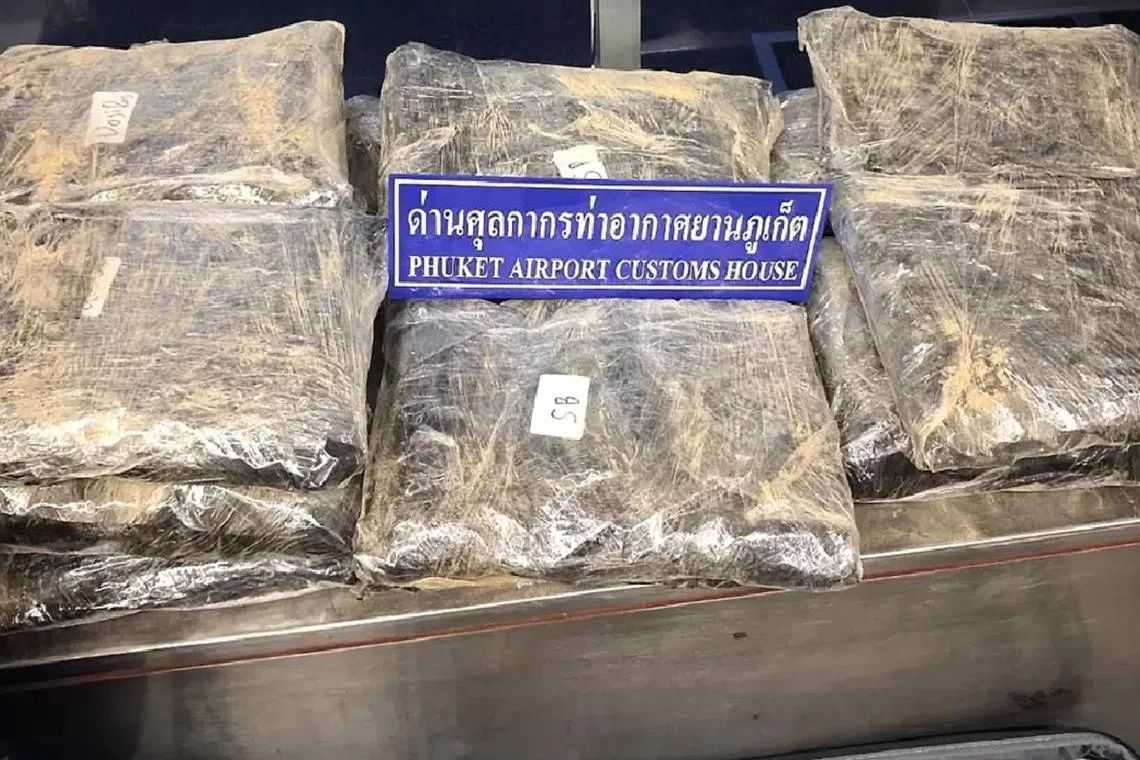
Authorities at Phuket International Airport have arrested two women on suspicion of attempting to illegally export cannabis flowers, confiscating a combined 32kg of the substance from their luggage on Thursday. The enforcement action, conducted by customs officials and local police at the international departures terminal, underscores rising vigilance at Thailand's major gateways as the country grapples with cannabis control in the post-decriminalisation era. Both suspects have been charged with customs violations and narcotics offences, though their initial admissions suggest straightforward smuggling attempts rather than large-scale trafficking operations.
The first apprehension occurred around 11am when an 18-year-old Filipino national, Levannah Chelsea Guzman, was stopped as she prepared to depart. During routine customs screening, officers from Phuket Airport Customs House discovered 14 vacuum-sealed packages tucked inside a black Pierre Cardin rolling suitcase, containing cannabis flowers that weighed 14.5kg inclusive of packaging materials. The woman immediately acknowledged ownership of both the luggage and its contents, offering no resistance to questioning. Her case exemplifies the volume of individual smuggling attempts occurring through Southeast Asian airports, often involving young couriers unaware of or willing to risk the severe legal consequences.
Within two hours, authorities arrested a second suspect at approximately 1pm. Penpitcha Phutsiang, a Thai national, was discovered carrying an even larger quantity concealed in a green Swish Navy wheeled suitcase containing 16 packages of cannabis flowers totalling 17.6kg. Similarly, Phutsiang admitted to ownership of the suitcase and its contraband without dispute, suggesting both individuals may have been acting as couriers rather than principal organisers. The rapid-fire arrests at the same airport on the same day indicate that smugglers continue to use multiple simultaneous routes through the same checkpoint, perhaps banking on customs resources being stretched across numerous passengers during peak departure hours.
The legal framework governing these cases spans multiple Thai statutes. Both women face charges under the Customs Act BE 2560 (2017) for attempting to export goods without completing required procedures, the fundamental violation underlying their arrests. However, the prosecution has layered additional counts relating to narcotics law, the Protection and Promotion of Traditional Thai Medicine Wisdom Act BE 2542 (1999), and a Public Health Ministry notification issued in 2025 governing controlled cannabis products. This multi-statute approach reflects Thailand's complex regulatory environment surrounding cannabis, which was decriminalised for medical and research purposes in late 2018 but remains heavily restricted for general civilian use and export.
Thailand's regulatory stance on cannabis presents a particular vulnerability for smugglers and enforcement authorities alike. While cannabis was officially removed from the narcotics list for certain permitted uses, the substance remains classified as controlled, and exportation without authorisation constitutes a serious offence. The 2025 health ministry notification cited in the charges suggests ongoing refinement of the legal framework governing cannabis products, likely tightening controls on hemp flowers and related materials that occupy a grey zone between medical ingredients and recreational drugs. This evolving landscape creates enforcement challenges, as officers must distinguish between authorised medical cannabis and illicit recreational quantities.
From a regional perspective, cannabis smuggling through Southeast Asian airports represents a broader phenomenon driven by price differentials and growing demand across Asia. Thailand's proximity to consumer markets in East Asia, combined with its status as a major transit hub, makes it an attractive transshipment point for smugglers. The quantities seized—14.5kg and 17.6kg per individual—fall within the range of courier-level operations rather than wholesale trafficking, suggesting organised networks remain active in recruiting and deploying mules through commercial air transport. Malaysian authorities should take note that such activities are not isolated to one jurisdiction but reflect transnational smuggling patterns that could equally affect Malaysian airports.
The enforcement response at Phuket underscores Thailand's commitment to intercepting cannabis exports, a priority that has intensified despite the drug's partial legalisation domestically. Customs authorities have been explicitly tasked with heightening vigilance on outbound passengers' luggage, reflecting official recognition that traffickers are exploiting loopholes or misjudging enforcement intensity. Such operations depend heavily on random and targeted screening protocols, intelligence from previous cases, and officer training in identifying concealment techniques. The success in apprehending both suspects suggests customs personnel are maintaining adequate vigilance despite inevitable resource pressures at a busy international airport.
For Malaysian readers and policymakers, these arrests carry implications for regional drug control strategy. Malaysia maintains strict prohibitions on cannabis under the Dangerous Drugs Act 1952, and the substance remains a controlled narcotics listing with no medicinal exceptions. Thailand's more permissive framework, while limited to authorised medical applications, creates a differential in legal risk that may incentivise smuggling attempts into more restrictive neighbours. Intelligence cooperation between Thai and Malaysian authorities regarding smuggling networks and modus operandi becomes correspondingly important, as individuals apprehended in one jurisdiction may have connections or intentions involving the other.
The cases also illustrate the gender dimension of drug smuggling networks. Both arrested individuals are women, reflecting a documented trend in Asia whereby criminal organisations recruit female couriers, often assuming they face lighter sentences or pose a lower law enforcement profile. Neither suspect's background information suggests sophistication or organisational affiliation, indicating they may be disadvantaged individuals recruited through promise of payment with limited understanding of legal consequences. Such patterns suggest that supply-side enforcement alone proves insufficient; demand-side reduction and economic alternatives for vulnerable populations remain necessary complements to airport interdiction.
Looking ahead, these arrests will likely feature in official statistics cited to justify expanded customs operations at Phuket and other major Thai airports. The confiscated 32kg, while substantial from a retail perspective, represents a fraction of estimated trafficking volumes passing through Southeast Asia. The legal proceedings against Guzman and Phutsiang will test the application of Thailand's recently updated cannabis legislation and may establish precedent regarding evidentiary standards and sentencing expectations for export offences involving cannabis flowers. Both suspects face potential imprisonment and fines under the relevant statutes, with sentences likely determined by judicial interpretation of culpability and the quantity involved.

