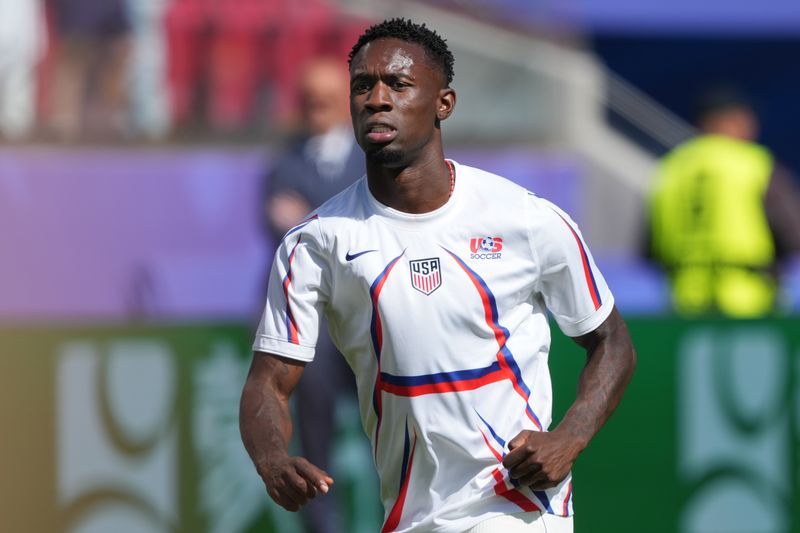
European football's governing body UEFA has delivered a stinging rebuke to FIFA's controversial decision to suspend the implementation of a red-card ban for United States striker Folarin Balogun, in a move that has exposed deep rifts within world soccer's regulatory apparatus. The extraordinary intervention came after US President Donald Trump personally contacted FIFA president Gianni Infantino requesting a review of Balogun's dismissal, setting off alarms across the sport's institutional landscape about the sanctity of disciplinary procedures and the vulnerability of competition rules to political pressure.
In a formal statement released Monday, UEFA articulated its profound alarm at FIFA's handling of the case, declaring that it expressed "disbelief at such an unprecedented, incomprehensible and unjustifiable decision." The European confederation's language reflected the severity with which it views the precedent being established, suggesting that FIFA's action threatens the foundational principle that rules are enforced consistently and impartially. UEFA's core concern centred on what it described as the erosion of "certainty of rules" by the organisations mandated to protect them, warning that without such certainty, "the integrity of the game is at stake and the credibility of a competition is undermined."
The Balogun incident itself emerged from a World Cup fixture between the United States and Bosnia during the round of 32 stage. The American striker, who had already netted three goals for his national team in the tournament, received a straight red card following a VAR review of an incident in which he dragged his cleats down the back of defender Tarik Muharemovic's leg and onto his foot. Under standard FIFA regulations, such a dismissal would have automatically triggered a suspension for the player's team's next match, the round of 16 encounter against Belgium scheduled for Monday. This is where Trump's unprecedented involvement altered the trajectory of events.
Trump's request to Infantino to reconsider the red card represented a striking moment of direct political intervention in a sporting disciplinary matter. Rather than rescinding the card entirely, FIFA took a middle-ground approach that satisfied neither sporting purists nor those demanding complete vindication. The global governing body announced that it would suspend the implementation of the ban for a probationary period of one year, effectively allowing Balogun to play in the Belgium match while keeping the technical red card on his record. This solution, while permitting the player to participate in a crucial fixture, has created fresh complications about what a suspended ban actually means and whether FIFA's disciplinary framework retains any meaningful force.
The Belgian Football Association (RBFA) responded with indignation to FIFA's decision, expressing its astonishment at how the ruling had been reached. The RBFA's reaction underscores a critical imbalance created by FIFA's action: one federation's national leader secured preferential treatment for his country's player, while another federation faced disadvantage in a knockout competition where every match carries enormous stakes. This asymmetry strikes at fundamental notions of competitive fairness that are supposed to underpin international tournaments. According to reporting from The Athletic, the RBFA has formally lodged an appeal against FIFA's decision, signalling its determination to challenge the ruling through whatever channels remain available.
For Malaysian and Southeast Asian observers of world football, this episode carries particular significance. It demonstrates how political capital and access to world leaders can apparently influence outcomes that are theoretically governed by objective, neutral regulations. In a regional context where questions about institutional impartiality and the relationship between political power and sporting administration remain sensitive, the Balogun case offers a cautionary example of how precedents set at the global level can gradually reshape expectations and norms throughout the sport's hierarchies.
The broader implications extend beyond this single incident. FIFA's decision to suspend rather than enforce the ban creates profound uncertainty about the enforceability of its regulations. When players, federations, and national governments observe that a red card can be effectively nullified through political channels, confidence in the disciplinary system necessarily erodes. Other players facing similar suspensions in future tournaments will understandably question whether their cases might similarly benefit from high-level diplomatic pressure, inevitably politicising what should remain technical, rule-based determinations.
UEFA's forceful response reflects European football's institutional anxiety about the legitimacy of FIFA's authority. The continental confederation has long harboured reservations about FIFA's governance structures and decision-making transparency. This incident provides concrete evidence that those concerns possess substance. When the body responsible for enforcing football's rules demonstrates willingness to modify those rules under political pressure, it validates the skepticism that UEFA and other continental bodies have historically expressed.
The timing of Trump's intervention and FIFA's swift accommodation raises questions about the decisional autonomy of football's governing institutions. Football has historically prided itself on maintaining independence from political interference, even as national governments have occasionally attempted to leverage their power. FIFA's capitulation to presidential pressure, should that characterisation prove accurate, represents a notable erosion of that independence. The message transmitted by this sequence of events is that sufficiently powerful politicians can expect FIFA to accommodate requests regarding sporting outcomes.
Looking forward, this dispute will likely shape FIFA's reputation and may influence how continental federations approach future collaboration with the world governing body. UEFA's pointed criticism suggests that European football's establishment views FIFA's decision as a breach of an implicit social contract in which all member federations would be treated equally under established rules. The fallout from the Balogun case will probably extend well beyond this single World Cup fixture, establishing patterns of expectation and resentment that could complicate FIFA's relationships with confederation leaders and national federations across the globe.

