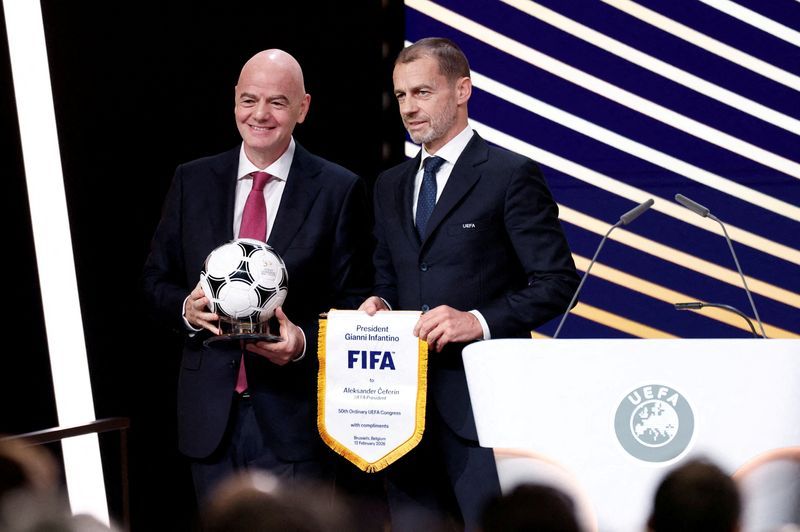
European football's governing body UEFA has escalated its confrontation with FIFA President Gianni Infantino by petitioning a United States federal court for access to documents and witness testimony held by FIFA's American subsidiaries. The move, detailed in a filing submitted under U.S. law, signals UEFA's determination to pursue criminal charges against Infantino and potentially other senior FIFA officials and advisers in Switzerland, centring on a controversial scheme that collapsed just days after its public unveiling last month.
At the heart of the dispute lies the FIFA Forward Enterprise proposal, which would have transferred commercial rights associated with men's and women's World Cups and the Club World Cup into a new subsidiary controlled by external investors. UEFA alleges that Infantino orchestrated this complex transaction behind closed doors, working with a handful of trusted advisers and investment partners while deliberately circumventing FIFA's established governance structures. The confederation argues that the proposal violated FIFA's statutes by sidelining the FIFA Council, regional football confederations, and the organisation's 211 member associations from any meaningful consultation process.
UEFA's court application specifically targets FIFA (AMERICAS), Inc. and FWC2026 US, Inc., two Florida-registered entities that UEFA believes possess crucial records documenting how the FFE transaction was conceived, structured, valued and eventually approved before its sudden withdrawal. The confederation claims these documents and witness accounts are essential for mounting a criminal mismanagement case under Article 158 of the Swiss Criminal Code, underscoring the severity with which UEFA views the alleged misconduct.
The valuation underlying the FFE proposal has become a central flashpoint in the dispute. According to UEFA's legal filing, external investors offered approximately $4.2 billion for a stake in the enterprise, implying a total valuation of around $20 billion for FIFA's commercial operations. UEFA contests this figure vigorously, asserting that it substantially undervalues FIFA's genuine commercial assets. The confederation further contends that the valuation process lacked transparency, noting that no competitive auction was held and no independent valuer scrutinised the figures, raising questions about whether FIFA deliberately suppressed valuations to facilitate investor participation.
Infantino has defended the scheme as a "golden opportunity" to expand football development funding globally, maintaining that it was merely a preliminary proposal requiring majority support from FIFA's member associations and approval from the FIFA Council before implementation. However, UEFA's investigation uncovered that FIFA staff members internally complained of being misled about the proposal's true nature and scope. Moreover, FIFA Secretary General Mattias Grafstrom reportedly was excluded from the drafting process entirely, a striking omission for such a significant strategic initiative that raised additional red flags about how the scheme was being managed.
Europe's response to the proposal was swift and unified. On July 30, UEFA's 55 member associations unanimously voted at an emergency meeting to withdraw all their teams from FIFA competitions, including the World Cup, unless the FFE plan was immediately abandoned. This unprecedented show of solidarity represented an existential threat to FIFA, whose commercial model depends overwhelmingly on revenue from World Cup tournaments. Facing the prospect of European teams' absence from the 2026 World Cup and other major competitions, FIFA capitulated within 24 hours, with Infantino announcing the proposal's withdrawal on July 31.
Yet UEFA's victory on the immediate issue has not satisfied the confederation's broader concerns about FIFA's governance and accountability. Despite securing written assurances that the FFE project had been "irrevocably and permanently withdrawn," UEFA only provisionally suspended its threat to boycott FIFA competitions. The confederation's 55 member associations have unanimously mandated UEFA to pursue "every available institutional, political and legal avenue" to force systemic reforms and restore meaningful constraints on presidential authority. UEFA has also demanded an independent external review of how the FFE proposal was conceived and advanced, explicitly rejecting FIFA's capacity to investigate itself and expecting the global football community to accept conclusions drawn from such an internal inquiry.
UEFA's position reflects broader scepticism about FIFA's governance culture and Infantino's leadership style. The confederation has questioned why Infantino felt compelled to seek outside investors when FIFA maintains reserves of several billion dollars that, according to UEFA, rightfully belong to member associations and should be deployed for development purposes through established channels. This argument resonates across football globally, as it frames the FFE scheme not merely as a governance violation but as a potential misappropriation of collective wealth.
Infantino's political standing, however, remains stronger in certain regions than UEFA suggests. While Europe has turned sharply against him, the African and South American confederations continue to support his leadership. The Saudi Arabian Football Federation explicitly backed Infantino on Thursday, issuing a statement endorsing his "continued efforts to restore unity across the football family and continue growing the game." With Infantino already signalling his intention to contest the March 2027 FIFA presidential election for a fourth term, regional support from Africa and South America could prove decisive, potentially offsetting European opposition.
For Southeast Asian football and Malaysian readers, the unfolding crisis at FIFA carries significant implications. Malaysia and other Asian nations depend on FIFA competitions for revenue, development funding, and international competitive opportunities. A destabilised FIFA leadership facing potential criminal prosecution could disrupt funding mechanisms, tournament scheduling, and governance clarity during a critical period for Asian football's growth. Additionally, questions about commercial rights valuation and investor participation in football structures could influence how Asian football confederations evaluate future partnerships with international investors or FIFA-affiliated entities.
UEFA's legal manoeuvre in the U.S. court system represents a calculated escalation beyond regulatory complaint into the criminal justice realm. By seeking American court assistance, UEFA has leveraged U.S. legal mechanisms to gather evidence for a Swiss prosecution, demonstrating that the confederation is prepared to pursue this matter with the full rigour of international law. This strategy signals that UEFA views the episode not as a policy disagreement subject to internal FIFA arbitration but as potentially criminal conduct warranting formal prosecution.
The coming months will test whether UEFA can maintain its coalition pressure while pursuing legal avenues simultaneously. The confederation's insistence on structural reforms and independent review suggests that even if FIFA temporarily shelves the FFE proposal, the underlying governance issues that permitted such a scheme to progress will continue generating friction between Europe and FIFA leadership. As Infantino prepares for his re-election campaign, the shadow of potential criminal liability and sustained calls for reform will frame his bid to extend his tenure.

