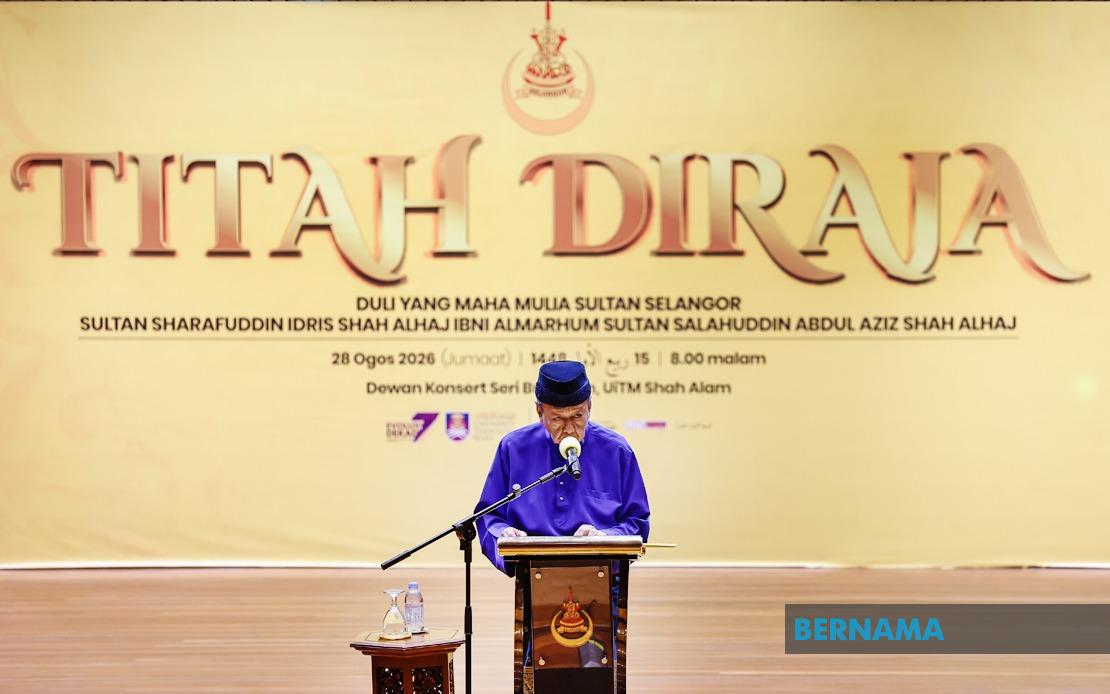
The Sultan of Selangor, Sultan Sharafuddin Idris Shah, has delivered a pointed reminder about Universiti Teknologi MARA's foundational responsibility, insisting that as the institution expands and modernises, it must not abandon the low-income Malay and Bumiputera youth from rural communities who form the bedrock of its legacy. Speaking at the university's 2026 Royal Address ceremony at Dewan Konsert Seri Budiman in Shah Alam, His Royal Highness articulated a vision in which UiTM remains a transformative force for students whose families work in agriculture, fishing, manufacturing, and other working-class occupations—groups that might otherwise face insurmountable barriers to higher education.
The Sultan's intervention carries particular weight given the ongoing debates in Malaysian higher education about equity, access, and the changing demographics of student enrolment. His statement reflects broader anxieties within the ruling establishment that economic liberalisation and the expansion of the private university sector might inadvertently create a two-tier system where prestigious institutions become progressively unaffordable or unwelcoming to their original constituency. By framing UiTM's mission in explicitly social-mobility terms, Sultan Sharafuddin has positioned the university as an instrument of national cohesion rather than merely an academic facility, linking educational opportunity directly to political stability and national development.
To understand the weight of this intervention, the scale of UiTM's achievement warrants context. The institution began in 1965 with a modest intake of 219 students and eleven faculty members, yet expanded dramatically within a single decade to accommodate nearly 7,000 pupils alongside a teaching complement of approximately 1,000 academics. The university now operates roughly 60 degree programmes and maintains branch campuses distributed across multiple states. In contemporary terms, UiTM produces more than 40,000 graduates annually and boasts an alumni network exceeding one million individuals—making it one of Southeast Asia's largest tertiary education providers by volume.
Yet expansion creates complacency risks. His Royal Highness warned explicitly that institutional growth should not marginalise the communities UiTM was created to serve. The statement implicitly rejects the notion that selectivity, rising entry standards, or fee increases—all common accompaniments to university expansion and internationalisation—should become barriers to access for economically vulnerable students. This reflects a fundamental tension in Malaysian higher education policy: the desire to compete globally and achieve world rankings often clashes with the inclusive mandate that justified public investment in the sector in the first place.
Sultan Sharafuddin proposed a concrete mechanism to sustain UiTM's accessibility mission. He called for an alumni contributions scheme whereby graduates would donate RM10 monthly or RM100 annually to support the institution. While modest at the individual level, the mathematics are striking: a one million-strong alumni network participating fully could generate approximately RM100 million annually. The Sultan framed this not as taxation but as reciprocal obligation—a recognition that alumni owe something to the institution that transformed their economic circumstances. This approach carries an implicit critique of privatisation models and tuition-fee dependency, suggesting instead that sustainable funding should flow from beneficiaries who have already experienced upward mobility.
The revenue model proposed carries particular relevance for Southeast Asian readers. Across the region, public universities face recurring budget pressures as governments prioritise healthcare and infrastructure spending. Malaysia, like its neighbours, has experimented with cost-sharing arrangements where students or families bear larger portions of educational expense. The Sultan's proposal suggests an alternative pathway: alumni networks themselves might become funding vehicles, enabling universities to serve new generations of disadvantaged students without shifting costs downward to already-struggling families. This principle could resonate across Thailand, Indonesia, and the Philippines, where public university systems similarly struggle to maintain access missions amid fiscal constraints.
The Sultan's characterisation of UiTM's true success metric deserves emphasis. He deliberately pivoted away from quantitative measures—enrolment figures, graduation rates, research outputs—toward qualitative outcomes: whether the institution has genuinely transformed lives and catalysed national development. This represents a subtle but significant reframing of university excellence. Rather than accepting the global rankings consensus that emphasises research productivity and international reputation, His Royal Highness identified social impact as the fundamental metric. He noted that UiTM graduates populate every professional sector—accounting, engineering, medicine, law, architecture, public service, entrepreneurship, the arts, and media—and that their collective contribution to the economy and society justifies the institution's existence far more meaningfully than prestige or global standing.
This perspective carries important implications for Malaysian policymakers wrestling with higher education reform. The proliferation of private universities, the push toward fee-based models, and the emphasis on international competitiveness have subtly reoriented institutional missions away from social equity. By invoking UiTM's original purpose with such directness and moral clarity, the Sultan has essentially issued a reminder that public universities serve purposes beyond market competition. They are instruments of social mobility, engines of inter-generational opportunity, and stabilisers of broader national cohesion.
The Sultan's remarks also subtly address concerns about changing student demographics. Malaysia has witnessed gradual shifts in university composition as rising middle-class enrolments and private institution growth have altered the profile of first-generation learners. Some observers worry that institutions like UiTM might become progressively middle-class, with working-poor families finding it harder to navigate admissions processes or afford living expenses despite nominal fee structures. By reasserting the primacy of access for rural and economically vulnerable populations, Sultan Sharafuddin has pushed back against this drift.
Moreover, the Sultan's invocation of the "UiTM Dihatiku" (UiTM in My Heart) slogan signals the importance of emotional and psychological investment in institutional identity. He suggested that this affirmation should translate into concrete material support, turning sentiment into financial commitment. For a generation of UiTM alumni who have achieved professional success and accumulated resources, the proposal represents a test of whether that sentiment extends beyond graduation ceremonies into sustained engagement with institutional wellbeing.
The presence of Higher Education Minister Datuk Seri Dr Zambry Abd Kadir at the ceremony suggests official receptivity to these ideas, though implementation would require coordination across government education agencies, UiTM administration, and alumni associations. Creating the administrative infrastructure for a voluntary contribution system, ensuring transparency in fund utilisation, and designing support mechanisms for struggling students all present operational challenges.
For Southeast Asian educators and policymakers observing Malaysian developments, the Sultan's address offers a counterweight to prevailing globalisation narratives. It asserts that even as universities internationalise and aspire to world-class status, their primary accountability remains to the communities and social strata they were established to serve. This is particularly resonant in a region where public higher education systems inherited missions centred on nation-building, equity, and inclusive development—commitments that require active, sustained reaffirmation to remain operational.

