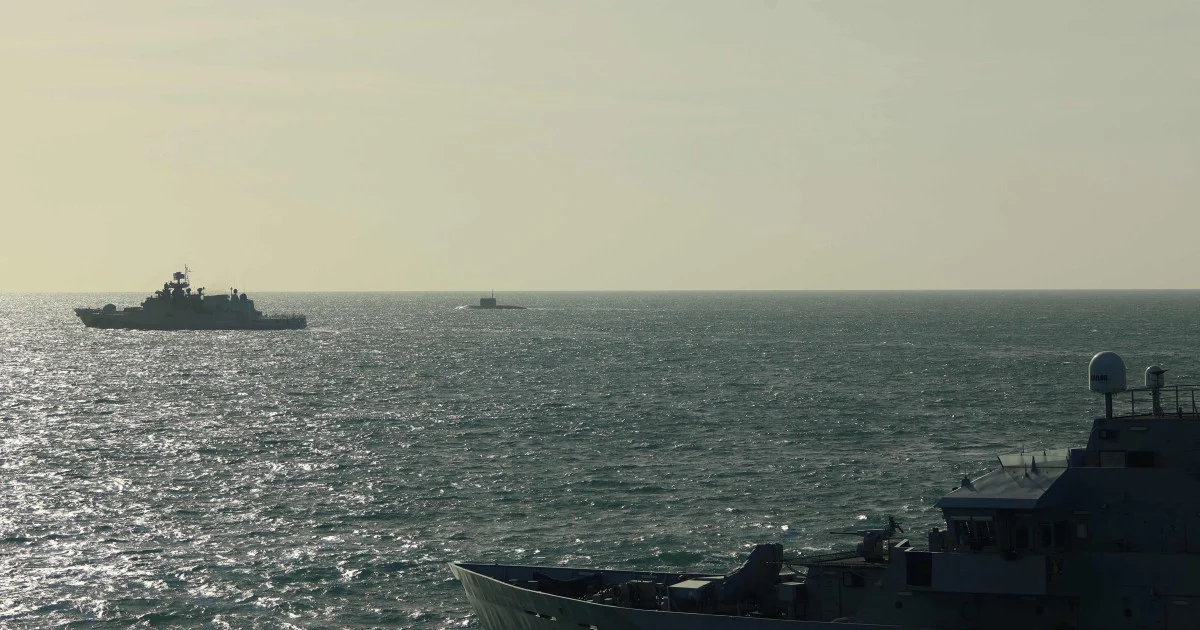
British Prime Minister Keir Starmer on Wednesday sought to temper international alarm over a Russian warship firing warning shots near a civilian yacht in the English Channel, describing the episode as an act of dangerous carelessness rather than intentional provocation. The distinction drawn by the premier reflects competing pressures: the need to respond seriously to an apparent violation of international maritime protocols while avoiding language that might escalate already fraught relations between London and Moscow to a further diplomatic crisis.
The incident itself underscores the precarious nature of naval operations in one of Europe's busiest waterways, where British and Russian vessels regularly traverse the same strategic corridor. The English Channel remains a crucial chokepoint for global commerce and military mobility, making any confrontation there laden with symbolic and practical significance. For policymakers in London, the challenge lies in responding proportionately without playing into Moscow's apparent strategy of testing Western resolve through repeated boundary-pushing actions at sea.
Starmer's characterisation carries particular weight given Britain's role as a NATO member with significant naval assets operating near Russian interests. By framing the warship's actions as reckless rather than sinister, the British leader avoided inflaming rhetoric while still placing responsibility squarely on Moscow for dangerous seamanship. The terminology matters considerably in diplomatic circles, where precise word choice can determine whether an incident becomes a manageable flashpoint or crystallises into a broader escalation narrative.
Russia has deployed its naval forces with increasing frequency in waters claimed by Western nations, testing the boundaries of international maritime law and NATO responses. These operations form part of a broader pattern of Russian assertiveness in European waters, ranging from submarine incursions to naval exercises conducted in provocative proximity to allied coastlines. The warship incident in the English Channel represents another data point in this escalating pattern, signalling Moscow's willingness to risk confrontation for tactical or strategic advantage.
For maritime security analysts, the incident highlights vulnerabilities in existing protocols governing naval conduct in international waters. While established conventions govern the use of warning shots, enforcement mechanisms remain limited, and disputes frequently arise over whether particular actions constitute genuine safety measures or deliberate intimidation. The ambiguity allows states to pursue aggressive postures while maintaining plausible deniability about hostile intent—precisely the space that Starmer's statement acknowledges exists.
The broader context of UK-Russia relations extends far beyond the English Channel incident. Britain has emerged as one of Moscow's most vocal critics following Russia's invasion of Ukraine, providing substantial military and financial support to Kyiv and introducing comprehensive economic sanctions targeting Russian interests. This geopolitical background inevitably colours any maritime confrontation, with each side interpreting incidents through the lens of existing animosity. Starmer's measured response must therefore balance the demands of alliance solidarity with the dangers of uncontrolled escalation.
For Southeast Asian maritime powers observing these European tensions, the incident offers uncomfortable parallels to their own experiences with assertive naval conduct in contested waters. The principles at stake—freedom of navigation, respect for international law, and the right to operate in international waters without harassment—resonate across multiple regions experiencing similar pressures from more powerful neighbours. The way Western nations respond to Russian provocations thus carries implications for how smaller states might expect support when facing comparable challenges.
The incident also reflects the thin line separating military professionalism from dangerous brinkmanship. Warning shots in confined waters can easily escalate from deterrent measure to provocation, particularly when communications between vessels operate under stress or through linguistic barriers. The English Channel's congestion means that any naval confrontation risks affecting third-party commercial traffic and innocent civilian mariners, extending consequences beyond the immediate protagonists.
British officials have not disclosed the precise circumstances surrounding the warship encounter or the identity of the vessel targeted by warning shots, limiting public understanding of the severity or specific context. This informational reserve, while potentially responsible in security terms, also prevents independent assessment of whether Starmer's characterisation fully captures the incident's nature. The opacity that often surrounds maritime incidents leaves room for divergent interpretations and subsequent dispute about what actually occurred.
Starmer's response signals that London intends to manage the incident through diplomatic channels while maintaining deterrent capabilities in the region. British naval forces continue operating in areas adjacent to Russian interests, suggesting no intention to yield navigational space or modify operational patterns in response to intimidation. This approach aims to convey resolve without triggering the kind of tit-for-tat escalation that could transform isolated incidents into sustained crises.
Moscow's apparent tolerance for international criticism of its maritime activities suggests confidence that Western responses will remain constrained by economic interdependence concerns and alliance management complexities. The Russian calculus appears to rest on the assumption that Britain and its allies will absorb provocative incidents as costs of strategic competition without allowing them to fundamentally alter the diplomatic framework.
Moving forward, the incident underscores the necessity for enhanced communication mechanisms between British and Russian naval commands, despite broader political hostilities. Professional protocols governing maritime encounters can reduce misunderstandings and prevent accidental escalation, even when strategic competition remains intense. Whether either side possesses sufficient interest in such arrangements remains uncertain, but the alternative—continued unpredictable naval interactions in crowded waters—carries unacceptable risks for neutral parties and regional stability alike.