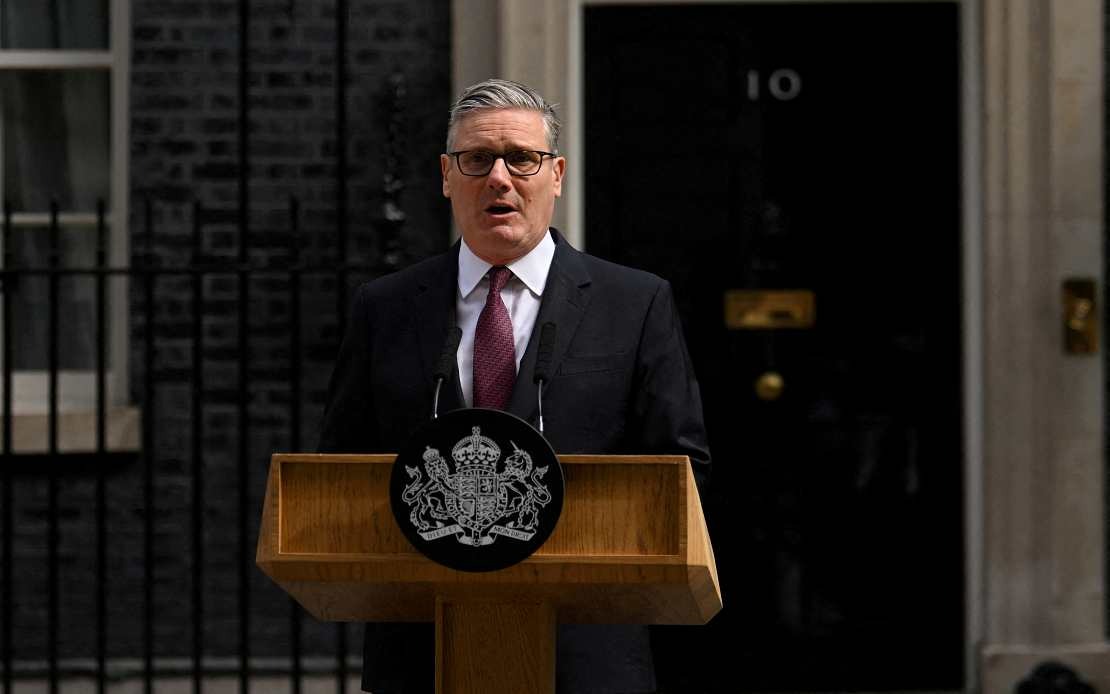
British Prime Minister Keir Starmer has demanded an urgent return to ceasefire negotiations between the United States and Iran, warning that the breakdown in diplomatic efforts poses a serious threat to global maritime commerce. Speaking at a joint press conference in Paris alongside leaders from France, Germany and Ukraine on Monday, Starmer emphasised that the cycle of military strikes between Washington and Tehran must be halted immediately to prevent further destabilisation of one of the world's most critical shipping corridors.
The crisis centres on the Strait of Hormuz, a narrow waterway connecting the Persian Gulf to the Indian Ocean through which roughly one-third of global seaborne oil passes annually. Control of this passage has long carried immense geopolitical and economic significance, and recent developments signal a dangerous escalation that could reverberate through international energy markets and supply chains worldwide. For Malaysia and the broader Southeast Asian region, which depends heavily on stable energy supplies and uninterrupted trade flows, the standoff represents a tangible threat to regional prosperity and economic growth.
Starmer's condemnation of Iranian strikes on commercial vessels and regional allies reflected mounting Western concern that the conflict is spilling beyond traditional military targets into civilian shipping lanes. The Prime Minister explicitly stated that such attacks on merchant traffic must cease, signalling that Britain views Iran's actions as disproportionate and destabilising. His remarks underscored how attacks on commercial infrastructure create a chilling effect on international shipping companies, many of which are already reassessing routes and insurance costs.
The backdrop to Starmer's intervention involves a dramatic reversal of earlier diplomatic progress. A memorandum of understanding intended to end the US-Israeli conflict had been signed in June, with expectations that Iran would correspondingly reopen the Strait of Hormuz to normal traffic. However, renewed military exchanges over the weekend between American and Iranian forces have unraveled those tentative arrangements. President Donald Trump announced that the US was reinstating economic pressure on Iran through a blockade and imposing what he characterised as transit fees on vessels seeking safe passage through the waterway.
This attempt to impose paid passage on international shipping through the strait represents an extraordinary assertion of control over what is internationally recognised as a vital global commons. The approach has few historical precedents among modern maritime powers and contradicts established international law regarding freedom of navigation. For smaller nations with limited naval capacity, including Malaysia, such a system would create acute vulnerabilities and impose significant economic costs on trading activities.
Starmer's positioning reflected a carefully calibrated diplomatic stance that seeks to protect commercial interests while maintaining leverage with the United States. Britain announced readiness to deploy naval assets to maintain freedom of navigation, a commitment that resonates with London's traditional role as a guarantor of global maritime security. This gesture also signals to Southeast Asian partners that Western powers remain committed to upholding the international rules-based order in critical sea lanes.
The Paris gathering itself carried symbolic weight, bringing together leaders of Western nations and Ukraine to coordinate responses to multiple regional crises. The inclusion of Volodymyr Zelensky alongside European leaders and the British Prime Minister suggested an attempt to forge consensus on how democratic nations should respond to authoritarian challenges across multiple theatres. However, the focus on Iran-US tensions indicated that Middle Eastern instability remains a pressing concern for transatlantic policymakers.
Starmer's emphasis on resuming negotiations rather than escalating military responses represents a diplomatic preference for dialogue, despite his strong language condemning Iranian actions. This approach reflects recognition that military escalation could spiral into a broader conflict with unpredictable consequences for global energy security and regional stability. The call for unrestricted freedom of navigation alongside ceasefire talks represents an attempt to bundle security assurances with diplomatic engagement.
The underlying dispute stems from the February outbreak of major conflict between the United States and its Israeli ally against Iranian-backed forces and Iran itself. Iran's decision to effectively blockade the Strait of Hormuz represented a dramatic escalation of asymmetric pressure, using control of critical infrastructure to impose costs on adversaries and their trading partners. The June ceasefire agreement had offered hope that this dangerous spiral might be contained and reversed.
For Malaysia and other developing economies dependent on stable energy imports, the implications are substantial. Disruptions to Persian Gulf oil flows trigger price increases that ripple through the global economy, raising import costs and damping growth prospects. Insurance premiums for vessels transiting contested waters also rise sharply, effectively imposing an invisible tax on all goods moving through the region. Extended shipping delays and route diversions further compress profit margins for trading companies.
The British call for urgent ceasefire resumption reflects underlying anxiety that without swift diplomatic intervention, the situation could deteriorate further into tit-for-tat military exchanges with no clear off-ramp. Each round of strikes, whether by the US blockading Iran's economy or Iran targeting shipping, hardens positions and makes compromise more difficult. Starmer's intervention sought to inject political momentum toward de-escalation before military logic overwhelms diplomatic possibilities.
Malaysia and other ASEAN nations have traditionally sought to maintain equidistant relationships with major powers while protecting their maritime interests. The current situation tests this balancing act, as stability in the Strait of Hormuz directly affects regional prosperity. Southeast Asian governments will be watching closely whether Western diplomatic efforts succeed in restoring ceasefire arrangements or whether the standoff persists as a chronic source of uncertainty in global energy and shipping markets.

