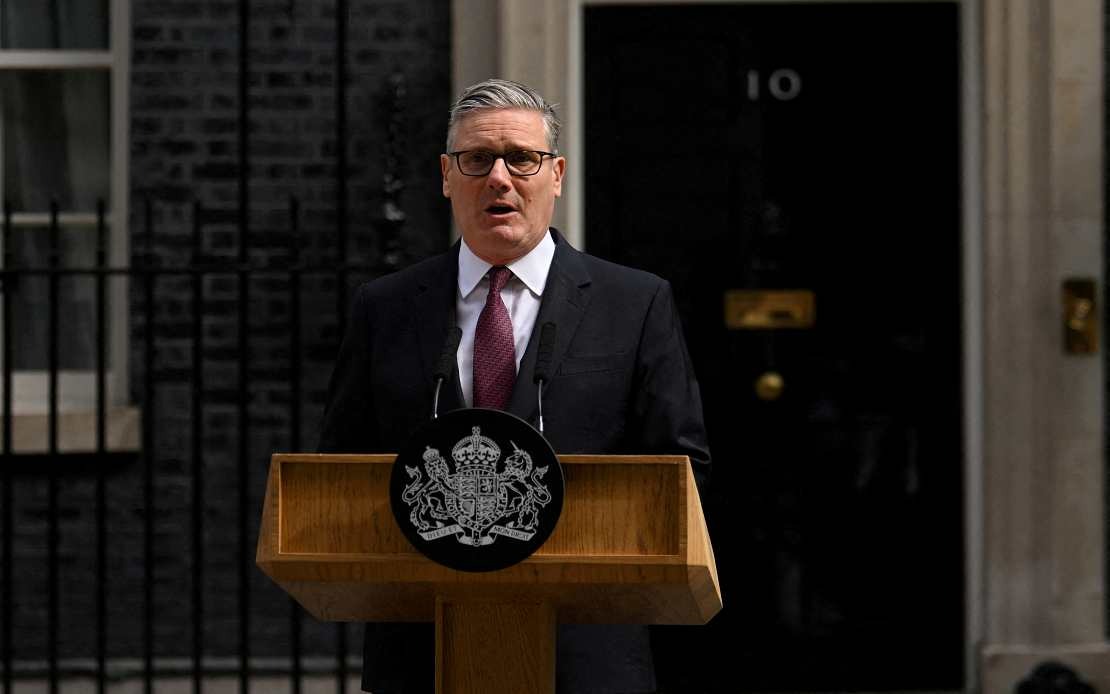
British Prime Minister Keir Starmer has announced his intention to resign from his position as Labour leader, intending to remain in office until a successor is selected and ready to govern when parliament reconvenes in September. This decision concludes months of mounting pressure on Starmer, whose popularity has collapsed to record lows despite taking office less than two years ago following an overwhelming electoral mandate that was supposed to restore stability to British politics.
Starmer's announcement represents a dramatic reversal from his earlier position. Just days before stepping back from his leadership ambitions, he had indicated he would contest any formal party leadership election sought to unseat him. His shift in stance over the weekend underscores the severity of the internal revolt against his leadership and the Labour Party's conviction that a change at the helm is essential to arrest its declining fortunes.
The immediate catalyst for Starmer's downfall was Andy Burnham's commanding victory in a parliamentary by-election held on Friday. Burnham, who serves as mayor of Greater Manchester and is regarded as one of Labour's most accomplished communicators, won his seat by convincingly defeating the Reform UK candidate. This outcome proved psychologically significant for Labour MPs, many of whom believe Burnham possesses the political acumen and public appeal necessary to rehabilitate a party haemorrhaging public support under Starmer's leadership.
Reform UK, led by Nigel Farage, has maintained a commanding position in national polling for over a year, reflecting profound voter dissatisfaction with the political establishment. Burnham's by-election triumph, therefore, offered Labour a glimmer of hope that a change of leadership might enable the party to reclaim ground against the surging right-wing party and restore its competitive standing in British electoral politics.
Yet Burnham's elevation to the party leadership would not immediately resolve the structural difficulties afflicting British politics and the broader economy. His stated priorities focus on fundamental economic transformation and reducing the cost of living, concerns that resonate with voters across the political spectrum. However, he has offered limited detail about how his administration would approach foreign policy, manage the economy, or handle defence matters—crucial portfolios that would demand immediate attention.
Burnham would inherit a fiscal landscape constrained by historically unfavourable market conditions. Britain currently carries the highest borrowing costs among Group of Seven economies, a consequence of elevated national debt, substantial interest payments, sluggish economic expansion spanning years, and persistent difficulty in reducing public expenditure. Meanwhile, critical defence and infrastructure investments remain pressing requirements. These realities sharply circumscribe the room available for new policy initiatives, regardless of who occupies Number 10.
Investor sentiment regarding a potential Burnham premiership remains fractured. His previous remarks suggesting Britain must escape dependence on bond market approval have sparked anxiety among financial analysts who question whether he would prioritise fiscal discipline and market confidence. Economists at Citibank cautioned that Burnham would inherit an exceptionally precarious fiscal position with minimal instruments to implement substantive policy changes—a sobering assessment that mirrors the constraints facing Starmer.
Starmer's departure marks the seventh prime ministerial transition since the 2016 Brexit referendum, an extraordinary level of churn that reflects the profound instability plaguing British governance. This turnover frequency, unmatched in nearly two centuries of British political history, demonstrates how successive administrations have struggled to satisfy voters increasingly angry about stagnant living standards, deteriorating public services, and the government's failure to address illegal immigration. Each new premier inherits the accumulated disappointment of citizens convinced their country has fundamentally ceased functioning.
The political advisory organisation Eurasia had previously suggested that an arrangement allowing Starmer to announce his departure whilst remaining in post until September would prove optimal. This staging would permit him to attend a significant UK-European Union reset summit scheduled for July, providing continuity on the international stage whilst allowing Burnham sufficient preparation time before formally assuming office. The proposed timeline represents a compromise between managing the immediate succession crisis and preserving institutional stability during the transition.
For Southeast Asian observers, the British political turmoil offers instructive parallels regarding electoral volatility and voter anger directed at incumbent coalitions. The rise of populist challengers like Farage's Reform UK, the erosion of establishment party legitimacy, and the rapid succession of failed leadership attempts demonstrate how disconnection between political elites and ordinary citizens can destabilise even long-established democracies. Malaysia's own political landscape, characterised by periodic shifts in voter preference and coalition realignment, underscores the universal challenge of maintaining public confidence in institutions and delivery of tangible improvements in citizens' living conditions.