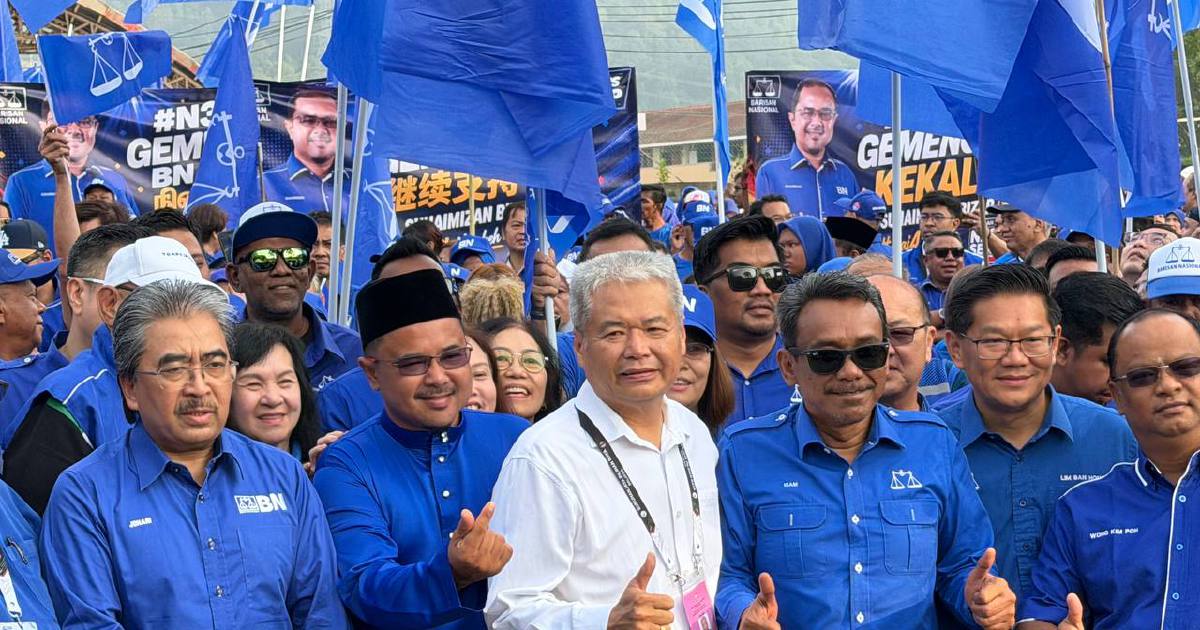
The presence of two senior Umno office-holders at the Dewan Perdana Tampin underscored the coalition's determination to project a unified front as nomination day for the Negri Sembilan state election unfolded. Umno vice-president Datuk Seri Johari Abdul Ghani and party treasurer Datuk Seri Tengku Adnan Tengku Mansor arrived at the venue to accompany Barisan Nasional candidates filing their nominations, a symbolic gesture reflecting the party's commitment to the contest in the state.
The staging of senior party figures at nomination centres has become standard practice in Malaysian electoral campaigns, serving multiple purposes beyond the ceremonial. Such appearances communicate internal party discipline and cohesion to both supporters and opponents, demonstrating that the top echelon remains engaged with ground-level contest mechanics. For Barisan Nasional, which has faced cyclical periods of internal strain and electoral uncertainty, maintaining visible leadership presence carries particular weight in reassuring the traditional coalition machinery and grassroots loyalists of institutional stability.
Negri Sembilan holds strategic importance within Malaysian politics. The state, with its mix of urban and rural constituencies, has historically served as a bellwether for broader political sentiment. The state election represents an opportunity for Umno to consolidate support within a crucial heartland, particularly given the party's historical dominance in the state assembly. A strong performance in Negri Sembilan would provide momentum heading into future electoral contests and reinforce Umno's position as the leading component of Barisan Nasional.
The nomination process itself marks the formal commencement of campaign activities, transforming political positioning from behind-the-scenes preparation into public contest. Candidates must submit their nomination papers at designated centres, with party leadership attendance serving as a morale-boosting exercise and media opportunity. The presence of Johari Abdul Ghani and Tengku Adnan Tengku Mansor ensured that the Tampin nomination filing received attention as a significant party event rather than mere procedural formality.
Johari Abdul Ghani holds considerable influence within Umno's internal hierarchy as vice-president, a position that places him among the party's top decision-makers. His appearance at nomination centres signals his direct involvement in campaign management and reflects the pecking order of party leadership. Tengku Adnan Tengku Mansor, serving as party treasurer, brings the perspective of the machinery responsible for resource allocation and campaign financing—indicating that financial preparation supports the candidate slate being fielded.
The Negri Sembilan election occurs within a broader context of Malaysian political realignment. The state, like others across the peninsula, has witnessed voter volatility in recent election cycles, with traditional party loyalties facing challenges from emerging political movements and shifting demographic patterns. Barisan Nasional's performance in such contests provides crucial data about the coalition's resilience and its ability to retain support among traditional constituencies. Success in Negri Sembilan would demonstrate that the coalition retains capacity to mobilise voters despite questions that periodically arise regarding its relevance in contemporary Malaysian politics.
The visible engagement of senior Umno figures also addresses internal party dynamics. Umno has navigated periods of factional tension, with ambitious politicians occasionally positioning themselves for future leadership contests. By appearing together at campaign events, senior leaders can demonstrate personal cohesion and commitment to collective party objectives, potentially tempering speculation about internal divisions or competing ambitions that might undermine electoral performance.
For Barisan Nasional candidates themselves, receiving accompaniment from party vice-president and treasurer provides tangible evidence of institutional support and suggests that campaign resources, both financial and organisational, will flow toward their candidacies. This assurance matters significantly in states where electoral competition remains fierce and where candidates require confidence that the party machinery will deploy resources effectively on their behalf.
The Tampin nomination centre event reflects the choreographed nature of modern Malaysian political campaigns, where leadership appearances are scheduled carefully to generate media coverage and reinforce particular messages. The choice of Tampin as a focal point for senior leadership attention indicates that the constituency holds significance within Barisan Nasional's campaign strategy for Negri Sembilan, whether due to electoral competitiveness, its representation of particular voter demographics, or its symbolic value within state politics.
As the Negri Sembilan state election campaign progresses, such leadership engagement will likely intensify, with senior Umno and Barisan Nasional figures making rounds across contested constituencies to provide encouragement and demonstrate party investment in victory. The nomination filing, culminating in such visible displays of leadership support, sets the tone for a campaign season that will test whether the coalition can maintain electoral momentum and validate claims of institutional effectiveness and organisational capacity to deliver results.

