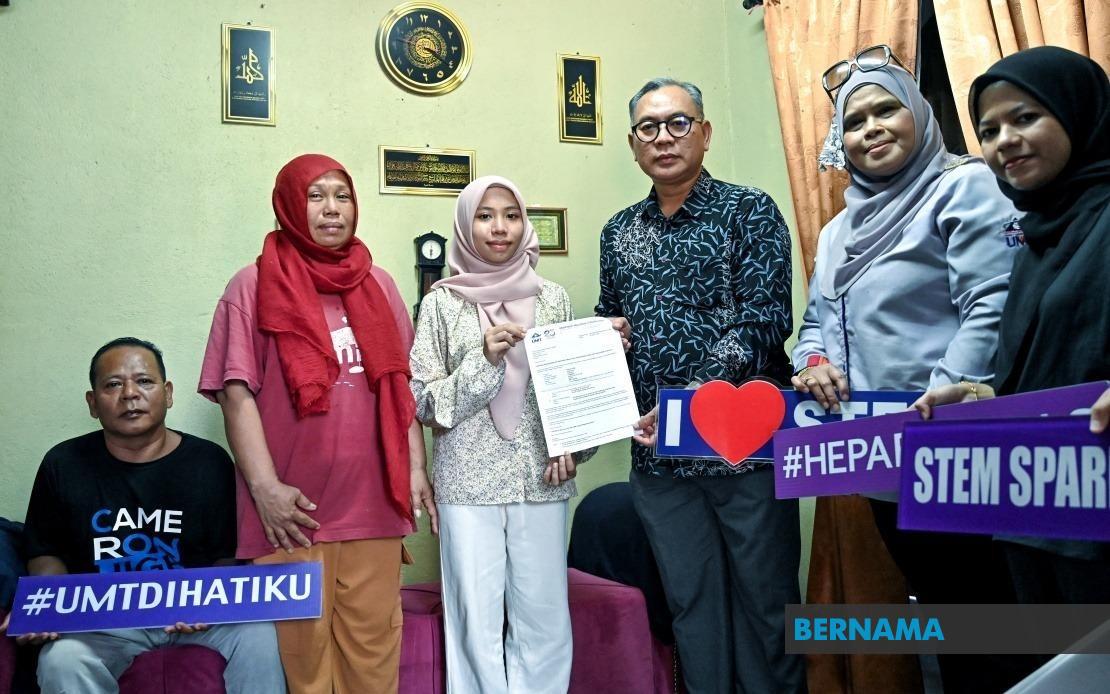
Nurul Amira Abdul Hamid's university dreams hung in the balance when her family's financial struggles threatened to derail her academic prospects. The eighteen-year-old from Parit Jawa in Bagan Serai had secured an offer to enrol at Universiti Malaysia Terengganu, yet the weight of registration and tuition fees loomed as an insurmountable barrier. With her father, Abdul Hamid Othman, managing chronic health issues and her mother, Asmah Che Ros, working as a housewife, the family lacked the means to support her higher education ambitions. The situation forced Nurul Amira to contemplate declining her place entirely and remaining in the workforce.
After completing her Sijil Pelajaran Malaysia examinations with three A grades, Nurul Amira took employment at a local goods store earning RM1,300 monthly to contribute to household finances and ease the burden on her parents. Working at this modest wage while watching peers advance to university felt like a crossroads moment in her life. Rather than accept what seemed inevitable, she reached out directly to UMT to explain her predicament, hoping the institution might recognise her situation and offer some form of support. The proactive approach proved decisive in changing her trajectory.
Universiti Malaysia Terengganu responded by offering Nurul Amira a pathway to tertiary education through multiple forms of financial assistance. The institution arranged the Al-Ikhlas Scholarship providing RM500, complemented by additional funding mechanisms designed to alleviate the cost of her one-year Science, Technology, Engineering and Mathematics Foundation programme. Beyond the scholarship, UMT additionally covered RM400 in related fees that would have otherwise fallen to her family. This multi-layered support system acknowledged that single interventions often prove insufficient for students facing compounded economic challenges.
The university's commitment extended further than merely funding academic programmes. Understanding that Nurul Amira's family possessed neither the financial capacity nor the means to transport her to campus, UMT actively arranged her transportation and provided living assistance throughout her study period. This holistic approach recognised that financial barriers to education encompass far more than tuition alone; accommodation, meals, transport, and study materials create an interlocking system of costs that can overwhelm families already managing tight budgets. By addressing these peripheral expenses, the institution ensured she could concentrate fully on her coursework without the constant anxiety about meeting basic needs.
UMT Vice-Chancellor Prof Dr Mohd Zamri Ibrahim emphasised the institution's philosophical commitment to ensuring no deserving student remains behind due to economic circumstances. His public statement reflected a deliberate institutional strategy whereby university leadership personally engages with students and families navigating financial hardship. Rather than relegating such matters to administrative departments, the vice-chancellor positioned direct engagement as a core university responsibility. This approach signals that accessibility and equity represent institutional priorities rather than peripheral concerns addressed through bureaucratic procedures.
The vice-chancellor's invitation to students facing financial difficulties to approach the university first, before declining admission, speaks to a fundamental philosophical stance about tertiary education's democratisation. By explicitly stating that UMT will respond with assistance rather than rejection, the leadership removed a psychological barrier that often prevents disadvantaged students from even attempting to negotiate with institutions. Many students from low-income backgrounds assume universities operate with fixed policies offering no flexibility; by publicly reframing institutional responsiveness, UMT encouraged such students to advocate for themselves rather than silently withdrawing from consideration.
During the 2024 academic year, UMT has provided financial assistance to more than ten students from underprivileged families. While this figure may seem modest in an institutional context, it represents a deliberate prioritisation strategy. The consistency of identifying and supporting such cohorts suggests established mechanisms for identifying vulnerable students early in the admissions cycle rather than waiting for them to face crisis situations. This preventative approach potentially captures more potential beneficiaries than reactive systems that only assist students who independently voice their struggles.
Nurul Amira's case exemplifies how seemingly small scholarships and support mechanisms can catalyse transformative life outcomes. Her trajectory from shelf-stocking to STEM Foundation studies represents more than personal advancement; it represents the preservation of human capital within Malaysia's higher education ecosystem. Students like Nurul Amira, selected through competitive admission processes and demonstrating academic excellence through their SPM results, represent Malaysian talent that might otherwise be lost to the economy through underemployment in low-wage retail positions.
The maritime and nautical science field that Nurul Amira will pursue through her eventual Bachelor's degree connects directly to Malaysia's strategic economic interests. As a nation with significant maritime boundaries and a crucial position within global shipping lanes, Malaysia requires skilled professionals across marine-related disciplines. Students from lower-income backgrounds often possess particular motivation and dedication, having overcome obstacles that more privileged peers never encounter. Their presence in specialised fields like maritime transportation strengthens institutional diversity while addressing specific workforce development needs.
UMT's intervention raises broader questions about how Malaysia's higher education sector should systematically approach equity and access. While individual institutional generosity remains commendable, systemic solutions require coordinated policy frameworks that incentivise universities to proactively support disadvantaged students. The government's role in financing or subsidising such support mechanisms becomes increasingly important as the number of academically capable yet financially constrained students potentially swells. Nurul Amira's success story, while genuinely positive, also highlights the contingency inherent in relying on individual institutional benevolence rather than guaranteed support structures.
For Nurul Amira and her family, UMT's intervention transformed an anticipated disappointment into genuine possibility. Her journey from SPM student to STEM Foundation participant to future maritime professional demonstrates how targeted institutional support addresses not merely immediate financial barriers but enables long-term social mobility and career development. As she progresses through her studies, her success will likely inspire younger students from similar backgrounds while validating UMT's investment in equitable access policies. The ripple effects of supporting a single motivated student extend far beyond individual beneficiary, influencing family aspirations and community perceptions of what educational advancement remains achievable for those facing economic constraints.

