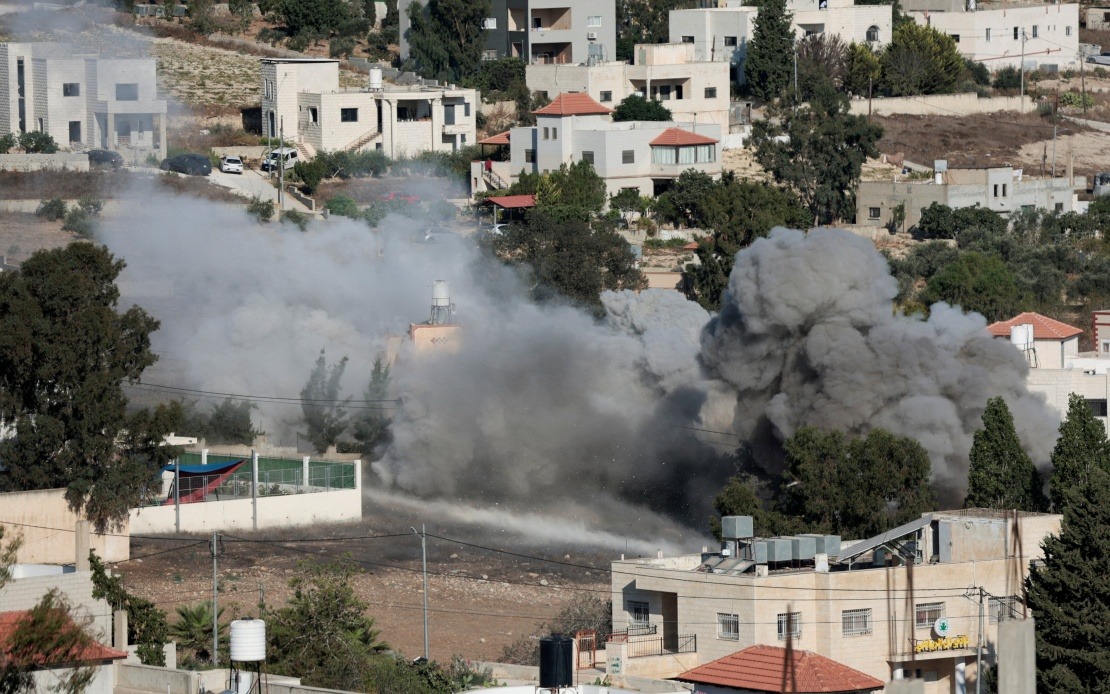
The United Nations Human Rights Office operating in the Occupied Palestinian Territory has documented a marked deterioration in the security situation facing Palestinian communities, with Israeli settler violence now reaching what it describes as an unacceptable threshold. The office has called for immediate intervention by Israeli authorities to halt the pattern of attacks and unlawful land seizures that have become systematic across the territory, while demanding the dismantling of settler outposts that serve as launching points for assaults against Palestinian civilians.
The characterisation by the UN body reflects mounting international concern over the nexus between settler expansion and communal violence in the West Bank. Since an Israeli colonial outpost was established near Qusra, a town south of Nablus, in November 2025, the surrounding region has experienced a steady intensification of hostile activities. Settlers have progressively taken control of territory adjacent to Palestinian settlements, using this territorial grip to launch coordinated campaigns of intimidation and resource denial against Palestinian residents who have inhabited these lands for generations.
The catalogue of abuses documented by the UN office spans a wide spectrum of violent and harassing conduct. Homes have been invaded without legal authority, Palestinian families subjected to physical assault, property vandalised, livestock and possessions stolen, and buildings deliberately set ablaze. These incidents extend beyond individual criminal acts to include the targeting of communal spaces, notably a mosque which came under attack from settler groups seeking to disrupt religious and cultural life in affected villages. The cumulative effect of such activities is designed to generate an atmosphere of fear and instability.
Among the most egregious incidents documented was an event in July involving settlers from the Ras al-Ain outpost in the Qusra area who orchestrated a comprehensive blockade of three Palestinian homes. The settlers severed water and electricity connections to these dwellings, effectively cutting residents off from essential utilities. This initial act of collective punishment escalated further when, on August 9, settlers erected barriers at all vehicular and pedestrian access points, establishing a physical cordon around the homes and preventing occupants from either entering or leaving the encircled area.
The consequences of this siege for the trapped Palestinian families proved immediately dire. Three households comprising approximately fifteen individuals, including at least two children, found themselves confined within their homes under conditions of extreme duress. Unable to access clean water or reliable electricity, and prevented from obtaining food and medical supplies, the families faced escalating risks to their health and wellbeing. Residents made multiple appeals to Israeli military personnel stationed at the vicinity to intercede and restore access, but these requests went unheeded. Israeli forces stationed at the scene appeared instead to enforce the cordon, actively preventing ambulance crews, human rights workers, and journalists from approaching the blockaded homes.
While Israeli soldiers eventually removed the physical barriers that settlers had erected on August 12, they refrained from removing the settlers themselves from the area. This partial intervention left the three families still surrounded by a hostile population, with the military presence failing to establish genuine protection or freedom of movement. The UN office assessed that the removals of the tent did not represent a material improvement in the situation and that risks of further escalation remained acute.
The UN Human Rights Office has characterised these actions as criminal conduct that occurs either with explicit support or implicit tolerance from the Israeli state apparatus. As the occupying power in the West Bank, Israel bears direct responsibility under international law for preventing such attacks, investigating perpetrators thoroughly, and ensuring that those found culpable face penalties proportionate to their crimes. The office stressed that the pattern of behaviour documented in Qusra and similar locations represents a deliberate strategy aimed at rendering Palestinian life untenable in targeted areas, with the ultimate objective of triggering involuntary displacement and territorial abandonment.
The international legal framework governing this situation has been clarified through the International Court of Justice, which has determined that all Israeli colonies established in occupied territory are inherently illegal under international law. The ICJ has issued explicit directives that Israel must cease all colonial expansion activities, evacuate all settler populations including those engaged in violent harassment of Palestinians, and terminate its unlawful presence throughout the West Bank. These rulings establish an unambiguous legal standard that should govern Israeli policy and conduct.
The UN office has stressed that compliance with international humanitarian law requires Israel to fulfil specific obligations toward the Palestinian population under occupation. These include establishing and maintaining adequate security apparatus to detect and prevent settler attacks before they occur, conducting thorough and impartial investigations into all incidents that do transpire, and ensuring accountability through the criminal justice system for perpetrators, their supporters, and officials who tolerate such violations. Without robust implementation of these mechanisms, the pattern of violence will persist.
For Malaysian observers, this situation reflects broader tensions within international humanitarian law between occupation powers and civilian populations in occupied territories. The siege incident involving the three families in Qusra represents an extreme manifestation of collective punishment tactics that have long drawn criticism from human rights organisations globally. Malaysia, as a nation with historical experience of occupation and security conflicts, maintains strong positions on Palestinian rights within international forums and has consistently advocated for adherence to international law principles that govern military occupation and civilian protection.
The urgency conveyed by the UN office regarding the situation of the three families underscores that windows for peaceful resolution narrow when territorial disputes harden into patterns of forced displacement. The families remain trapped in a precarious situation with limited prospects for relief absent external pressure on the Israeli authorities to enforce security protocols that prevent settler violence and restore normal access to essential services. The office's warning that time is running out reflects genuine concern that without immediate intervention, these families will face displacement from their ancestral lands.

