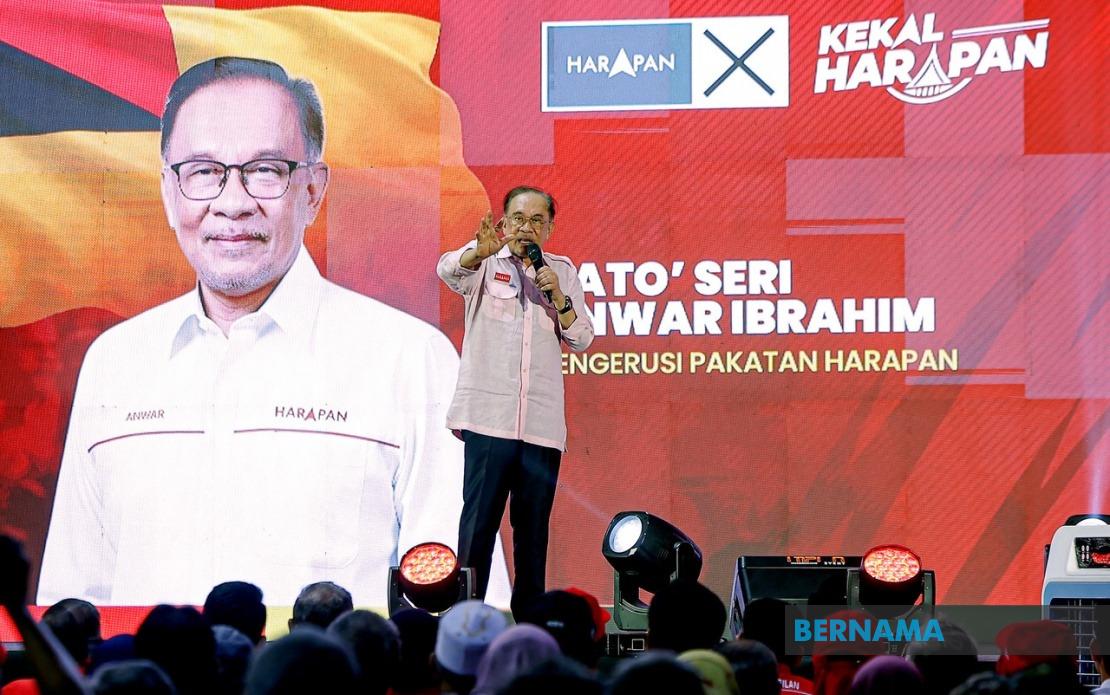
Prime Minister Datuk Seri Anwar Ibrahim has moved to reassure Malaysians about the resilience of the federal Unity Government, declaring that the coalition maintains its strength and cohesion at the national level despite mounting pressures from electoral competition occurring simultaneously across Malaysian states. Speaking in Seremban on July 22, Anwar sought to dispel any concerns about potential fractures within the governing alliance by highlighting that ministerial coordination continues to function effectively, with Cabinet meetings proceeding on schedule and without disruption.
The assertion comes at a time when Malaysia's political landscape faces concurrent pressures at different governance levels. While the ruling coalition partners—encompassing parties such as Pakatan Harapan and Barisan Nasional—compete vigorously against one another for state-level dominance and voter support in various constituencies, Anwar stressed that these electoral contests have not infected federal-level governance. The Prime Minister's comments reflect an attempt to maintain public and investor confidence in the government's ability to manage the economy and pursue policy objectives despite the inherent tensions created when coalition members campaign against each other during elections.
The maintenance of governmental stability carries significant implications for Malaysia's economic trajectory and its standing among international investors. Anwar explicitly linked the cohesion of the federal coalition to economic performance, arguing that any disruption to cabinet harmony would undermine investor confidence and potentially slow the nation's growth prospects. This framing positions coalition unity not merely as a political requirement but as an economic necessity, suggesting that the government views internal stability as foundational to achieving its developmental goals.
To substantiate his claims of continued functionality, Anwar pointed to the regular convening of Cabinet meetings attended by senior ministers including the Minister of Agriculture and Food Security, Datuk Seri Mohamad Sabu, Transport Minister Anthony Loke, and Deputy Prime Minister Datuk Seri Dr Ahmad Zahid Hamidi. The invocation of specific Cabinet operations serves as concrete evidence of administrative continuity, demonstrating that policy coordination and executive decision-making proceed unimpeded by electoral considerations or factional tensions. This operational steadiness at the federal level represents a deliberate contrast with potential complications that might emerge at state boundaries, where coalition members face direct electoral competition.
The Prime Minister's acknowledgement that "there might be issues" at the state level while asserting that the federal structure "is not threatened yet" reveals an acute awareness of the structural fragility inherent in Malaysia's multi-level coalition politics. Rather than denying the existence of tensions, Anwar's measured rhetoric appears designed to normalize state-level competition as natural and manageable, while establishing a clear firewall around federal governance. This distinction is crucial for understanding how Malaysian coalitions typically function during periods of electoral activity—maintaining national-level unity for policy continuity while permitting robust competition for local control and representation.
From an investor perspective, Anwar's reassurances address a legitimate concern that has plagued Malaysian politics periodically: the possibility of governmental paralysis or sudden realignment triggered by electoral outcomes or internal coalition ruptures. Foreign and domestic investors require predictability regarding policy direction, regulatory frameworks, and economic management. By publicly reaffirming Cabinet cohesion and explicitly linking coalition stability to economic prosperity, the Prime Minister seeks to signal that Malaysia remains a reliable destination for capital and business activity despite its complex political operating environment.
The timing of these comments, delivered during the period immediately preceding or following elections, underscores the strategic importance of managing perceptions about governmental continuity. Successful coalition governments in Southeast Asia—including Malaysia's own historical precedents—have navigated electoral periods by maintaining clear separation between campaign competition and cabinet functionality. Anwar's statement appears calibrated to reinforce this distinction and prevent spillover effects from election campaign rhetoric into policy-making institutions.
The invocation of religious language—his use of "Insha'Allah" when expressing hope that stability persists—also serves a rhetorical function beyond mere personal piety. This phrase localizes the message for Malaysian audiences and appeals to a shared cultural and religious framework, while also acknowledging that political outcomes rest partly beyond government control. It subtly reminds the electorate and observers that stability depends on their electoral choices and democratic participation.
For Southeast Asian observers, Malaysia's federal coalition model presents both opportunities and challenges. The ability to maintain ministerial collaboration while permitting electoral competition suggests that diverse political actors can coexist within shared governance structures. However, the vulnerability that underlies such arrangements—the constant possibility that state-level victories might translate into federal realignment—creates inherent uncertainty that occasionally surfaces during critical transition periods.
Looking forward, Anwar's public statements establish a baseline against which the government's actual performance will be measured. Should the cabinet maintain its operational efficiency and policy coherence through electoral cycles and their aftermath, the Prime Minister's assertions will prove vindicated. Conversely, any subsequent breakdown in coalition discipline or ministerial coordination could undermine the credibility of such reassurances and invite renewed scrutiny of the federal government's stability. The coming months will test whether the declared unity translates into sustained administrative effectiveness and economic outcomes that justify investor confidence.

