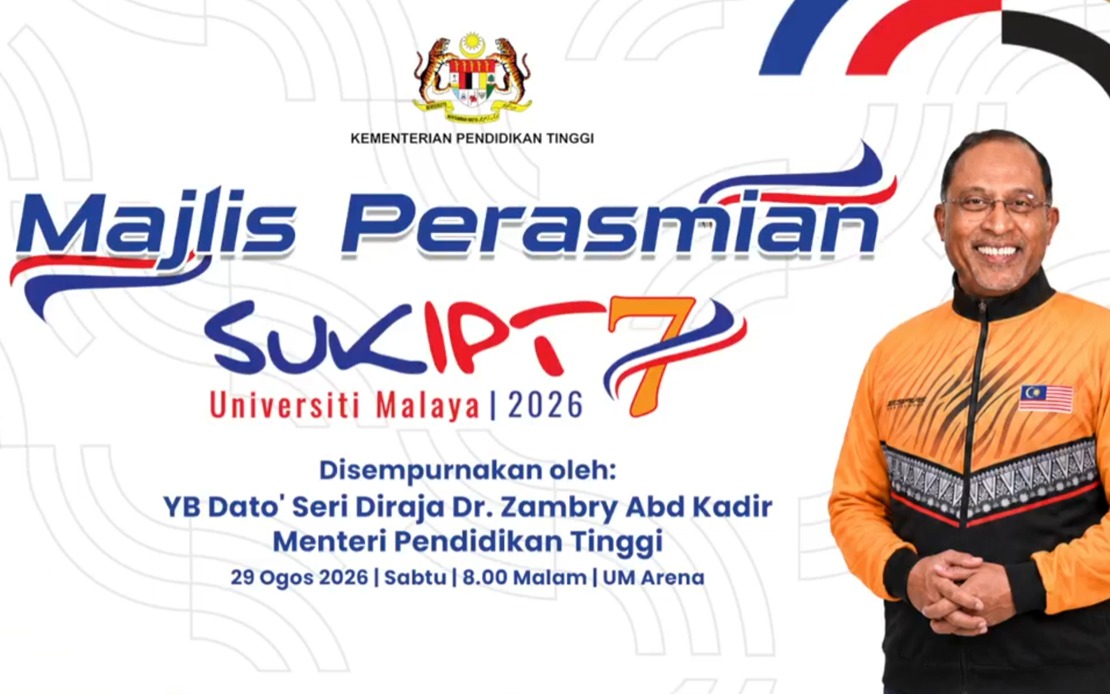
The achievements accumulated by athletes from Malaysian higher education institutions on the global sporting stage demonstrate the critical role universities play in identifying and developing elite talent capable of representing the country with distinction. Higher Education Minister Datuk Seri Dr Zambry Abdul Kadir made this observation while addressing delegates at the opening ceremony of the Higher Education Institution Games (SUKIPT) 2026, held at Universiti Malaya Arena in Kuala Lumpur on Thursday, underscoring the government's commitment to nurturing sporting excellence through the tertiary education system.
Zambry emphasised that the international success achieved by IPT athletes, particularly their medal hauls at the Glasgow 2026 Commonwealth Games, substantiates the capacity of Malaysian university students to compete effectively against elite international competitors. He characterised this performance as reflective of the vision the government holds for university sports—one that prioritises challenging existing records and demonstrating Malaysia's capabilities on the world's largest sporting platforms. The minister framed these accomplishments as tangible evidence that Malaysia's higher learning institutions extend beyond academic rigour to encompass genuine athletic development.
Among the standout performers highlighted by Zambry were weightlifters from two of the country's largest universities. Muhammad Erry Hidayat, representing Universiti Putra Malaysia, secured the gold medal in the men's 79-kilogramme weightlifting competition, whilst his counterpart Muhammad Aniq Kasdan from Universiti Teknologi MARA captured first place in the men's 60-kilogramme category. These dual victories in a technically demanding discipline underscore the quality of coaching and training infrastructure available within Malaysian universities.
The minister also drew attention to a historic breakthrough achieved by Amir Daniel Abdul Majid from Universiti Sains Malaysia, who became the first Malaysian judoka to capture Commonwealth Games gold in his sport. This milestone holds particular significance not merely as an individual achievement but as a watershed moment demonstrating Malaysian excellence in a discipline that traditionally has been dominated by nations with longer sporting pedigrees. Complementing this achievement was the bronze medal secured by Amirul Daniel Abdul Rahim from Universiti Malaya in lawn bowls, indicating that university-trained athletes are excelling across diverse sporting disciplines.
Beyond the international arena, Malaysian university athletes have sustained a trajectory of record-breaking performances at domestic competitions. Omar Osman from Politeknik Sultan Ibrahim achieved distinction in the 400-metre sprint, whilst Muhammad Fadwah from UiTM and Danish Iftikhar Muhammad Rosli from Universiti Pendidikan Sultan Idris made their marks in sprinting events. Most notably, the latter pair shattered existing Malaysia Games records in the 200-metre and 4x100-metre relay competitions, signalling that university sports programmes are generating depth of talent across track and field disciplines.
The scope of SUKIPT 2026, the biennial competition now in its seventh iteration, reflects the scale and maturity of the inter-university games ecosystem. Running from late August through early September at Universiti Malaya, the tournament assembles sixty-four contingents drawing from twenty public universities, forty-two private higher education institutions, a polytechnic institution, and a community college. This representation encompasses a broad swathe of Malaysia's tertiary sector and highlights how competitive university sports has become as a pathway to national team selection.
The games programme spans thirty sporting disciplines, engaging over eight thousand athletes and officials in competitions designed to identify emerging talent while providing established performers with high-level competitive exposure. The tournament operates under the banner "Creating a Legacy of Champions," a thematic emphasis that articulates the government's strategic positioning of university sports as developmental infrastructure rather than mere recreational activity. This framing represents a meaningful evolution in how Malaysian policymakers conceptualise the relationship between academic institutions and athletic excellence.
Financial incentives embedded within the tournament structure reinforce the value placed on achievement. The games distribute 227 gold medals, with individual Sportsman and Sportswoman of the Games recipients receiving RM3,000 each. Team accolades carry heavier rewards, with Best Male and Female Team designations awarding RM7,000 to successful contingents. Most significantly, athletes who break national records during competition receive RM20,000, a sum designed to recognise the particular difficulty of surpassing existing benchmarks and to encourage performers to pursue excellence beyond merely winning medals.
The strategic importance of university-based athletic development becomes apparent when considering Malaysia's competitive position within Southeast Asia and globally. Nations with stronger Olympic and Commonwealth Games medal tallies have typically invested substantively in university sports systems, recognising that the four-year collegiate cycle aligns precisely with Olympic quadrennial cycles and provides extended development windows for aspiring international competitors. Malaysia's expansion and professionalisation of its SUKIPT platform thus represents more than ceremonial activity; it constitutes an institutional mechanism for talent identification and nurturing.
Zambry's remarks must be contextualised within broader government priorities regarding national sports policy. The minister's emphasis on university athletes challenging records and elevating Malaysia's international standing reflects recognition that sustained competitive advantage requires systematic development frameworks. Rather than depending on sporadic individual brilliance, the government appears committed to creating structural conditions—through university infrastructure, coaching standards, and competitive opportunities—that enable consistent production of medal-calibre athletes.
The diversity of sports represented within SUKIPT 2026, spanning weightlifting, judo, lawn bowls, and track and field alongside thirty other disciplines, indicates that Malaysian universities are developing athletes across a comprehensive sporting spectrum. This breadth contrasts with development models concentrated in a limited number of sports and suggests confidence that university-trained performers can compete internationally across multiple domains. For Malaysian readers assessing the country's sports future, this institutional approach offers grounds for qualified optimism regarding Malaysia's capacity to maintain and enhance its regional and global competitive standing.

