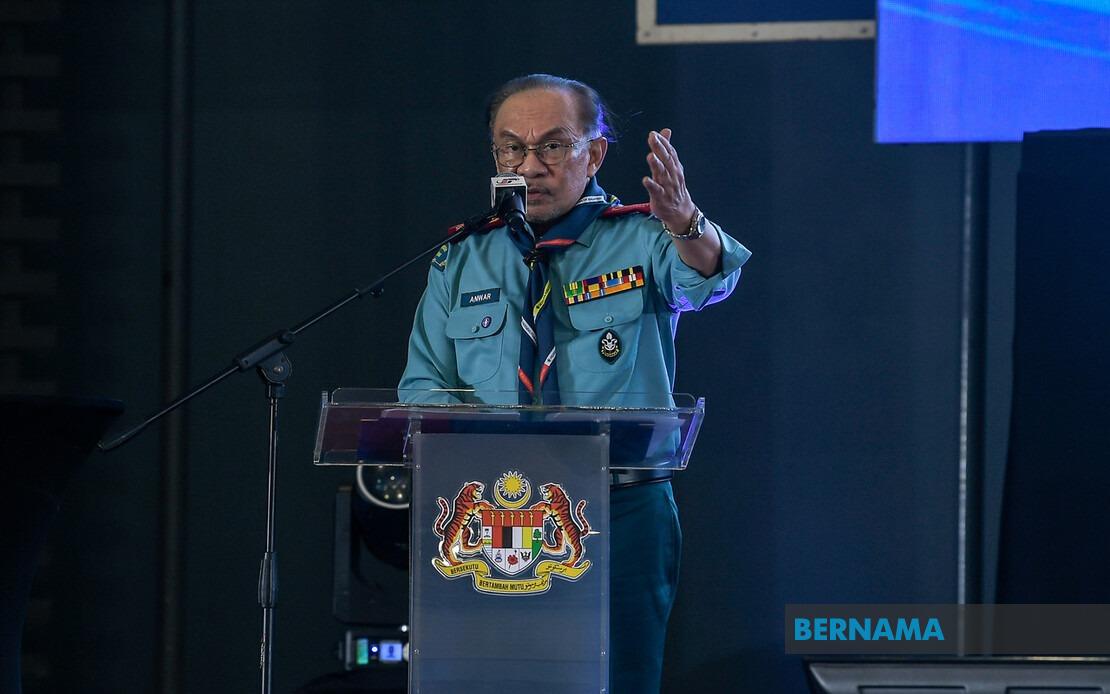
Prime Minister Datuk Seri Anwar Ibrahim has pushed back against perceptions that efforts to strengthen Malay as Malaysia's official language come at the expense of other tongues, asserting instead that linguistic diversity enhances rather than hinders national development. Speaking at the Ambang Merdeka Sahabat MADANI 2026 programme at Universiti Teknologi MARA (UiTM) Permatang Pauh on August 29, Anwar framed the debate not as a competition between languages but as a complementary approach to equipping Malaysians with the skills needed in an interconnected world.
The Prime Minister's remarks address longstanding sensitivities in Malaysian society regarding the status of Malay and the role of minority languages in the education system and public discourse. His intervention signals an attempt to recalibrate the conversation away from zero-sum framing, where gains for one language are interpreted as losses for another, toward a more inclusive vision of multilingual competence. This nuanced positioning reflects broader tensions within Malaysia's multicultural democracy, where language policy remains intertwined with questions of national identity, economic opportunity, and communal harmony.
Anwar emphasised that every Malaysian citizen, irrespective of ethnic background, should develop strong proficiency in the national language as a foundation for shared citizenship and communication. Simultaneously, he argued that competence in English, Mandarin, and Tamil should be actively cultivated to unlock educational pathways and economic advantages in regional and global markets. This dual-track approach acknowledges Malaysia's reality as a nation where command of multiple languages is not merely cultural enrichment but increasingly a practical necessity for workforce competitiveness.
The Prime Minister specifically highlighted English as a critical global medium that has evolved into the lingua franca of international commerce, diplomacy, and technology. Rather than viewing English proficiency as a threat to Malay, Anwar suggested the education system should embrace English as a complementary tool that enhances opportunity without displacing the national language. This framing reflects recognition that Malaysian students competing in international universities and multinational corporations require near-native English capability while maintaining strong Malay literacy.
Regarding Mandarin, Anwar pointed to its growing significance as a regional economic language, particularly given Southeast Asia's deepening commercial ties with China and the prevalence of Chinese-speaking business networks throughout the region. He positioned Mandarin competence not as a cultural or identity marker but as an economic imperative that allows Malaysians to participate fully in cross-border trade, investment opportunities, and professional networks that increasingly operate in Chinese. This reasoning appeals to pragmatic considerations about workforce development and competitive advantage in regional labour markets.
The emphasis on Tamil proficiency signals recognition of Malaysia's Indian community and the language's continuing relevance to sections of the population, while also acknowledging broader Asian linguistic diversity. By grouping Tamil alongside English and Mandarin as worthy of cultivation, Anwar attempted to frame language policy as inclusive rather than hierarchical, where the elevation of Malay does not require the marginalisation of minority languages. This inclusive rhetoric is designed to reassure non-Malay communities that their linguistic heritage remains valued within the national project.
Anwar explicitly rejected the notion that multilingualism creates a competitive or zero-sum dynamic, arguing instead that learning regional languages expands rather than constrains individual potential and national economic interests. His statement that children should master Chinese while maintaining strong Malay articulates a vision of additive bilingualism, where additional languages build upon rather than erode foundational competencies. This reflects international pedagogical research suggesting that multilingual education, when properly structured, enhances cognitive development and academic outcomes.
The Prime Minister also addressed broader social cohesion, cautioning against deliberate efforts to generate interethnic tensions through language disputes. His warning that national harmony cannot be assumed permanent without consistent investment in unity reflects awareness that language politics in Malaysia have historically mobilised communal anxieties and become flashpoints for identity conflicts. By connecting language policy to social peace, Anwar sought to elevate the debate beyond technical educational matters toward fundamental questions about Malaysia's stability and inclusive development.
Anwar called for cultivation of shared values centred on reciprocal assistance, solidarity, and collective benefit, framing these principles as prerequisites for ensuring all Malaysians, regardless of ethnicity, share equitably in the nation's prosperity. This invocation of common purpose aims to reframe language discussions within a broader narrative of national cooperation and mutual advancement rather than cultural competition. The emphasis on inclusive development suggests that language policy should be evaluated not merely through the lens of cultural preservation but through its effects on economic mobility and social opportunity for all communities.
For Malaysian policymakers and regional observers, Anwar's intervention attempts to chart a middle path between competing demands: honouring Malay's constitutional status while recognising the practical necessity of multilingualism in a globalised economy. His remarks implicitly critique both those who view Malay promotion as inherently threatening to minorities and those who dismiss other languages as economically irrelevant. This balancing act reflects the genuine complexity of language policy in diverse societies, where decisions about curriculum, official communications, and educational standards carry profound implications for opportunity and belonging.

