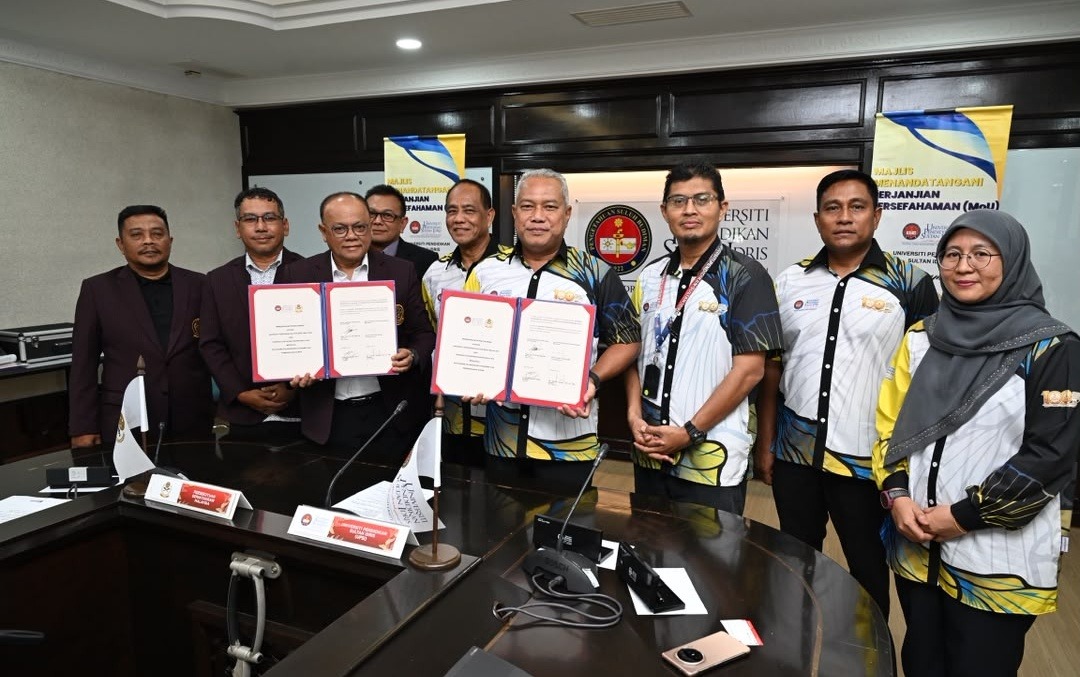
A landmark agreement between Universiti Pendidikan Sultan Idris (UPSI) and the Malaysian Sepaktakraw Federation (PSM) signals a fresh institutional commitment to nurturing athletes who can balance elite-level competition with tertiary education. The Memorandum of Understanding, signed at UPSI's Tanjong Malim campus on July 15, establishes a formal three-year framework for deepening cooperation across education, research, and community engagement—with built-in provisions for extension subject to mutual agreement.
The partnership emerges from recognition that aspiring sepak takraw athletes have historically faced constraints in pursuing formal qualifications whilst managing demanding training and competition schedules. UPSI's undertaking to accommodate flexible academic pathways for PSM-affiliated competitors addresses a longstanding tension in Malaysian sports development: the difficulty of creating credible dual pathways that neither dilute academic standards nor compromise athletic preparation. The university's explicit commitment to enrol qualified athletes at all degree levels, coupled with scheduling flexibility, potentially transforms what could be a token gesture into functional institutional reform.
UPSI Vice-Chancellor Prof Datuk Dr Md Amin Md Taff framed the collaboration as extending far beyond ceremonial endorsement. He pledged concrete action plans, technical expertise sharing in coaching and officiating, and institutional resources dedicated to continuous implementation and monitoring. This emphasis on measurable outcomes rather than aspirational rhetoric distinguishes the arrangement from similar agreements that often remain dormant. The university's readiness to contribute sports technology capabilities and facilities reflects institutional infrastructure that few Malaysian tertiary institutions can match, positioning UPSI as a genuine resource hub rather than merely a credentialling body.
A critical component involves establishing a national training centre for sepak takraw under the collaboration's auspices. Such a facility, anchored at a university rather than dispersed across state-based premises, could standardise coaching methodologies, consolidate sports science support, and create economies of scale in athlete development. The proximity to academic departments would facilitate applied research in biomechanics, nutrition science, and sports psychology—domains where Malaysian sepak takraw has historically relied on informal or ad-hoc expertise.
PSM Vice-President Tengku Zaihan Che Ku Abdul Rahman situated the agreement within a broader ecosystem encompassing Malaysian Sports Schools and State Sports Schools. This positioning acknowledges that national-level sepak takraw depends on a talent pipeline beginning at secondary level, where athletes must simultaneously master demanding sport-specific skills and maintain academic progress. By formalising pathways from these feeder institutions through to UPSI, the agreement creates structural continuity previously absent. Athletes performing well at school level gain assurance that tertiary options exist, potentially reducing premature career exits driven by education anxiety.
The technical dimension merits attention in the Malaysian sports context. Sepak takraw demands sophisticated coordination, spatial awareness, and tactical understanding—attributes amenable to scientific analysis and systematic coaching progression. UPSI's sports science personnel and PSM's accumulated technical knowledge constitute complementary assets: one rooted in evidence-based methodology, the other in practical mastery. Their integration could accelerate coach qualification pathways and produce officials trained to international standards, areas where Malaysian sepak takraw has faced capability gaps.
Tengku Zaihan's observation that this MoU might serve as a template for other sports-higher education partnerships carries significant weight. Malaysian sports governance remains fragmented across multiple national federations and state bodies, each operating with limited coordination mechanisms. A replicable model demonstrating how universities can meaningfully contribute to athlete development—beyond simply granting admission—could encourage similar arrangements in badminton, athletics, shooting, and other domains. However, success hinges on UPSI's demonstrable commitment to implementing promised mechanisms rather than allowing the agreement to become institutional wallpaper.
The three-year timeframe with extension provisions offers appropriate balance. It allows sufficient duration to establish infrastructure, enrol multiple cohorts of athletes, and generate evidence of impact, whilst preserving accountability through periodic review. Should outcomes prove limited, either party retains leverage to renegotiate or terminate. Conversely, success creates foundation for a fuller Memorandum of Agreement, which Md Amin indicated would follow—suggesting architects view the current MoU as foundational rather than comprehensive.
For Malaysian readers, this agreement matters because it addresses systemic weakness in national sports administration: the tension between elite ambition and human capital investment. Unlike wealthy nations where wealthy athlete sponsorships can subsidise education, Malaysia's sports funding remains constrained, forcing false choices between studying and competing. University partnerships, if properly implemented, partially dissolve this dilemma by leveraging educational infrastructure already in place.
The implications extend to workforce development. Sepak takraw careers have historically ended abruptly post-competition, leaving athletes without transferable qualifications. Athletes completing university degrees whilst competing gain alternative career pathways—as coaches, sports science professionals, administrators, or entirely different fields. This credential portability strengthens long-term athlete welfare and reduces dependency on welfare systems for retired competitors.
Regionally, the arrangement also positions Malaysia within evolving standards for athlete support. Southeast Asian neighbours increasingly integrate sports and education through university systems, creating competitive pressure for institutional innovation. UPSI's initiative, if executed credibly, strengthens Malaysia's reputation as a nation taking athlete welfare seriously and differentiates the country within the broader sepak takraw development landscape where Thailand, Indonesia, and Vietnam compete for regional dominance.
Ultimately, the MoU's value depends not on signatures but on subsequent action: whether flexible timetables genuinely materialise, whether training facilities meet international specifications, whether sports science inputs translate into measurable performance improvements. The framework is in place; Malaysian sepak takraw's next chapter depends on institutional discipline in translating good intentions into sustained operational reality across a three-year implementation period.

