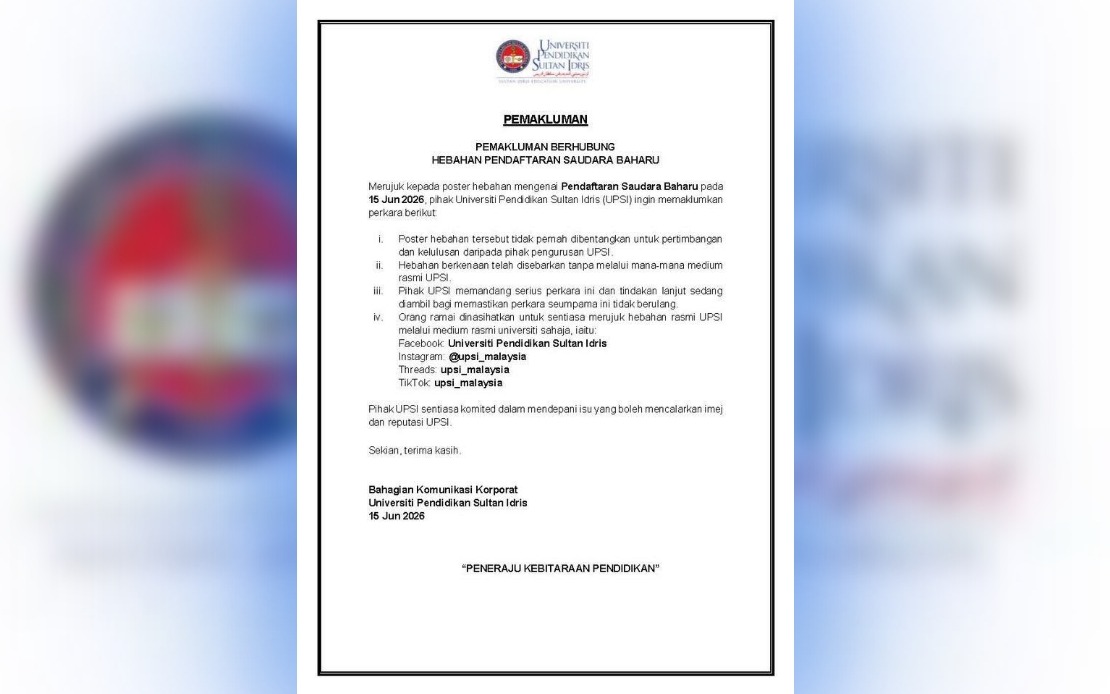
Universiti Pendidikan Sultan Idris (UPSI) has moved to distance itself from a poster concerning the registration of 'saudara baharu' or newly converted Muslims that recently gained traction across social media platforms. The institution issued a swift denial through its official social media accounts, emphasising that it bore no responsibility for the document's creation or dissemination and had taken the matter under serious review.
According to the university's statement, the poster in question, which carried a date of June 15, was never formally submitted to UPSI's administration for deliberation or endorsement. The institution stressed that the material did not emerge through any of its recognised official communication channels, suggesting instead that it had been distributed independently by unknown parties. This distinction is crucial, as it positions the university as a victim of misinformation rather than a source of it.
The rapid response from UPSI reflects growing institutional concern about the unauthorised use of university identity in circulating sensitive content. Religious and administrative matters involving Malaysian higher education institutions have become increasingly susceptible to viral spread, often without proper verification or contextual understanding. The university's emphasis on distinguishing between authorised and unauthorised communications underscores the challenges faced by tertiary institutions in managing their public image in an era of instantaneous digital dissemination.
UPSI's statement explicitly committed the institution to preventing similar incidents in the future, indicating that internal procedures would be strengthened or reviewed. The university called upon the general public to exercise discernment by consulting only official announcements released through verified university channels. This advisory serves a dual purpose: it protects the institution from false attribution while encouraging media literacy among students, staff, and the broader Malaysian community.
The university also reaffirmed its dedication to safeguarding its institutional reputation and image. Higher education institutions in Malaysia operate within a complex landscape where multiple stakeholders—students, parents, government bodies, religious authorities, and the public—scrutinise their actions and communications. Any association with controversial or unvetted content can generate significant reputational damage, particularly when matters involving religious conversion are involved, given the sensitive nature of such topics within Malaysian society.
The emergence of such material without official sanction highlights broader cybersecurity and communications management challenges facing Malaysian universities. Digital impersonation, whether intentional or accidental, can occur through various mechanisms including compromised social media accounts, spoofed materials, or individuals acting without proper authorisation. UPSI's swift clarification indicates the institution recognises the importance of rapid response protocols when its identity or credibility is potentially at stake.
For Malaysian readers and parents considering UPSI or other institutions, this incident serves as a reminder of the importance of verifying information directly with universities through their official websites and verified social media accounts. In an environment saturated with digital content, misinformation can spread exponentially within hours, and institutional reputations can be compromised before authorities have opportunity to respond. The ease with which materials can be attributed to organisations without their knowledge or consent represents an ongoing challenge for institutional management.
The broader context of religious conversion in Malaysia adds another dimension to this incident. Malaysia's dual legal system, which incorporates Islamic law alongside civil law, means that matters involving conversion are subject to specific procedures and regulations. Any institution appearing to facilitate or organise conversion-related activities without proper channels or oversight could face scrutiny from multiple quarters. UPSI's emphatic denial therefore carries particular significance beyond simple reputation management.
The university's reference to preventing recurrence suggests internal measures may be implemented, potentially including enhanced protocols for verifying communications, staff training on social media misuse, or improved monitoring systems. These steps reflect standard institutional responses to such incidents across Malaysian higher education. By taking ownership of the problem and demonstrating proactive measures, UPSI positions itself as a responsible institution committed to transparency and accountability.
For the wider Malaysian higher education sector, this incident provides a cautionary example of how easily institutional identity can be misappropriated in digital spaces. As universities increasingly rely on social media for authentic communication with stakeholders, the risk of impersonation or unauthorised use simultaneously increases. Institutions must balance accessibility and digital engagement with robust verification and authentication systems to protect against such vulnerabilities.