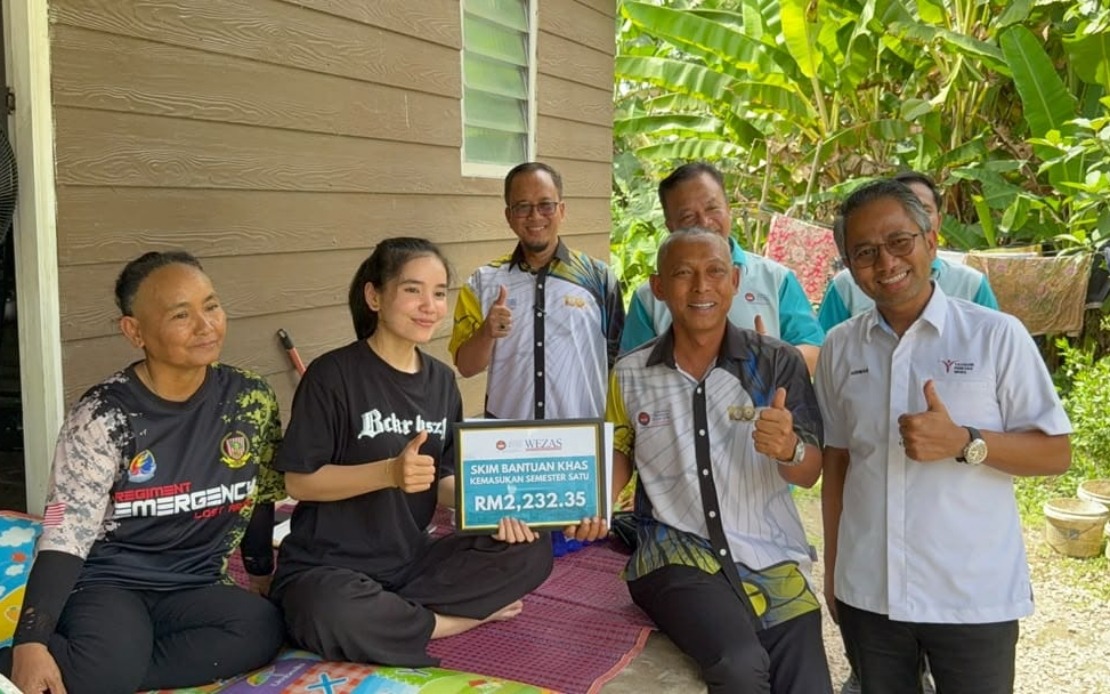
Lovely Sabana Augustine's journey from financial hardship to securing a place at Universiti Pendidikan Sultan Idris represents a turning point for the outstanding STPM achiever, who will now pursue studies at the university's Faculty of Human Sciences beginning in the 2026/2027 academic session. Her enrollment became possible after receiving RM1,500 in combined assistance from multiple sources within Malaysia's higher education ecosystem, addressing the registration fees and essential preparations that had previously seemed beyond her family's reach.
The 19-year-old's story gained considerable traction across social media platforms when she publicly appealed for financial support to cover her enrollment costs. Her plea resonated widely because it illuminated a persistent challenge facing talented but economically disadvantaged students across Malaysia—the gap between academic merit and financial capability. That visibility ultimately catalysed institutional responses from UPSI's leadership, triggering a coordinated support mechanism that extended beyond her individual case.
Beyond Lovely Sabana, two other prospective students benefited from the same assistance programme. Siti Nurdianis Nordin, who will enroll in the Faculty of Management and Economics, and Muhamad Ilias Danish, joining the Faculty of Languages and Communication, each received identical support. The three recipients represent diverse family circumstances united by genuine economic vulnerability—each facing obstacles that could have derailed their tertiary education prospects without intervention.
The financial package comprised two distinct components. UPSI's Centre for Waqf, Endowment, Zakat, Khairat, and Sadaqah (WEZAS) contributed RM500 per student, leveraging Islamic philanthropic frameworks embedded within the university's institutional structure. Yayasan Perkasa Siswa (YPS), a foundation dedicated to student welfare, supplied the remaining RM1,000, demonstrating the role that semi-independent entities play in Malaysia's student support architecture. This multi-source approach reflects how modern Malaysian higher education increasingly mobilizes hybrid funding mechanisms rather than relying solely on government allocations.
Lovely Sabana's personal circumstances underscore why such assistance programmes matter materially. Living with her mother Mek Kenui in Tumpat, Kelantan, she comes from a household where the sole income earner—her mother—works as a school cleaner earning approximately RM800 monthly while also serving as a Malaysian Volunteer Corps Department (RELA) member. Her father, a former soldier, passed away in 2017, eliminating what might have been a secondary income source. The economic mathematics of university enrollment in such circumstances become prohibitively difficult without external support.
Siti Nurdianis navigates similarly precarious financial terrain, relying on her mother's irregular day wages with no stable monthly income guarantee. Muhamad Ilias Danish's family experienced a more acute crisis when his father died, removing their primary breadwinner entirely. He now contributes to household expenses while pursuing his own education, representing the category of students balancing filial responsibility with personal advancement. These three cases, while individual, exemplify patterns affecting thousands of Malaysian students annually whose academic potential exceeds their family resources.
Hirman Awang, Director of the Department of Higher Education's Student Affairs Division, framed the initiative within Malaysia's broader higher education policy commitment. He emphasized that the Higher Education Ministry (MOHE) views financial constraint as an illegitimate barrier to academic opportunity for qualified students. His statement positioned YPS as a frontline mechanism for safeguarding student welfare, with the RM1,000 contribution intended not merely as fee relief but as psychological endorsement—communicating institutional care alongside material support.
UPSI's institutional response demonstrates how individual university leadership can activate support mechanisms beyond standard bureaucratic provision. Prof Dr Norkhalid Salimin, the deputy vice-chancellor for Student Affairs and Alumni, articulated a philosophy positioning universities as holistic developmental institutions rather than transactional education providers. His characterization of early assistance initiatives reflected growing recognition within Malaysian higher education that genuine support commences before students formally enroll, requiring proactive identification of prospective student difficulties.
The collaboration between UPSI, YPS, and the Department of Higher Education (JPT) represents strategic coordination across Malaysia's higher education ecosystem. Such partnerships acknowledge that no single institutional actor possesses sufficient resources to comprehensively address student poverty. By combining UPSI's waqf-based charitable mechanisms, YPS's dedicated student welfare mandate, and JPT's policy authority, the initiative demonstrates infrastructure for scaling similar interventions across other universities and cohorts.
For Malaysian policymakers and education administrators, this case illuminates both the efficacy and limitations of current student support systems. While the RM1,500 assistance addressed immediate enrollment barriers for three students, Malaysia educates hundreds of thousands annually, suggesting that even well-coordinated institutional responses remain inadequate at system scale. The visibility Lovely Sabana's social media appeal generated raises questions about whether merit-based students must achieve viral attention to access support that arguably should flow systematically.
The September 13 enrollment date marks when these three students will formally transition from prospective to enrolled status, transforming their academic aspirations into lived university experience. Yet their story extends beyond personal triumph. It illustrates how Malaysia's higher education system mobilizes response to individual hardship while simultaneously exposing systemic gaps where talented students might otherwise be excluded. Replicating such support across Malaysia's university network would require sustained policy commitment and resource allocation far exceeding current ad hoc institutional initiatives, raising important questions about equity, merit, and access that will define Malaysian higher education's trajectory.

