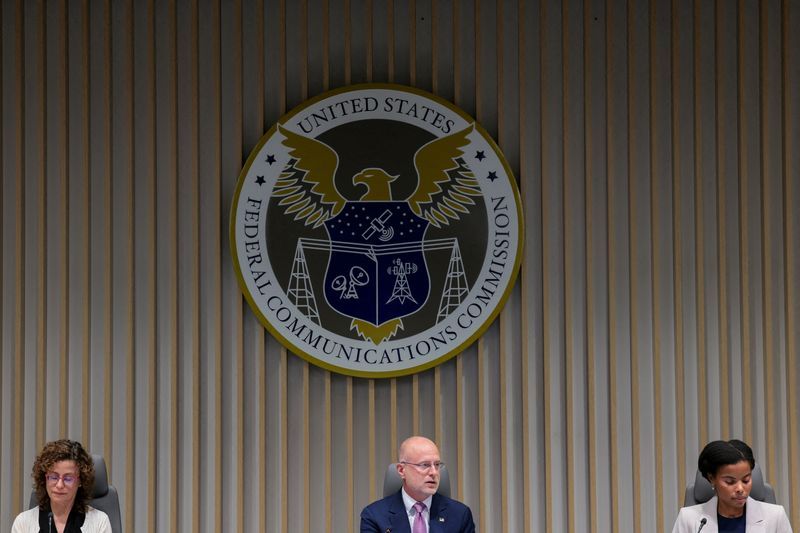
The United States Federal Communications Commission has moved to strengthen its grip on Chinese technology imports by voting to prevent the sale of devices within American borders that incorporate critical hardware components manufactured by companies flagged as national security threats. The decision, announced on Wednesday, represents a significant escalation in America's ongoing technological competition with China and signals the direction of the current administration's approach to managing supply chain risks in the telecommunications and consumer electronics sectors.
At the centre of this regulatory action is the closure of what FCC Chair Brendan Carr described as a "component part loophole" that had previously allowed companies to circumvent restrictions. Until now, while complete devices manufactured by blacklisted firms such as Huawei and ZTE could not receive new authorizations for sale in the United States since 2022, the regulation contained a critical weakness: devices that incorporated component parts made by these same companies could still gain approval for market entry. This inconsistency meant that Chinese manufacturers could effectively maintain a presence in American markets through indirect channels, embedding their technology in products assembled or sold by other entities.
The revised rules establish a comprehensive prohibition on any device seeking to enter the US market that contains logic-bearing hardware components manufactured by Huawei or other flagged Chinese firms. Logic-bearing components represent the sophisticated, decision-making elements of electronic devices—essentially the technological heart that controls functionality. By targeting these specific parts rather than merely finished products, the FCC has adopted a more granular regulatory approach designed to prevent the infiltration of potentially compromised technology at the foundational level of device architecture.
The rationale underlying this decision rests on cybersecurity and espionage concerns that have become increasingly central to American technology policy. Chris McGuire, a former official within the White House National Security Council during President Joe Biden's administration, articulated the security logic to Reuters, explaining that "compromised components, particularly semiconductors or communications devices, can be used to corrupt entire devices." This assessment reflects a broader understanding that hardware vulnerabilities can be weaponized to compromise functionality, intercept communications, or enable unauthorized access to networks and user data at scales that could threaten critical infrastructure.
The FCC's action exists within the context of a far more expansive crackdown on Chinese technology that President Donald Trump's administration has pursued since taking office. In the weeks preceding this component-level prohibition, the regulatory agency has moved against multiple categories of Chinese technology imports. Most notably, the FCC implemented import bans on additional equipment from a collection of Chinese manufacturers that took effect in mid-July, and has proposed restrictions on military-grade drones originating from Chinese suppliers. The breadth of these measures suggests a coordinated strategy to systematically reduce Chinese technological presence across multiple infrastructure and consumer segments.
Beyond consumer devices and components, the FCC has expanded its regulatory perimeter to address broader questions of network infrastructure and telecommunications sovereignty. The commission has recently prohibited the importation of new foreign drone and router models and is contemplating further measures that would prevent American telecommunications carriers from establishing interconnection arrangements with Chinese telecom firms identified as security concerns. These network-level restrictions represent an attempt to reduce dependency on Chinese infrastructure at the architectural level where data flows and network control converge.
Among the most consequential proposals under FCC consideration is a potential prohibition on Chinese telecommunications companies that operate data centers or "Points of Presence" within the United States from maintaining interconnection arrangements with other carriers. Points of Presence function as critical infrastructure nodes where internet traffic concentrates and exchanges between network operators occur. Such facilities grant their operators visibility into significant volumes of data traffic and create theoretical pathways for surveillance or traffic manipulation. An effective ban on such operations would require Chinese telecom firms to entirely cease their American data center operations, fundamentally severing their operational integration into American internet infrastructure.
For regional observers in Southeast Asia, these American regulatory developments carry substantial implications for technology supply chains and infrastructure choices across the region. Malaysia, like its neighbours, faces ongoing decisions regarding telecommunications infrastructure investment, 5G network deployment, and technology procurement policies. The American restrictions on Chinese components and infrastructure raise important questions about supply chain diversification and the long-term viability of integrating Chinese technology into critical systems that may eventually require interoperability with American networks or devices.
The escalating American restrictions also reflect deeper structural tensions in global technology markets. As the United States seeks to minimize Chinese technological influence within its borders, it simultaneously seeks to persuade allied and partner nations to adopt compatible restrictions. This creates diplomatic pressure on countries throughout Asia and Europe to align their technology policies with American preferences, potentially limiting their autonomy in technology procurement and infrastructure development. The measures demonstrate how technology policy has become inseparable from strategic competition between major powers.
Huawei has not yet publicly responded to the FCC's decision, though the company has historically contested such restrictions as protectionist measures that lack substantive security justification. The corporation maintains that its equipment meets international security standards and that geopolitical considerations rather than technical concerns drive American regulatory decisions. Regardless of Huawei's position, the FCC's action suggests that American technology policy toward China will continue intensifying, with regulatory authorities finding new categories of restriction and closing existing loopholes that permit Chinese technology to maintain market access through indirect means.

